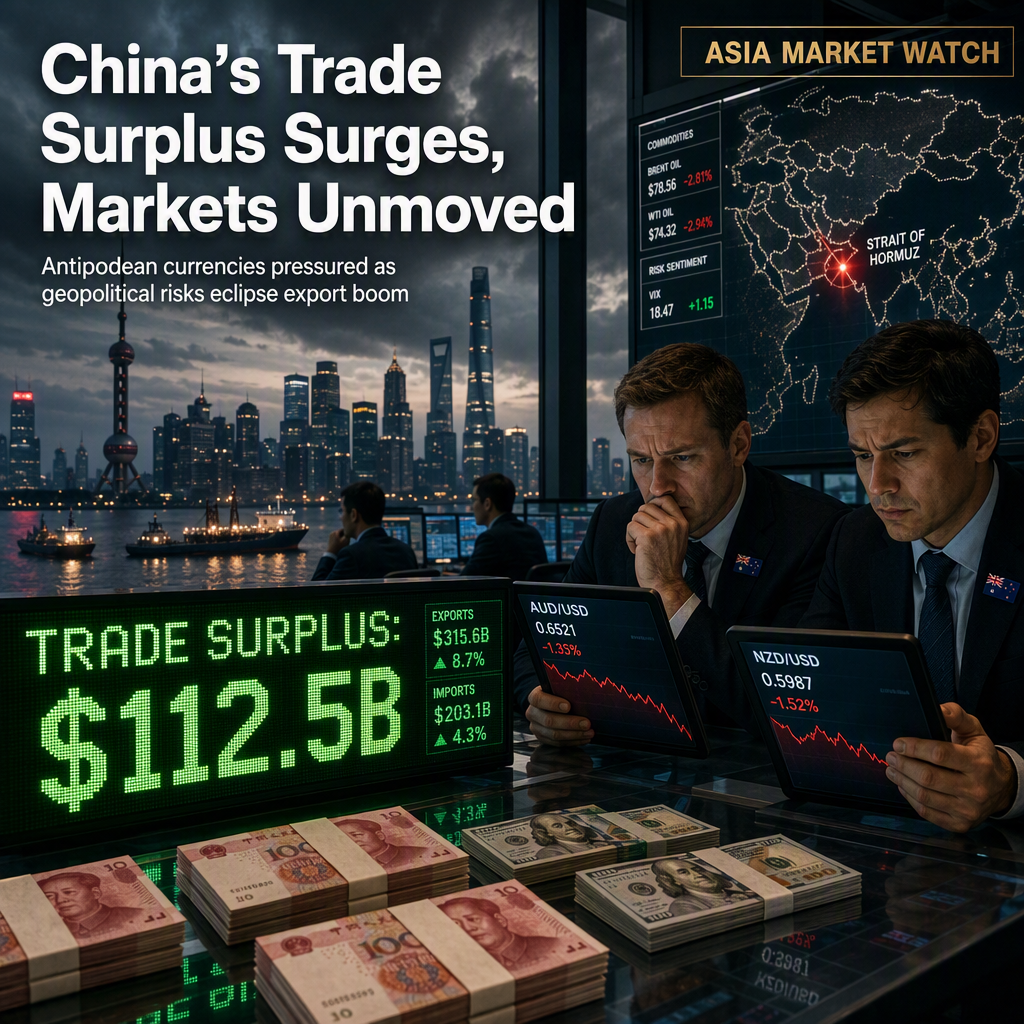
China's June Trade Balance data was released during the Asian session on Friday, showing a surplus of $112.5 billion in US Dollar terms, which exceeded expectations of $107.0 billion but was lower than the previous month's $125.62 billion figure [1][3]. In Chinese Yuan terms, the surplus widened to 767 billion, beating the estimated 740 billion but trailing the prior 859.05 billion reading [1]. Exports grew 23.9% year-over-year compared to June's 27% rise, while imports expanded by 27.5%, moderating from the previous 36% growth rate [1][3]. The data presented a mixed economic picture and failed to provide upward momentum for antipodean currencies such as the Australian Dollar (AUD) and New Zealand Dollar (NZD), both of which remained under pressure following the release [1][3].
The AUD/JPY pair halted its three-day winning streak, trading around 111.30, as the Australian Dollar lost ground due to a surge in global safe-haven demand triggered by escalating tensions in the Strait of Hormuz [1]. Similarly, the NZD/USD pair remained near its weekly low at 0.5865, with traders awaiting the US Nonfarm Payrolls report for further cues [3]. Geopolitical risks, including threats of attacks on Saudi Arabia and potential Iranian restrictions on US and Israeli vessels in the Strait of Hormuz, contributed to market instability, rising oil prices, and renewed inflation fears [1][2][3].
Market reactions were characterized by a flight to safety, with the US Dollar strengthening against both the British Pound and New Zealand Dollar, and the Japanese Yen initially gaining on joint intervention from Tokyo and Washington before retreating due to skepticism about the sustainability of such measures [1][2][3]. Analysts at ING suggested that the weakness in Asian currencies may have prompted US Treasury intervention in the USD/JPY pair, and that further moves could depend on Federal Reserve policy decisions [1].
Forward-looking commentary from Rabobank's FX strategists indicated that there remains a risk of one more Reserve Bank of Australia (RBA) rate hike this year, possibly in November, with the August 11 policy meeting expected to provide more clarity [1]. For the New Zealand Dollar, the Reserve Bank of New Zealand's hawkish tilt could help limit downside, though the immediate outlook remains cautious pending US labor market data [3].
Overall, the combination of mixed Chinese trade data, heightened geopolitical risks, and shifting central bank expectations has kept antipodean currencies subdued and bolstered safe-haven demand, with market participants closely monitoring upcoming policy signals and economic releases for further direction.
CONCLUSION
China's trade surplus exceeded expectations but failed to boost the Australian and New Zealand Dollars, as geopolitical tensions and safe-haven flows dominated market sentiment. The outlook remains cautious, with traders awaiting central bank guidance and key US economic data for further cues. Market volatility is likely to persist amid ongoing uncertainty.