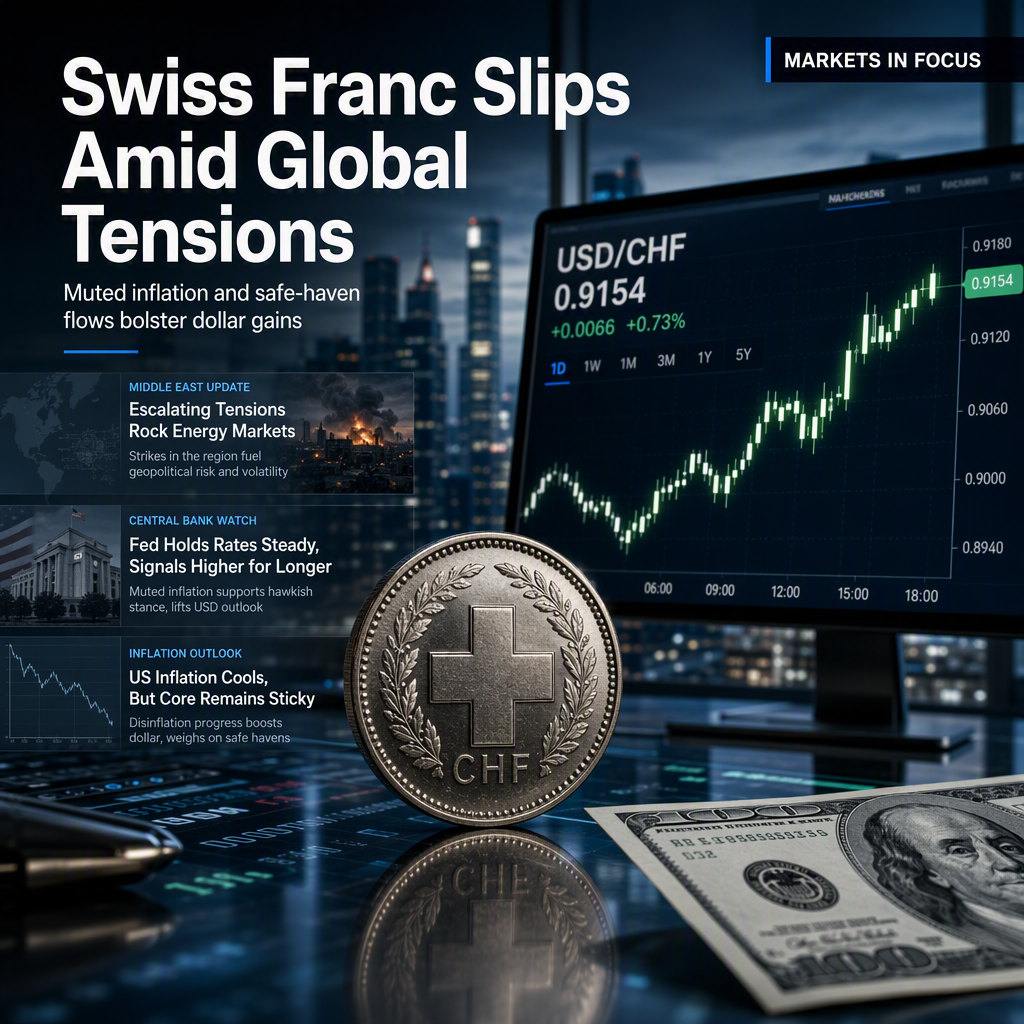
The Swiss Franc (CHF) weakened against the US Dollar (USD), with the USD/CHF pair extending its gains for the second consecutive day and trading around 0.8130 during Asian hours on Friday [1]. This appreciation of the US Dollar is attributed to renewed safe-haven demand amid escalating tensions in the Middle East, particularly concerns over the reopening of the Strait of Hormuz and Saudi Arabia's intention to extend military operations against Iran-aligned Houthis following attacks on its southern Najran province [1]. Additionally, Iran's parliament is considering measures to restrict the corridor and penalize hostile nations, further heightening geopolitical risks [1].
Rising US Treasury yields and recovering crude oil prices have fueled fears that the Federal Reserve could implement another interest rate hike next month. However, the CME FedWatch Tool indicates a 54.5% probability of a 25-basis-point rate increase in September, down from 63.4% last week, reflecting some moderation in expectations [1]. Investors are now focused on the upcoming July Nonfarm Payrolls (NFP) report for further guidance on the Fed’s policy trajectory [1].
On the Swiss economic front, data remains mixed. Switzerland’s non-seasonally adjusted unemployment rate rose to 3.0% in July from 2.9% in June, while youth unemployment (ages 15–24) edged up to 2.8% [1]. Markets are awaiting the release of July Foreign Currency Reserves and Q3 SECO Consumer Climate data for additional insights [1]. Inflation remains subdued, with July CPI at 0.4% year-on-year and core inflation at 0.3% for the fourth consecutive month [1]. The Swiss National Bank (SNB) has kept its policy rate at 0.00%, and strategists at Brown Brothers Harriman suggest that this muted inflation backdrop is likely to keep the Swiss Franc on the defensive, noting it is currently the weakest G10 currency this quarter [1].
From a technical perspective, USD/CHF maintains a modest bullish near-term bias, holding above both the nine-day and 50-day Exponential Moving Averages (EMAs), with the 14-day Relative Strength Index (RSI) near 54, indicating neutral-to-positive momentum [1]. Immediate resistance is seen at the 13-month high of 0.8207, while initial support lies at the nine-day EMA at 0.8111 [1].
CONCLUSION
The Swiss Franc remains under pressure due to muted inflation and a dovish SNB, while geopolitical tensions and safe-haven flows are supporting the US Dollar. Market participants are closely monitoring upcoming US and Swiss economic data for further direction, with the USD/CHF pair showing a constructive technical outlook in the near term.