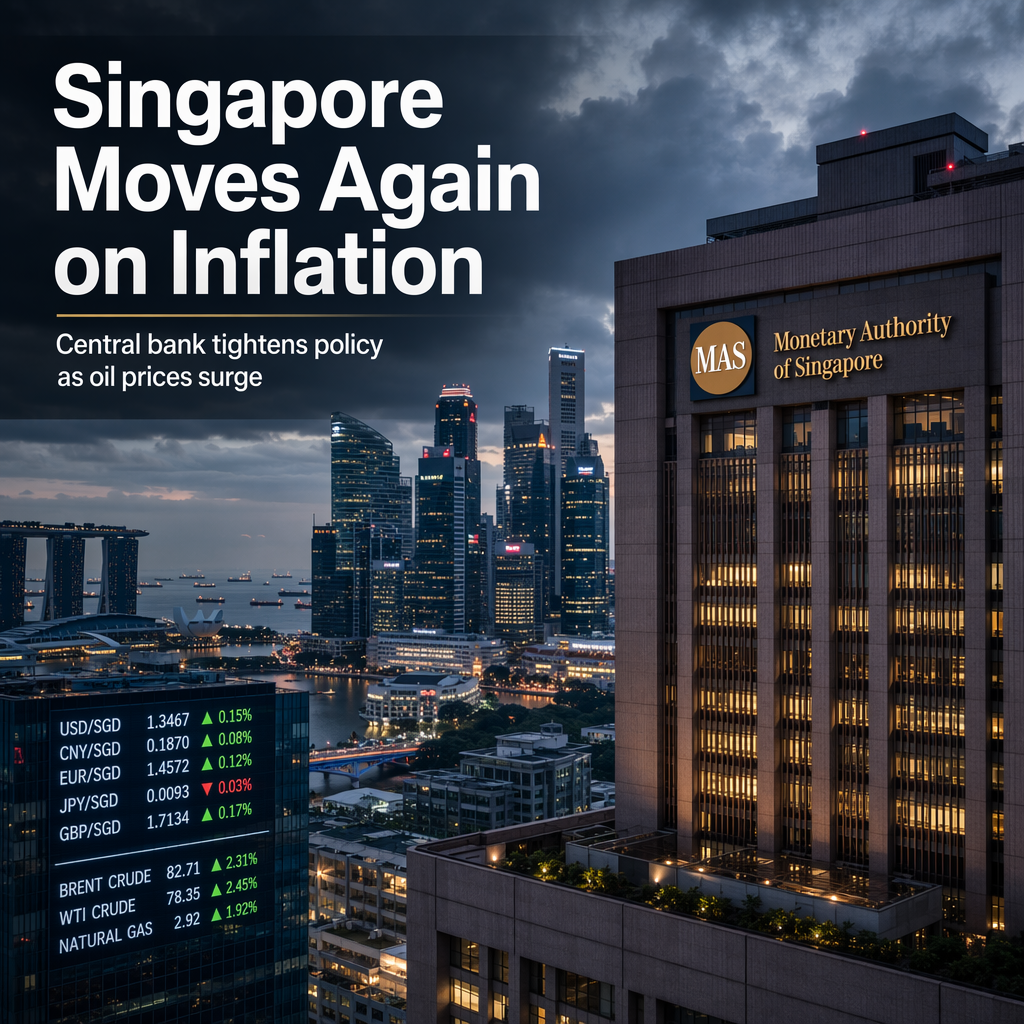
On July 27, 2026, Singapore's central bank, the Monetary Authority of Singapore (MAS), announced a second consecutive tightening of its monetary policy in response to a renewed surge in oil prices, despite currently subdued domestic inflation levels [1]. The MAS stated it would 'increase the rate of appreciation of the Singapore dollar's nominal effective exchange rate policy band very slightly,' noting that this adjustment is smaller than the one implemented in April. The width of the policy band and its central level remain unchanged [1].
Unlike most central banks that use interest rates, the MAS manages price stability by adjusting the Singapore dollar's exchange rate against a basket of currencies within an undisclosed band [1]. The MAS described the move as a 'calibrated adjustment' in an environment of 'continued heightened uncertainty,' building on its previous tightening in April [1].
Singapore's core inflation, which excludes accommodation and transportation costs, rose to 1.6% in June from 1.4% in May, staying near the lower end of the MAS's 2026 forecast range of 1.5%–2.5%. Headline inflation stood at 1.9% [1]. The recent rise in transportation fuel prices, attributed to the U.S.-Iran conflict, has been partially offset by softer services inflation, particularly in healthcare, communication, and education, according to BMI, a FitchSolutions company [1].
BMI noted that 'imported-cost pressures typically pass through to broader consumer prices with a lag,' and expects inflation to rise in the coming months [1].
CONCLUSION
Singapore's MAS has taken a cautious step to tighten monetary policy in response to external inflation risks, particularly from rising oil prices. While current inflation remains subdued, the central bank and analysts anticipate upward pressure on prices in the near future, signaling continued vigilance in policy adjustments.