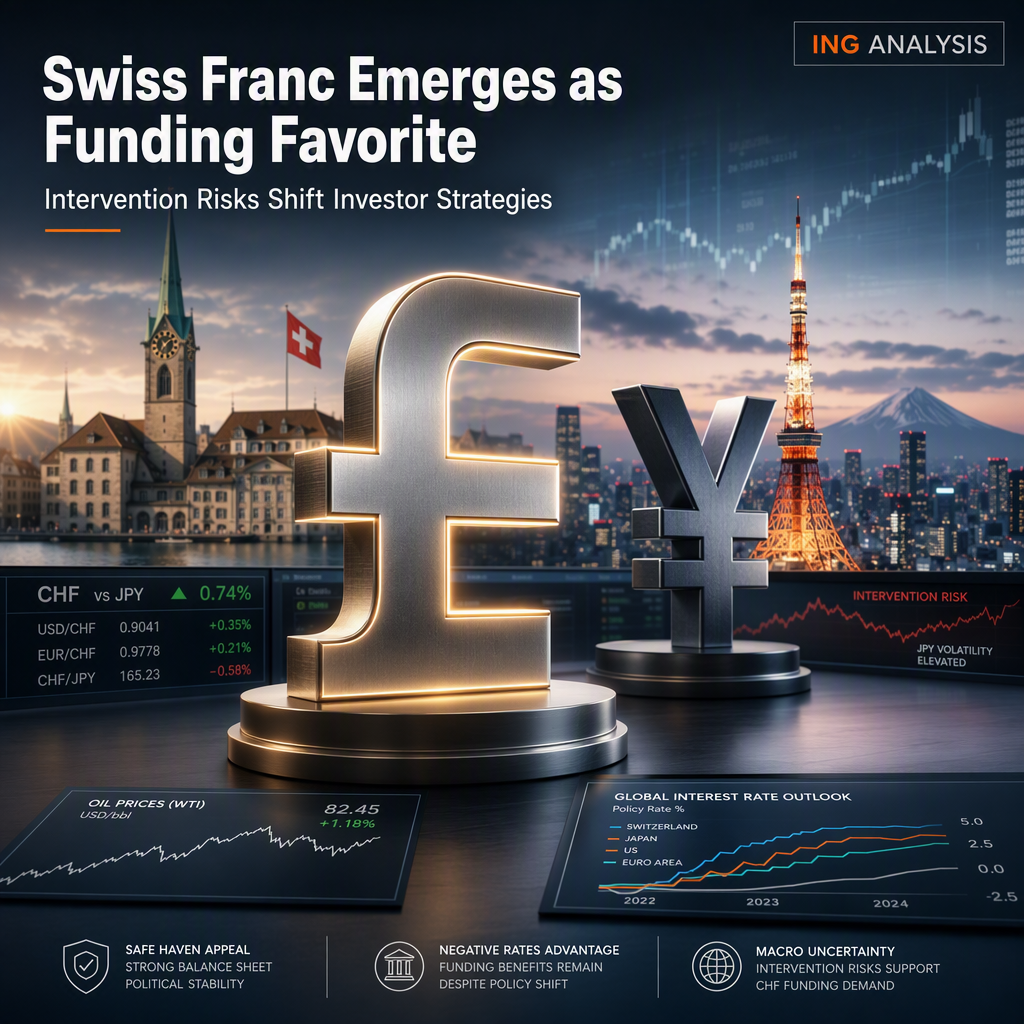
Chris Turner at ING notes that low volatility is affecting key funding currencies, specifically the Swiss Franc (CHF) and Japanese Yen (JPY), with investors increasingly favoring the franc for funding purposes. This shift is attributed to cheaper borrowing costs and the desire to avoid the risk of sudden yen buying intervention from authorities in Tokyo and Washington [1]. Turner explains that while the yen remains preferred due to its deeper liquidity pools, the franc is becoming more attractive as a funding currency [1].
Short CHF/JPY positions are highlighted as a carry-positive strategy for investors who believe yen intervention will be effective. Turner points out that short CHF/JPY is one of the few ways to express a carry-positive yen view, given the similar investment characteristics of the two currencies [1].
Regarding EUR/CHF, Turner suggests that a move toward 0.95 would likely require higher oil prices and broadly higher interest rates. The Swiss National Bank's (SNB) anchored zero-rate policy is seen as a factor leading to franc underperformance in this scenario [1].
No specific market reactions, analyst forecasts, or concrete data points such as dates, percentages, or named entities beyond ING and Chris Turner are provided in the article [1].
CONCLUSION
ING's analysis indicates a growing role for the Swiss Franc as a funding currency, driven by low volatility and intervention risks associated with the yen. Investors may increasingly adopt short CHF/JPY positions for carry-positive exposure, while EUR/CHF movement depends on broader macroeconomic factors. The SNB's zero-rate stance remains a key influence on franc performance.