
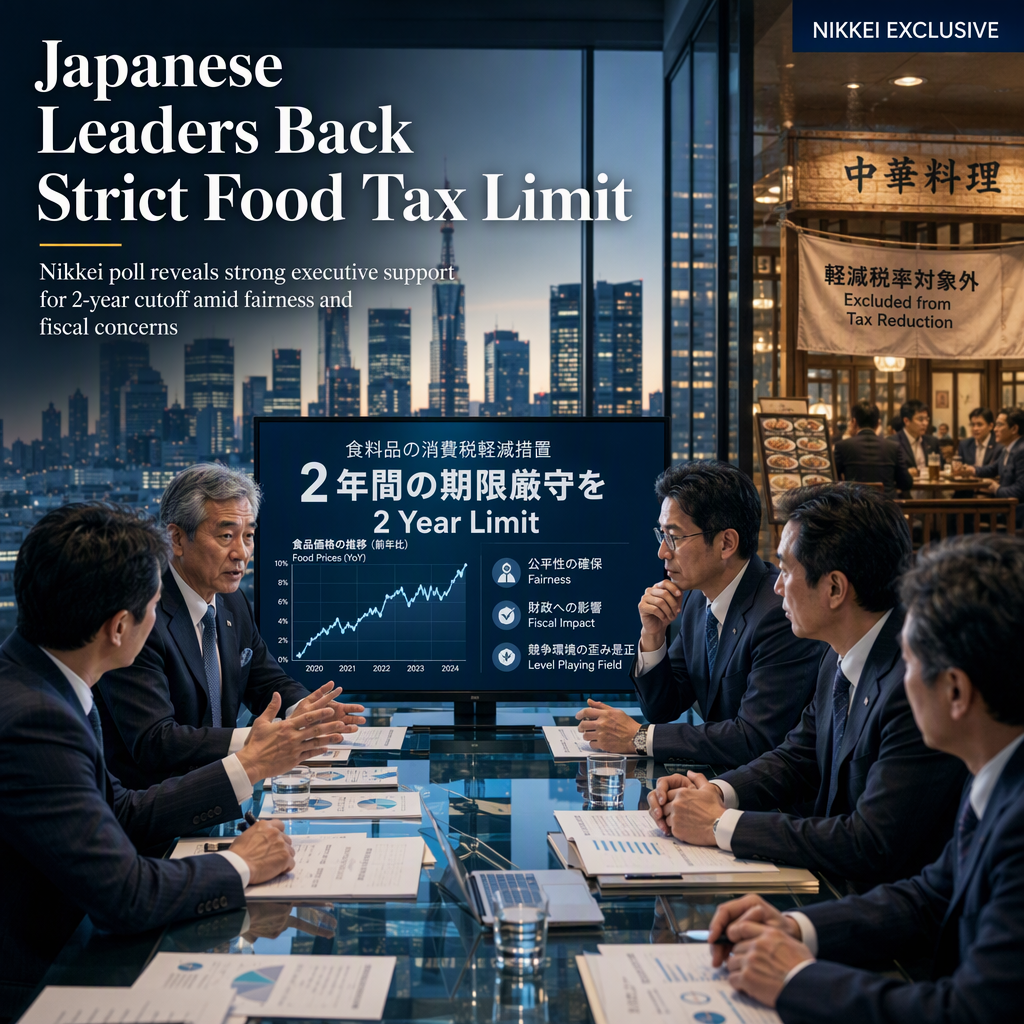
A recent Nikkei survey reveals that nearly three quarters of Japanese business leaders support a strict two-year limit on the government's planned consumption tax cut on food items [1]. The poll highlights widespread concerns among executives that extending the tax cut beyond the proposed period could undermine both market competition and fiscal discipline [1].
Some business leaders have expressed apprehension that the tax cut, which excludes restaurants, may create an uneven playing field by benefiting certain industries while disadvantaging others [1]. Specifically, there are worries that restaurants could be negatively impacted since they are not covered by the tax reduction, potentially distorting competition within the food sector [1].
The survey underscores the importance placed by the business community on adhering to the proposed two-year timeframe, with many executives emphasizing the need for clear limits to avoid long-term fiscal risks [1]. No specific market reactions or analyst forecasts were mentioned in the article [1].
CONCLUSION
The Nikkei poll indicates strong support among Japanese business leaders for a strict two-year limit on the planned food tax cut, reflecting concerns about competitive fairness and fiscal responsibility. The exclusion of restaurants from the tax cut is a particular point of contention, with potential implications for industry dynamics.