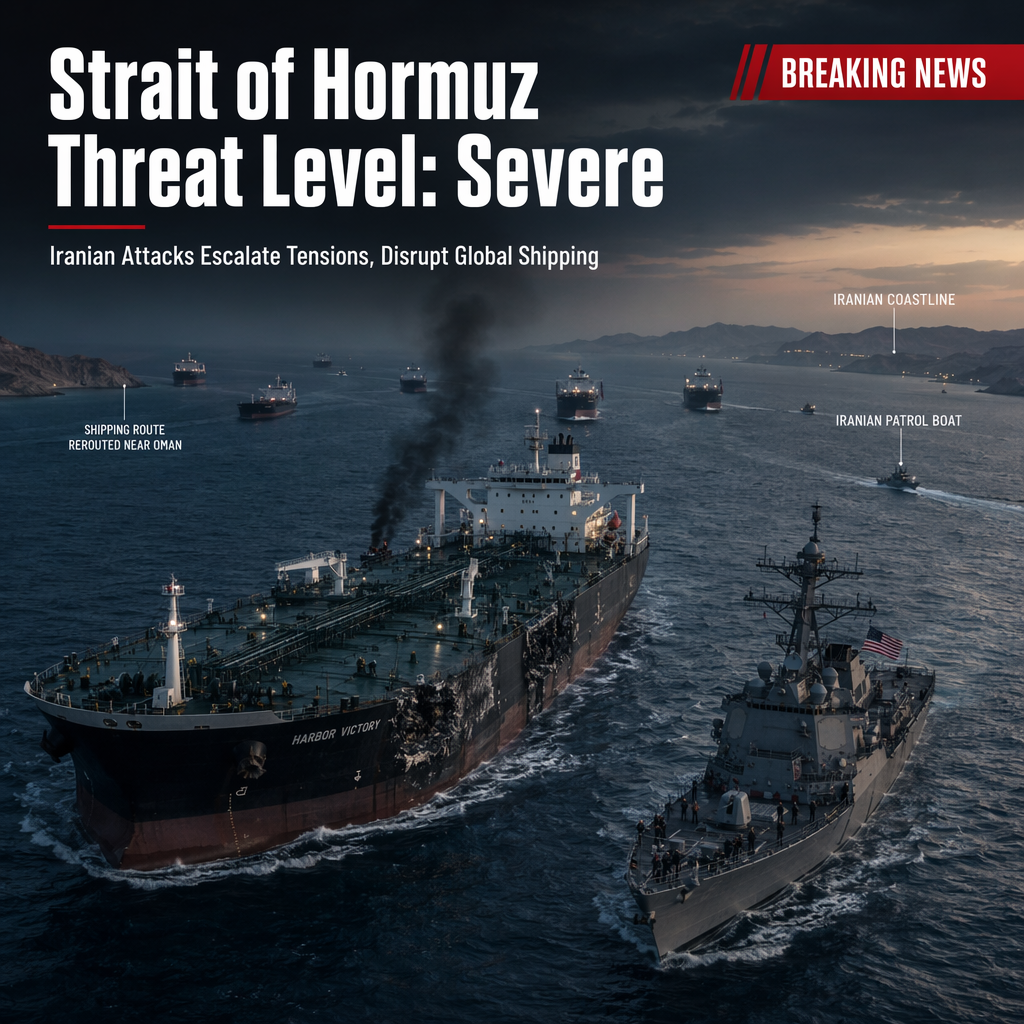
The Joint Maritime Information Center has elevated the threat level in the Strait of Hormuz to 'severe' following a series of Iranian attacks on tankers this week, according to a U.S.-led naval coalition warning issued to merchant vessels on Tuesday [1]. The attacks targeted ships using a southern route near Oman's coast, which is protected by the U.S. Navy. This escalation comes despite an interim deal signed between the U.S. and Iran on June 17, in which Iran agreed to allow safe passage for commercial ships through the strait [1].
Qatar has directly accused Iran of responsibility for an attack on its liquefied natural gas (LNG) tanker, Al-Rekayyat, near Hormuz, and has called on Tehran to cease actions that endanger global energy supplies [1]. The United Kingdom Maritime Trade Operations Centre has received three separate reports of tankers coming under attack in or near Hormuz this week [1]. The strait has now fractured into separate corridors, with Gulf states using a southern route protected by the U.S. Navy, while Iran has warned it will target ships not using a northern route approved by Tehran [1].
Maritime intelligence analyst Michelle Wiese Bockmann noted that Iran's actions are part of a targeted campaign to destabilize the southern corridor and send a message to Gulf State producers not using the Iranian-approved northern route [1]. U.S. Energy Secretary Chris Wright previously claimed that the U.S. Navy corridor had ended Iran's ability to close the strait, but Iran subsequently attacked a cargo ship using this route, prompting U.S. airstrikes in retaliation [1].
Ship traffic through Hormuz has increased since the interim peace deal but remains well below prewar levels. The trade intelligence firm Kpler reported that more than 100 ships passed through Hormuz over the weekend, and oil exports through the strait averaged around 4.3 million barrels per day in June, according to Windward data [1].
CONCLUSION
The escalation of attacks in the Strait of Hormuz has significantly raised the threat level for commercial shipping, with direct implications for global energy supplies and regional security. Despite an interim deal, tensions remain high, and shipping activity has not returned to prewar levels, underscoring ongoing instability in this critical maritime corridor.