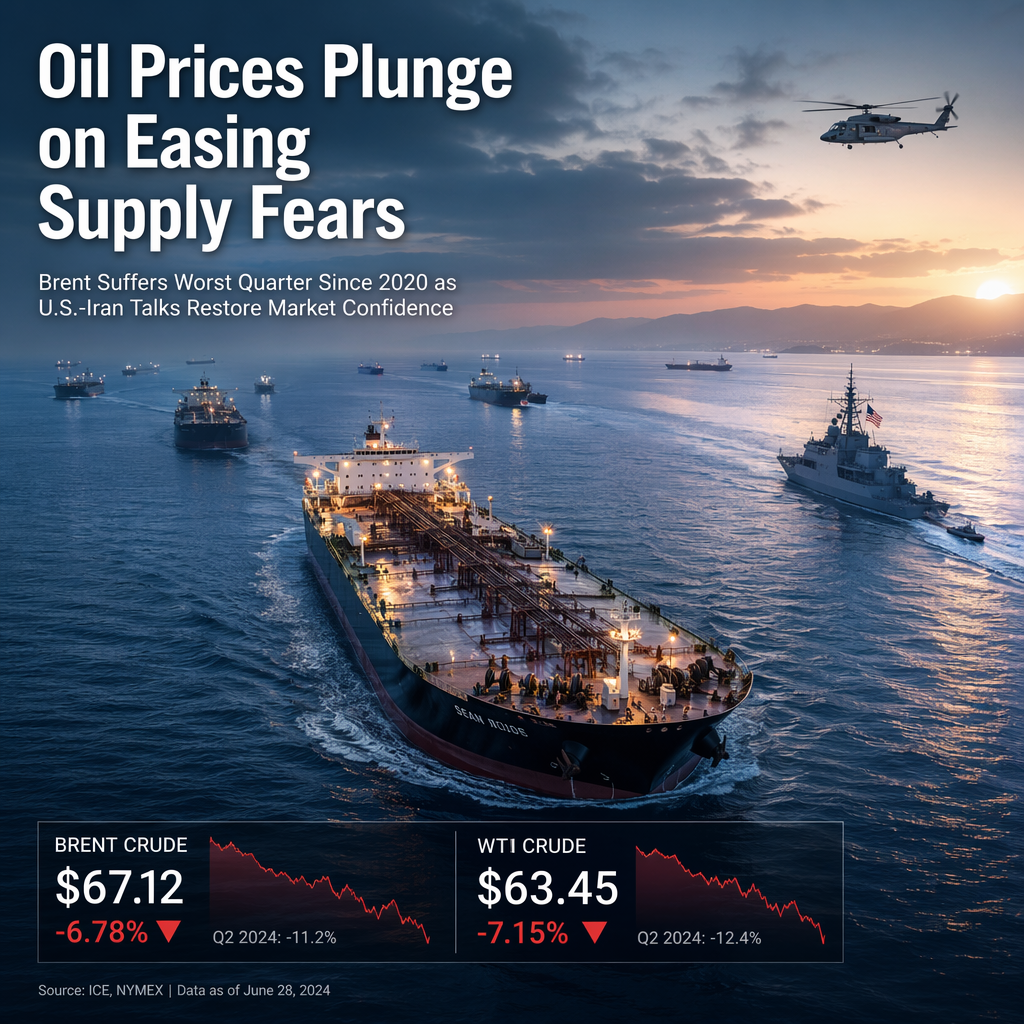
West Texas Intermediate (WTI) crude oil prices have declined for the third consecutive day, trading around $67.80 per barrel during Asian hours on Thursday, while U.S. WTI futures fell 1.33% to $67.67 and Brent crude dropped 1.12% to $70.77 per barrel on Wednesday [1][2]. Brent has experienced a nearly 40% drop this quarter, marking its worst quarterly performance since 2020, according to LSEG data [2]. The sharp downturn in oil prices is attributed to easing supply concerns following progress in indirect diplomatic talks between Washington and Tehran, as well as a rapid recovery in maritime traffic through the Strait of Hormuz [1][2].
A significant factor behind the price decline is the resumption of high-volume oil shipments through the Strait of Hormuz, supported by coordinated U.S. naval and air protection. U.S. officials report that crude oil flows through the corridor have now exceeded 10 million barrels per day, restoring a critical global energy supply route and reassuring markets [1]. ING estimates total tanker crossings at around 11 on Tuesday, which is below last week's peak of 24, but notes that inbound traffic is picking up, indicating growing confidence among shipowners [2].
Regional exporters have responded swiftly to the changing geopolitical landscape. The United Arab Emirates (UAE) has restored its oil exports to pre-conflict levels using operational workarounds and alternative routes, while Iranian oil exports have surged above 40 million barrels following the lifting of a U.S. naval blockade [1]. Additionally, record-breaking seaborne shipments from Russia have contributed to a buildup in global floating inventories, further pressuring crude prices downward [1].
Diplomatic efforts are ongoing, with U.S. President Donald Trump expressing optimism about the trajectory of negotiations, stating, "The denuclearization of Iran is moving along well. They've had very good meetings and we'll see" [1][2]. Indirect talks between the U.S. and Iran began in Doha on Tuesday, facilitated by Qatari mediators, following recent hostilities that threatened a 60-day ceasefire [2]. Qatari officials have announced plans for the next round of indirect talks to maintain momentum [1]. However, Tehran's insistence on retaining maritime administrative control over the Strait of Hormuz remains a sticking point for a full resolution [1].
Analysts at ING note that the market remains optimistic about the normalization of oil supplies from the Persian Gulf despite recent military flare-ups, which helps explain Brent's poor quarterly performance [2]. The immediate market narrative has shifted toward a surplus due to the influx of daily oil shipments and rising global inventories [1].
CONCLUSION
Oil prices have fallen sharply as diplomatic progress between the U.S. and Iran, along with recovering shipping activity through the Strait of Hormuz, has eased supply concerns. Brent crude's nearly 40% quarterly drop underscores the market's shift from fears of disruption to expectations of surplus. While diplomatic hurdles remain, the immediate outlook is shaped by increased supply and growing market confidence.