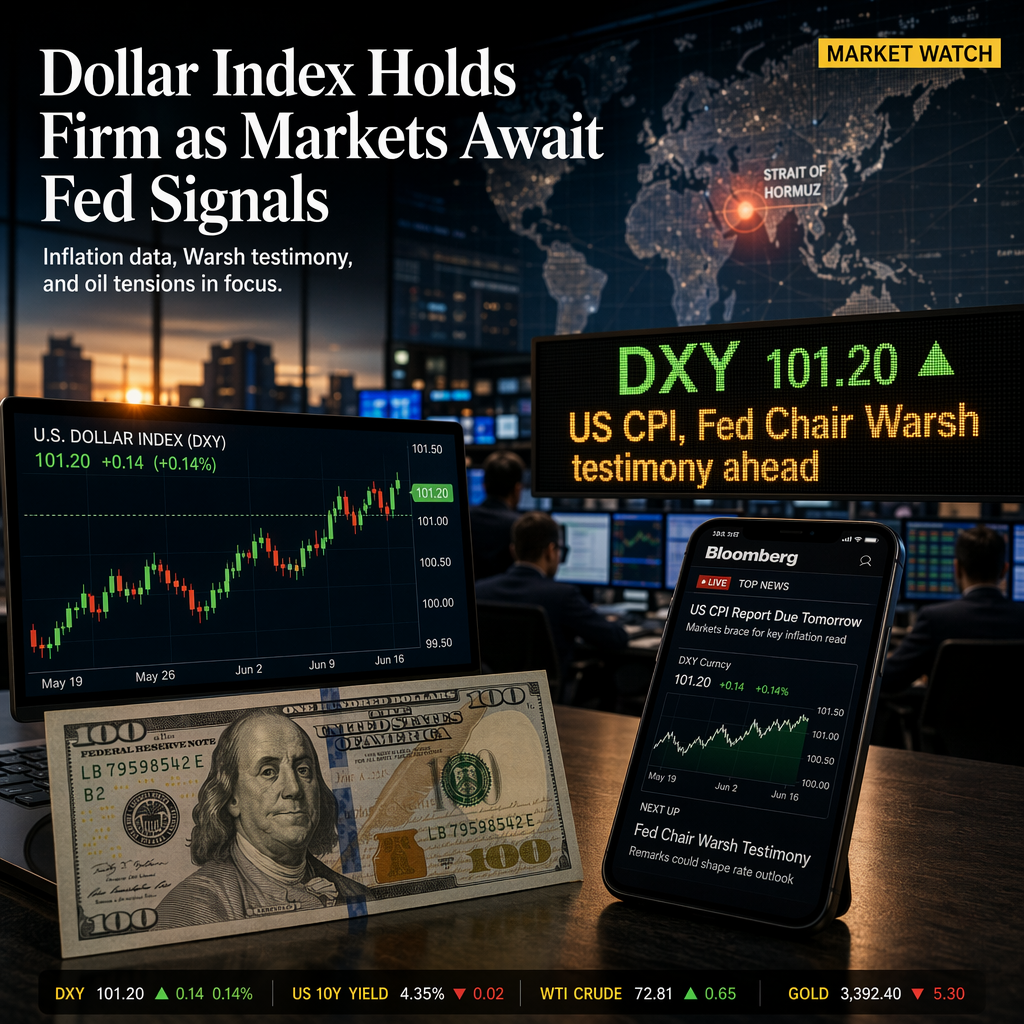
The US Dollar Index (DXY), which measures the Greenback against a basket of currencies, maintained modest intraday losses during the early European session on Tuesday, as market participants remained cautious ahead of the latest US consumer inflation figures and the inaugural congressional testimony of US Federal Reserve Chair Kevin Warsh [1]. The DXY held above the 101.00 level, supported by ongoing inflationary concerns stemming from elevated crude oil prices due to escalating tensions between the US and Iran and the closure of the Strait of Hormuz [1]. These developments have reinforced expectations that the Federal Reserve will raise borrowing costs by the end of the year, helping to limit downside pressure on the US Dollar [1].
From a technical standpoint, the DXY retains a bullish near-term bias, trading above both the 50-day Simple Moving Average (SMA) and the 100.50-100.55 resistance-turned-support zone [1]. The Relative Strength Index (RSI) stands at 60.54, indicating bullish momentum without being overbought, while the Moving Average Convergence Divergence (MACD) indicator remains slightly negative, suggesting that upside momentum is constructive but not aggressive [1]. Analysts note that a decisive move above the previous year-to-date high near 100.80 could open the path for the DXY to target the 102.00 mark and extend gains from the May monthly swing low [1]. Conversely, initial support is seen at 100.55-100.50, with the 50-day SMA at 99.92 serving as the next key demand area in the event of a corrective pullback [1].
Market participants are closely watching for signals from Fed Chair Warsh, who began his four-year term in May 2026, as his testimony and the upcoming US CPI data are expected to provide fresh cues on the Federal Reserve's policy path and the near-term trajectory of the US Dollar [1]. Until these events unfold, the DXY is expected to consolidate with a mild upward bias rather than initiate a deeper reversal [1].
CONCLUSION
The US Dollar Index remains supported above 101.00 as traders await key US inflation data and guidance from Fed Chair Warsh's testimony. Elevated crude oil prices and geopolitical tensions are fueling inflation concerns, reinforcing expectations for a potential Fed rate hike by year-end. The technical outlook favors further consolidation with a mild upward bias in the near term.