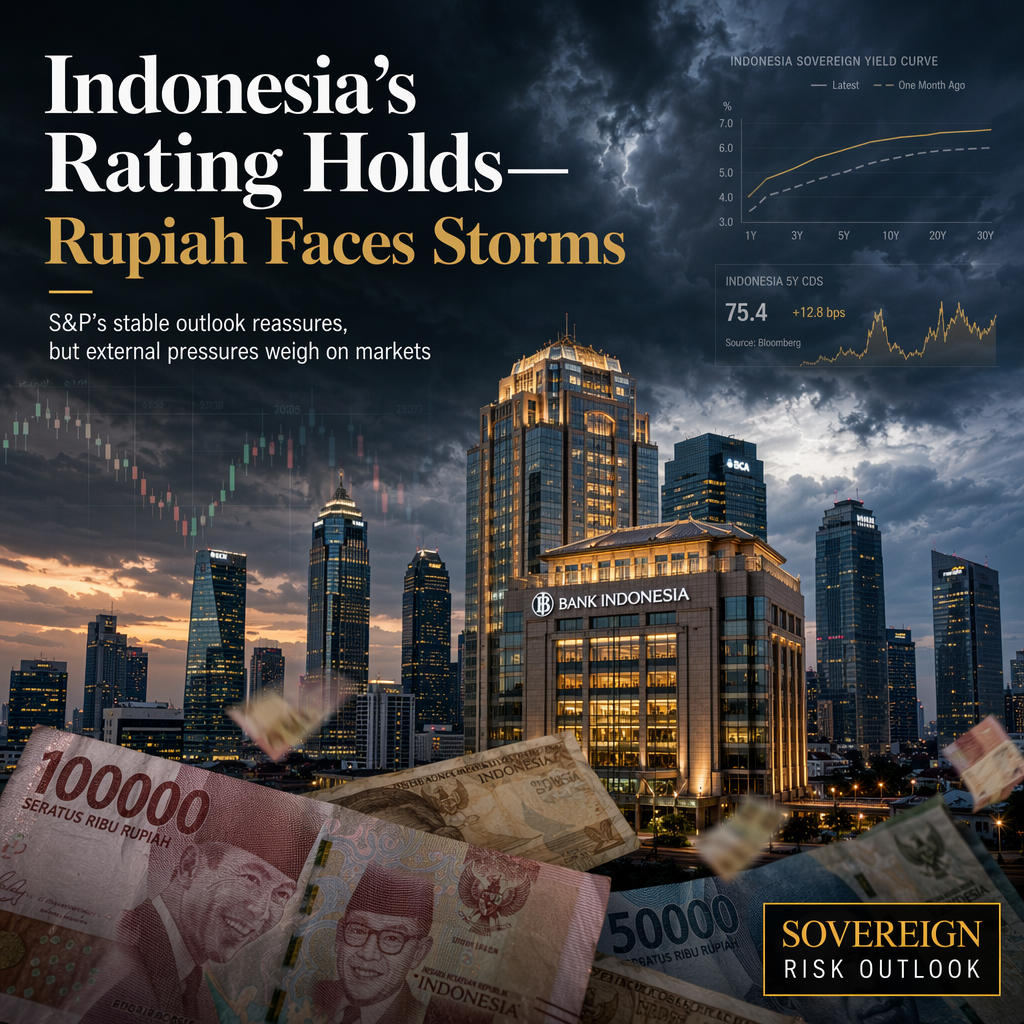
S&P Global Ratings has retained Indonesia’s sovereign rating and stable outlook, citing the country's record of fiscal discipline under various governments and assurances that the -3% of GDP deficit target will be respected [1]. The agency's positive view is also anchored on expectations that spending towards flagship schemes, such as the free meals program, will be rationalized, and that the centralized export agency will boost revenue [1]. DBS Group Research economist Radhika Rao notes that a credible commitment to fiscal discipline, stronger revenue mobilization, and prudent expenditure management will be timely, with transparent communication around fiscal priorities and funding plans helping to reduce policy uncertainty and reinforce confidence in the government's commitment to debt sustainability [1]. The reduction in downgrade risk is seen as a tailwind for local asset markets [1].
Despite the optimism from S&P’s decision, Rao highlights that risk appetite for Indonesian assets remains weak due to renewed West Asia tensions, higher US yields, a weaker Rupiah (USD/IDR back above 18,000, nearing new lows), and a sharply flatter IDR yield curve [1]. The IDR 2Y yield has adjusted up nearly 200 basis points compared to pre-West Asia conflict levels, a much larger extent than the long-end, following rate hikes and official preference to provide attractive differentials, effectively flattening the curve [1]. These external stressors are limiting prospects for a sustained rally in local markets, and intervention risks are rising as the Rupiah weakens [1].
DBS emphasizes that until exogenous stressors subside, a meaningful rally in Indonesian local markets will likely prove short-lived, despite the reduction in downgrade risk and S&P’s supportive stance [1].
CONCLUSION
While S&P’s retention of Indonesia’s sovereign rating and stable outlook provides a positive signal, external pressures such as geopolitical tensions, higher US yields, and a weakening Rupiah are dampening market optimism. The outlook for Indonesian assets remains cautious, with prospects for a sustained rally limited until these headwinds abate.