
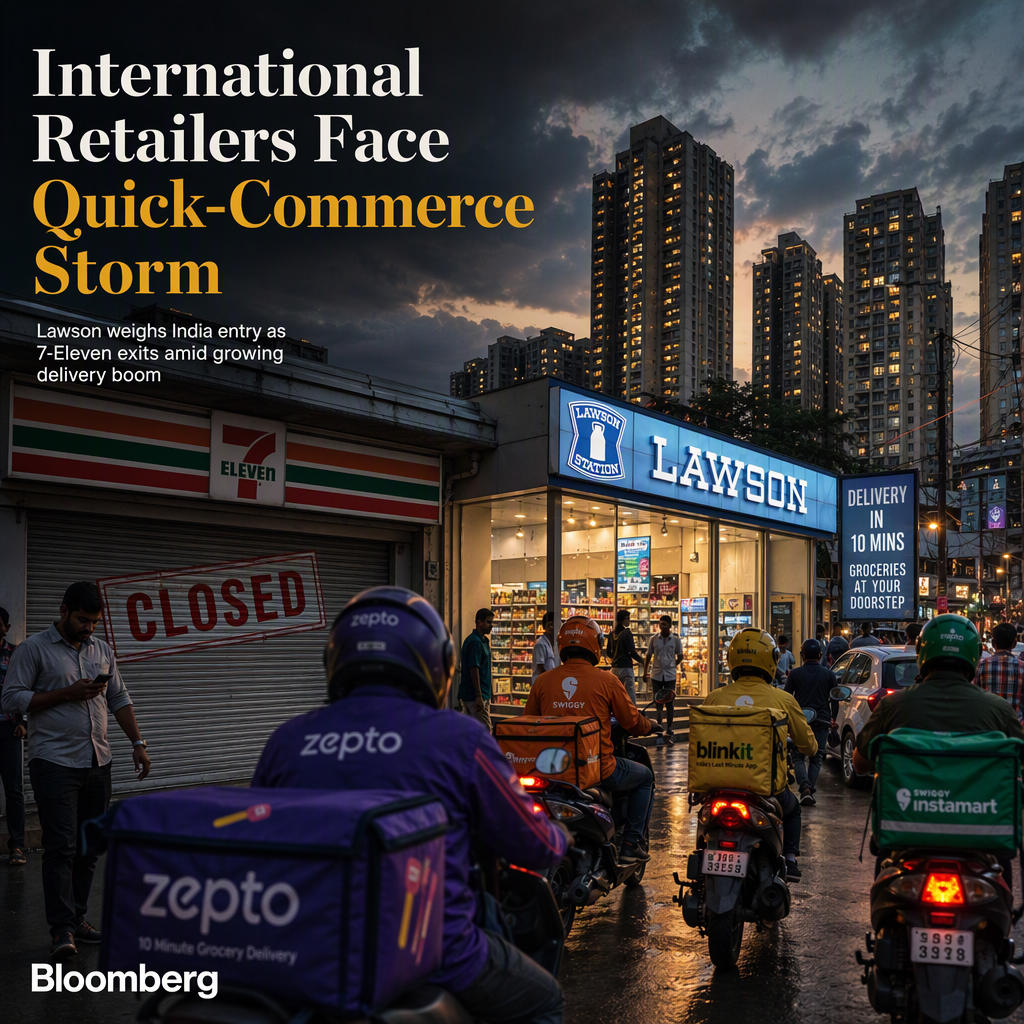
7-Eleven has exited the Indian market despite the support of the Reliance conglomerate, underscoring the intense competition in India's urban retail sector and casting uncertainty over the expansion plans of other foreign convenience store operators such as Japan's Lawson [1]. The rise of quick-delivery services in urban India is significantly eroding the market share of organized retailers, including international chains like 7-Eleven, making the environment increasingly challenging for new entrants [1].
The proliferation of instant delivery platforms, which offer groceries and essentials within minutes, is reshaping consumer behavior in Indian cities. This shift is particularly evident among time-pressed urban consumers who are opting for the convenience of home delivery over traditional brick-and-mortar shopping [1]. Lawson, one of Japan's largest convenience store operators, is currently assessing how to navigate these evolving market dynamics as it considers its expansion strategy in India [1].
Industry analysts emphasize that 7-Eleven's failure is not solely due to operational issues but also reflects fundamental changes in the Indian retail landscape driven by technology and consumer demand for instant gratification [1]. New entrants like Lawson will need to differentiate themselves not only from traditional competitors but also from tech-driven delivery platforms that are redefining the sector [1].
The ongoing transformation in India's convenience retail space has significant implications for expansion strategies, pricing models, and potential partnerships. Companies such as Lawson must carefully evaluate their approach in light of rapidly evolving consumer habits and the growing influence of quick-commerce disruptors [1].
CONCLUSION
7-Eleven's withdrawal from India signals the formidable challenges facing international convenience store chains in the country's rapidly changing retail landscape. As Lawson considers its own expansion, it must contend with both traditional rivals and the disruptive force of quick-commerce platforms, making strategic adaptation essential for success.