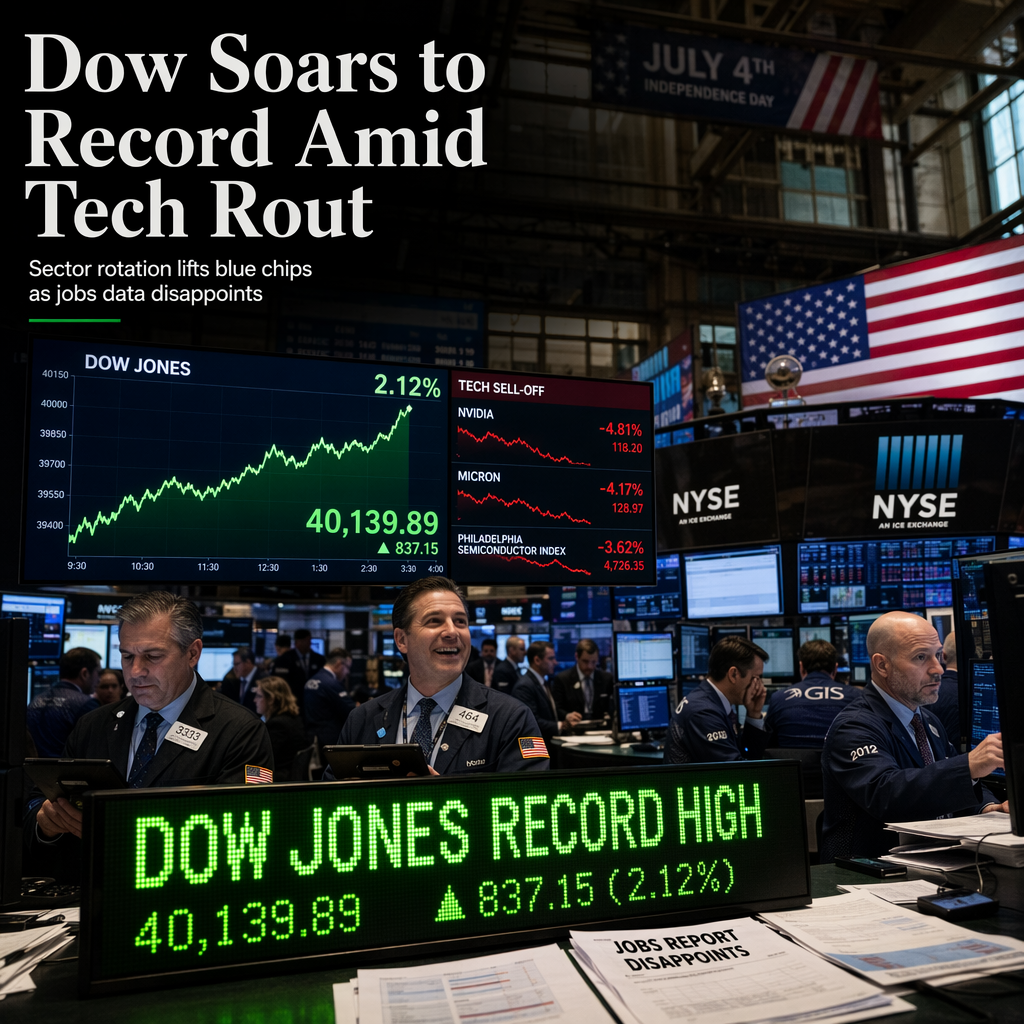
The Dow Jones Industrial Average (DJIA) reached a new intraday record on Thursday, rising approximately 0.6%, despite a June jobs report that fell short of expectations by nearly half, with only 57,000 jobs added compared to the 115,000 consensus forecast [1]. In contrast, the Nasdaq Composite declined and the S&P 500 remained flat, highlighting a rotation of capital from technology stocks to the Dow's older and cheaper constituents rather than a broad-based rally [1].
The semiconductor sector experienced notable declines for the second consecutive session, with chip stocks as a group dropping several percent. Two equipment makers fell close to 8%, and major players such as Nvidia and Micron also moved lower. This sector-wide selloff was attributed to a revaluation of the artificial intelligence trade, as concerns grew about the sustainability of capital spending in the face of rising computing costs [1].
Despite the disappointing jobs data, the unemployment rate actually improved to 4.2% from an expected 4.3%. The Federal Reserve, under its current leadership, was not expected to react strongly to a single soft jobs report, especially given its tendency to treat initial jobs data as preliminary. Rate futures showed little reaction, with the probability of a rate hold at the late-July meeting firming to 82%, which was already anticipated. The market continues to expect the Fed to maintain or potentially increase rates rather than cut them, as a slightly softer labor market and declining crude oil prices provide the Fed with justification to remain cautious [1].
It is also noted that the record-setting session occurred during a holiday-shortened week with thin liquidity, as US markets were closed on Friday for Independence Day. Such conditions can exaggerate market moves. Looking ahead, investors are awaiting the Institute for Supply Management (ISM) services survey on Monday and the release of the Federal Open Market Committee (FOMC) meeting minutes on Wednesday for further market direction [1].
CONCLUSION
The Dow's record high was driven by sector rotation rather than broad market strength, as technology and semiconductor stocks faced significant declines. Despite a weaker-than-expected jobs report, the market expects the Federal Reserve to maintain its current policy stance. Upcoming economic data and Fed minutes are likely to provide further guidance for investors.