
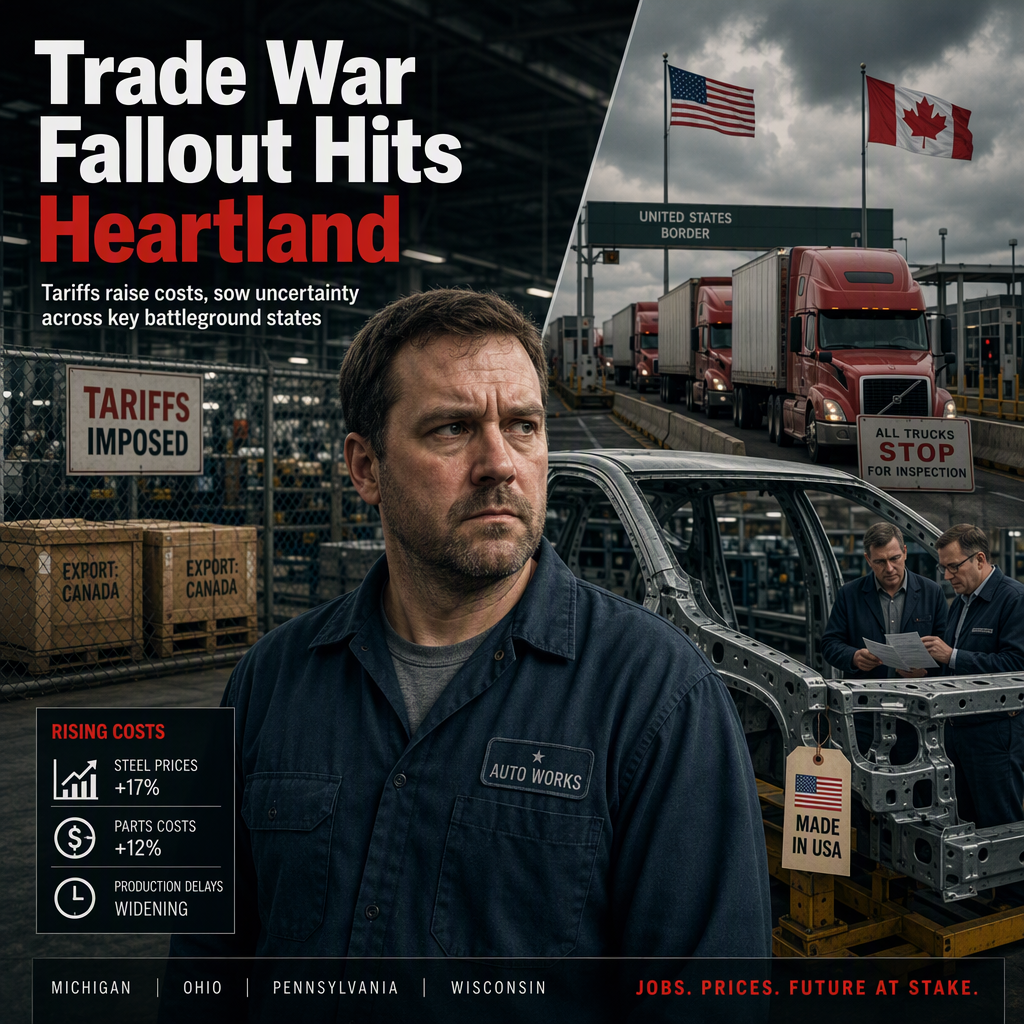
President Donald Trump's escalating trade war with Canada is raising fresh concerns in battleground states ahead of the November midterms, as both countries have imposed tariffs on billions of dollars’ worth of goods and Washington has banned nearly $1 billion in Canadian imports, including alcohol, dairy products, and motorcycles. The latest measures took effect on September 29, with negotiations between the U.S. and Canada remaining unresolved [1].
Trump asserts that the tariffs will bring manufacturing back to the United States and protect American industries. However, businesses may cut production, consumers could face higher prices, and manufacturers might delay investments due to the increased costs and uncertainty [1]. The trade fight has escalated under Trump and Canadian Prime Minister Mark Carney, with both sides imposing new measures targeting each other's goods and negotiations breaking down [1].
David Clement, policy director of the Consumer Choice Center, highlighted that Ohio, Illinois, Michigan, Pennsylvania, and Wisconsin are among the states most exposed to Canadian retaliation because of their manufacturing, agricultural, and cross-border supply chains. Clement stated, "American manufacturers or American businesses who rely on Canadian inputs are going to start to feel the pain right in the lead up to going to the ballot box" [1].
Ohio is particularly vulnerable, with roughly $2.3 billion in exports exposed. The state's machinery, transportation, minerals, and metals industries depend heavily on Canadian buyers and cross-border supply chains, and tariffs could make Ohio goods more expensive and reduce demand for products made by the state’s manufacturers [1]. Michigan’s auto industry faces heightened uncertainty as tariffs threaten the deeply integrated supply chain connecting the state with Canada. Clement noted that a single component on a U.S.-assembled vehicle can cross the border upwards of eight times before completion, meaning tariffs can increase costs at each stage of production [1]. The stakes could rise further if the administration moves ahead with a possible 50% tariff on Canadian goods, though further details are not provided [1].
At a recent G20 trade ministers meeting, U.S. Trade Representative Jamieson Greer acknowledged that key issues remain unresolved, underscoring the ongoing uncertainty and potential for further escalation [1].
CONCLUSION
Trump's trade war with Canada is causing significant concern in key battleground states, with billions in exports and critical industries exposed to retaliatory tariffs. The escalating measures are increasing costs for businesses and consumers, and unresolved negotiations suggest continued uncertainty. The market impact is high, especially for states with integrated supply chains and manufacturing sectors.