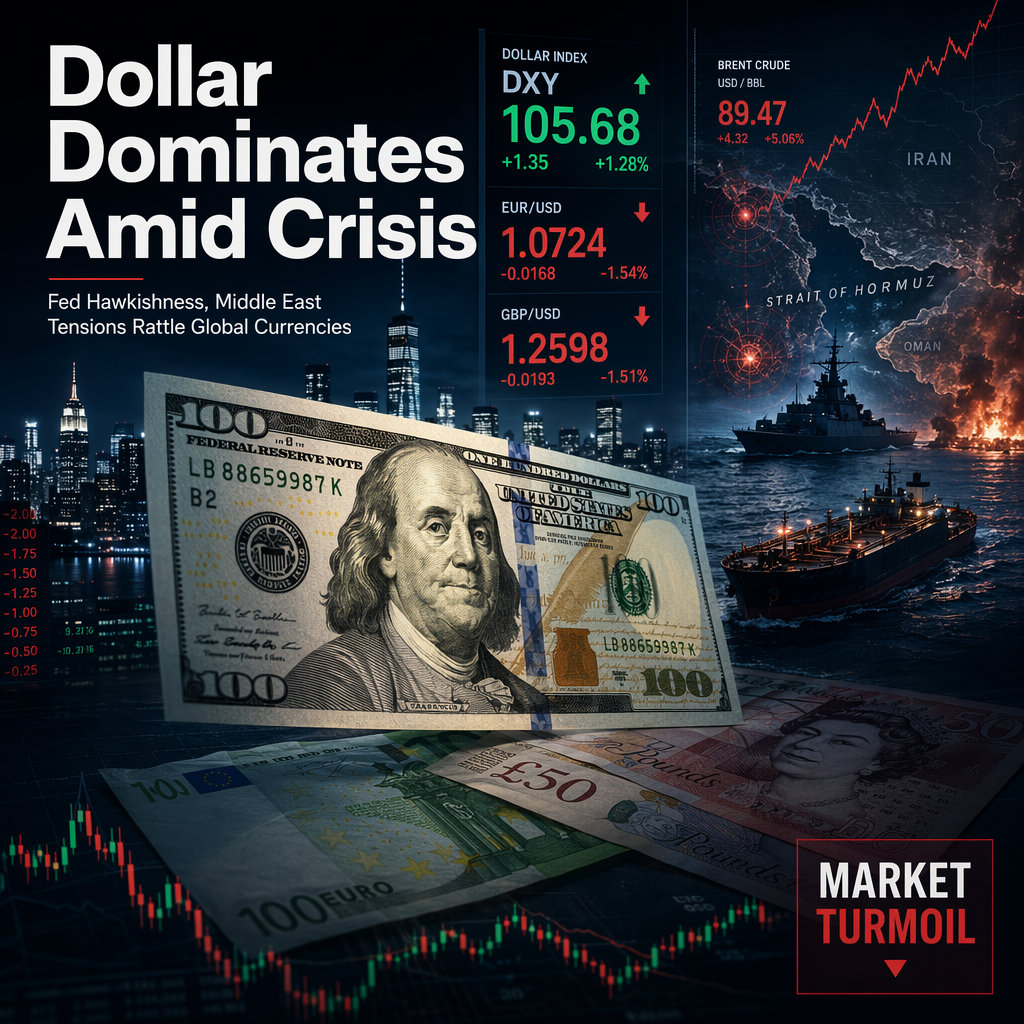
The US Dollar strengthened significantly at the start of the week, driven by escalating geopolitical tensions in the Middle East and unexpectedly hawkish signals from the Federal Reserve. President Trump announced on Monday that the US would reinstate its blockade of Iran and close the Strait of Hormuz to Iranian vessels and any ship trading with Tehran, while imposing a 20% transit fee on other ships passing through the critical oil chokepoint. This move follows renewed American strikes on Iran and Iranian attacks on commercial shipping, which ended a recent ceasefire and turned the Strait into a revenue source for the US. The announcement led to a surge in crude oil prices and a repricing of tanker insurance, as market participants anticipated higher costs and potential supply shocks [1].
Simultaneously, a Federal Reserve Governor, previously known for advocating rate cuts, delivered a speech in New York warning that the next policy move might need to be a rate hike. The official described policy as being at a crossroads and highlighted the importance of Tuesday's inflation report in determining the Fed's next steps. This shift in tone caused rate futures to price in a greater likelihood of a rate hike, with markets assigning better than even odds to a quarter-point increase by the September meeting and a 40% chance of a move as early as July. By December, the most likely outcome is a target band a full half-point higher than current levels [1].
The Euro and British Pound both suffered as a result of the Dollar's strength. EUR/USD fell 0.31% to 1.1379, with the US Dollar Index (DXY) rising 0.32% to 101.28. The 10-year US Treasury yield jumped 6 basis points to 4.624%, reflecting investor expectations of imminent Fed tightening. Money markets are now pricing in nearly 42 basis points of Federal Reserve tightening, according to Prime Terminal data [2]. GBP/USD also declined, trading at 1.3349 after probing the 1.3400 area earlier in the session [1].
Further compounding market anxiety, US CENTCOM announced a third consecutive night of strikes against Iran, while Iranian media reported explosions in Bandar Abbas and claimed that Iran's army targeted US military facilities in Kuwait and a US vessel with cruise missiles [2]. Looking ahead, markets are focused on the upcoming US inflation data and testimony from Fed Chair Kevin Warsh, as well as a speech by ECB President Christine Lagarde [2].
Technical analysis for EUR/USD shows a bearish outlook, with the pair trading below key moving averages and the Relative Strength Index (RSI) at 37, indicating continued downside pressure [2].
CONCLUSION
The combination of renewed US-Iran tensions and a hawkish shift from the Federal Reserve has triggered a broad rally in the US Dollar and selloffs in major currencies like the Euro and British Pound. With markets now pricing in a higher probability of Fed rate hikes and ongoing geopolitical risks, volatility is likely to remain elevated in the near term.