
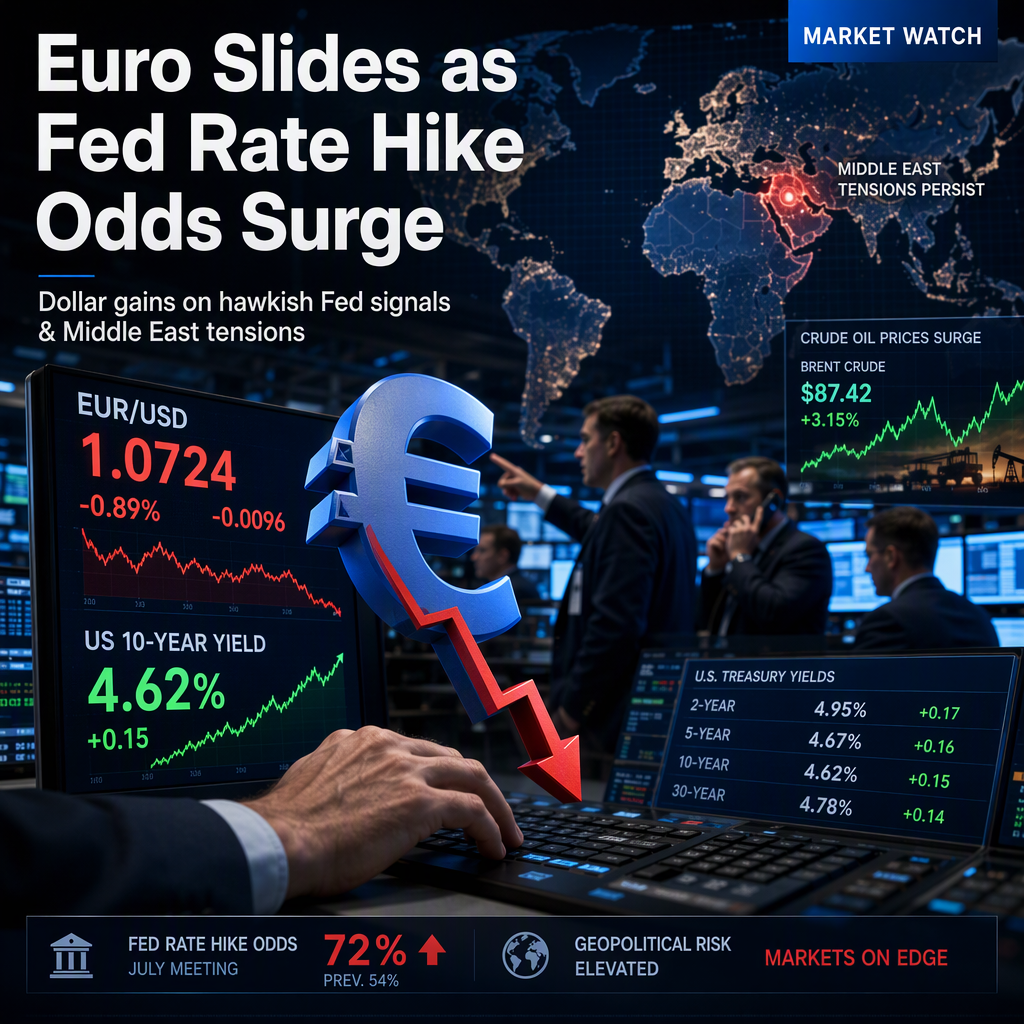
The EUR/USD pair experienced modest losses, trading near 1.1375 during early Asian hours on Friday, as the US Dollar strengthened against the Euro. This movement was driven by hawkish signals from Federal Reserve officials and a lack of progress in US-Iran negotiations, which heightened market uncertainty and supported safe-haven flows into the Dollar [1].
US Treasury yields surged, with the 30-year bond yield reaching 5.501%, a level not seen since June 2004, and the 10-year yield climbing to 5.223%, the highest since June 2007. These increases reflect rising market expectations for another Federal Reserve rate hike, fueled by resilient US economic data, rising oil prices, and hawkish remarks from Fed policymakers [1]. According to the CME FedWatch tool, the probability of an October rate hike has jumped to nearly 67.5%, up from 55.4% a week earlier and just 11% a month ago [1].
Philadelphia Fed President Anna Paulson stated that additional tightening could be necessary if the economy continues on its current path, emphasizing that inflation remains well above the Fed's 2% target [1]. Similarly, Fed's Hammack delivered a strongly hawkish message, warning that inflation risks remain tilted to the upside amid solid demand, and reiterating that price stability is the responsibility of central banks [1].
On the European side, the Euro remained under pressure as front-end yield spreads widened and concerns persisted about the potential impact of a US diesel export ban, despite US denials of a 90-day ban. However, German sentiment data provided a slight positive, with the IFO Business Climate Index rising to 89.9 and Expectations to 90.4 in September, exceeding expectations. Strategists at Scotiabank noted that while sentiment has improved, it continues to lag behind German GDP trends [1].
Geopolitical tensions also played a role, as US-Iran talks showed little progress. Iranian President Masoud Pezeshkian indicated that the US must decide whether to end hostilities, while negotiations remain stalled as both sides are unwilling to relinquish leverage. Ongoing Middle East conflicts and negotiation uncertainty are seen as factors supporting the US Dollar and weighing on the Euro [1].
CONCLUSION
The Euro's modest losses against the US Dollar reflect heightened expectations for a Fed rate hike and persistent geopolitical tensions. Rising US Treasury yields and hawkish Fed commentary have strengthened the Dollar, while the Euro remains pressured despite improving German sentiment. Market sentiment is cautious, with safe-haven flows favoring the Greenback amid ongoing uncertainty.