
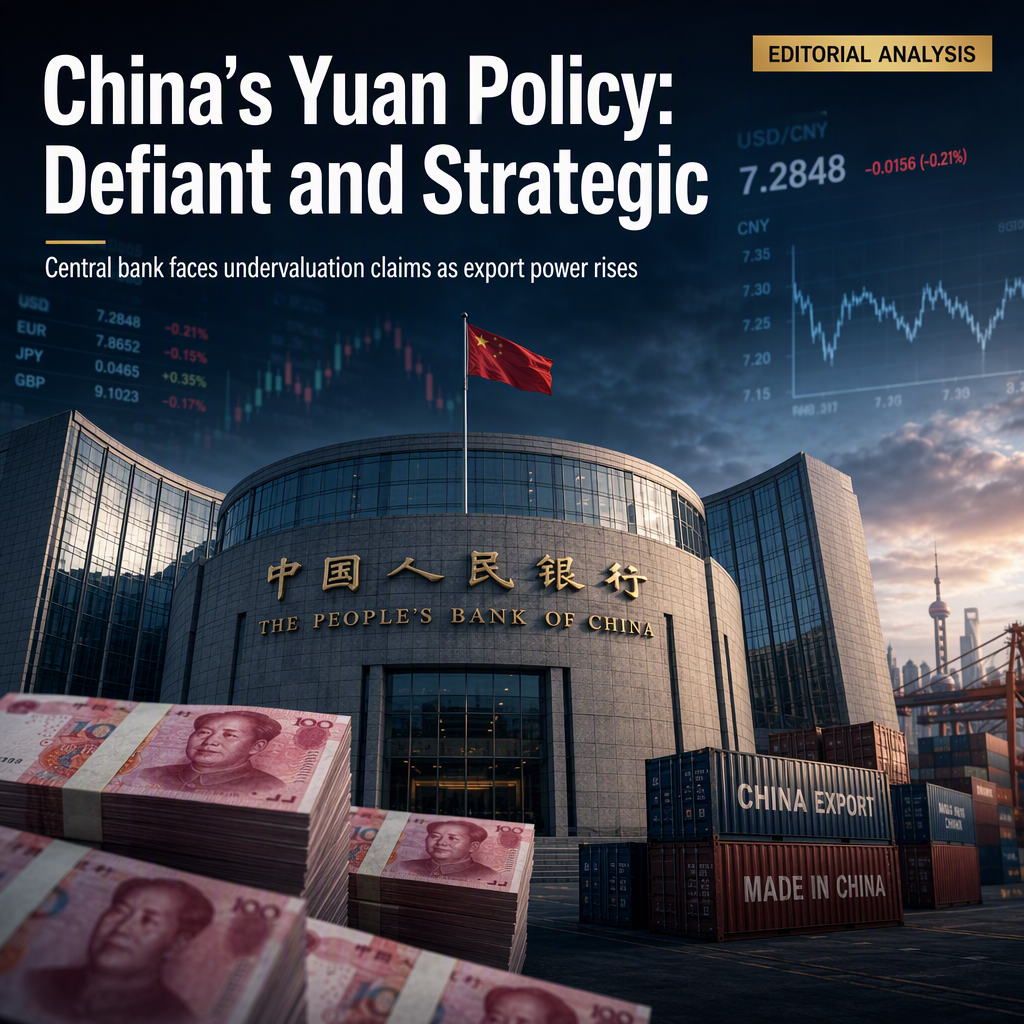
The People's Bank of China (PBoC) has released a new document defending its foreign exchange (FX) policy, rejecting claims that the Chinese yuan (CNY) is the primary driver of China's trade surplus. Instead, the PBoC attributes the country's export strength to competitive gains within its manufacturing sector, as highlighted by Halpenny from MUFG [1]. This statement coincides with ongoing talks between Trade Commissioner Maros Sefcovic and Chinese Commerce Minister Wang Wentao [1].
Recent data from the Bank for International Settlements (BIS) shows that the real effective exchange rate (REER) of the renminbi (RMB) rose by nearly 60% from 2005 to the end of 2015. However, from its 2022 peak, the index fell by 20% to last year's low, before recovering 6.5% to its current level [1]. The International Monetary Fund (IMF) estimates that the CNY is undervalued by 12% to 20%, which aligns with the consensus range among analysts [1]. While this undervaluation may contribute to export growth, the FX factor is considered only a partial explanation for China's export performance [1].
The release of the PBoC document suggests that China is not planning to change its FX policy stance in the near term. However, mounting international pressure appears to be encouraging China to allow the yuan to strengthen. Recent PBoC fixings in USD/CNY indicate a preference for a stronger CNY, even as the US dollar has broadly gained [1]. Additionally, the EUR/CNY exchange rate is 10% lower compared to its January high, and there is near-term potential for further declines [1].
CONCLUSION
China's central bank is firmly defending its FX policy and the current valuation of the yuan, attributing export strength to manufacturing competitiveness rather than currency manipulation. While the CNY is widely seen as undervalued, recent policy signals suggest a willingness to allow moderate appreciation. Market participants should monitor ongoing policy communications and FX fixings for further direction.