
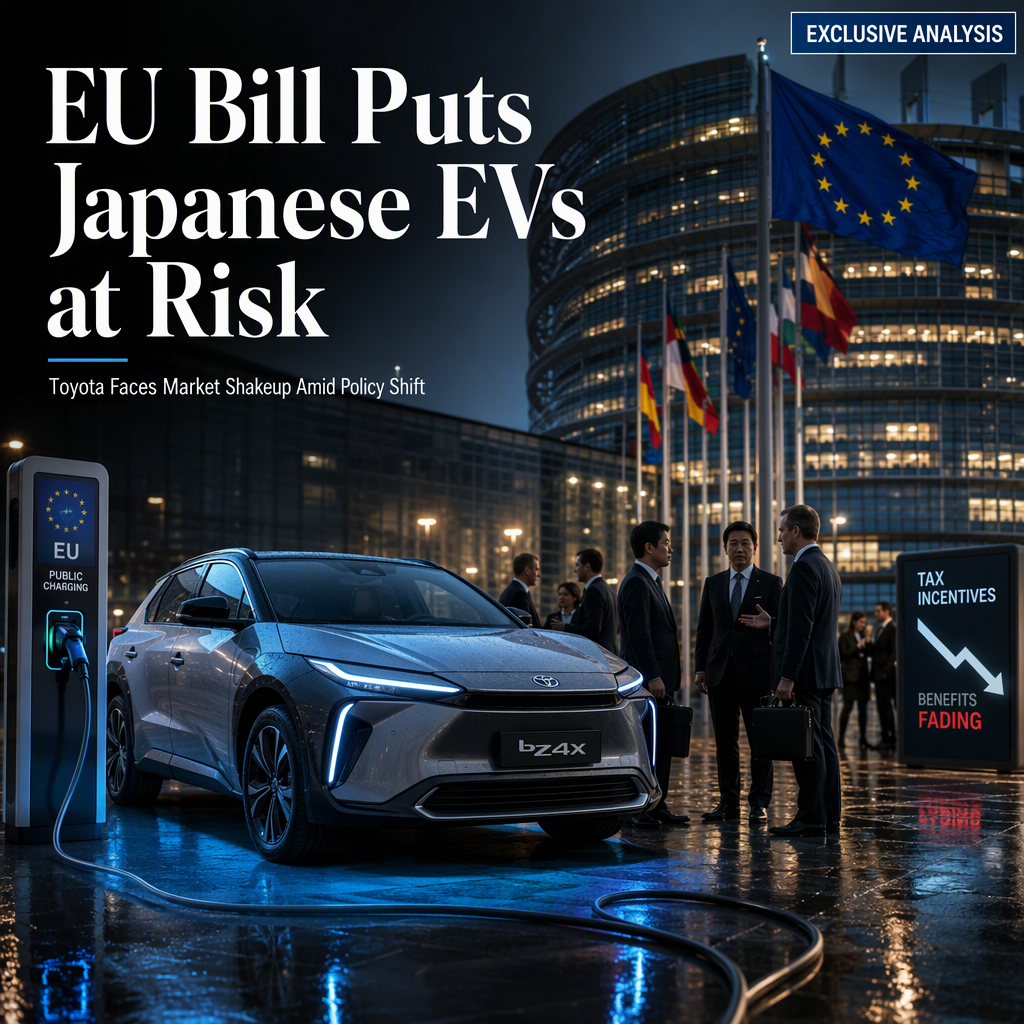
Toyota Motor and other Japanese electric vehicle (EV) manufacturers are facing a significant threat in the European Union as member states consider new industrial legislation known as the 'Made in EU' bill. This proposed bill would eliminate tax breaks for EVs assembled outside the EU, directly impacting companies like Toyota, which imports almost all of its EVs sold in the region, including the bZ4X model [1].
If the legislation is enacted, Japanese automakers could see a substantial decline in both market share and sales volume within the EU, as tax incentives would become available only for locally produced vehicles. This shift is viewed as a strategic move by the EU to strengthen its domestic automotive industry and reduce dependence on imported vehicles [1].
The potential removal of tax breaks for non-EU manufactured EVs has raised concerns among Japanese manufacturers, who may be forced to contend with higher costs and diminished demand for their products. As a result, companies like Toyota might need to reevaluate their supply chains and consider increasing local production within the EU to retain market access and competitiveness [1].
Industry analysts caution that the proposed changes could disrupt current market dynamics, placing Japanese automakers at a disadvantage compared to European competitors who already have established manufacturing operations within the bloc. The automotive industry is closely monitoring the situation, given the potential for significant shifts in competitive positioning and supply chain strategies [1].
CONCLUSION
The proposed 'Made in EU' bill poses a serious challenge to Japanese EV makers, particularly Toyota, by threatening their access to tax incentives in the European market. If enacted, the legislation could force a strategic realignment of manufacturing and supply chains, with significant implications for market share and industry competition.