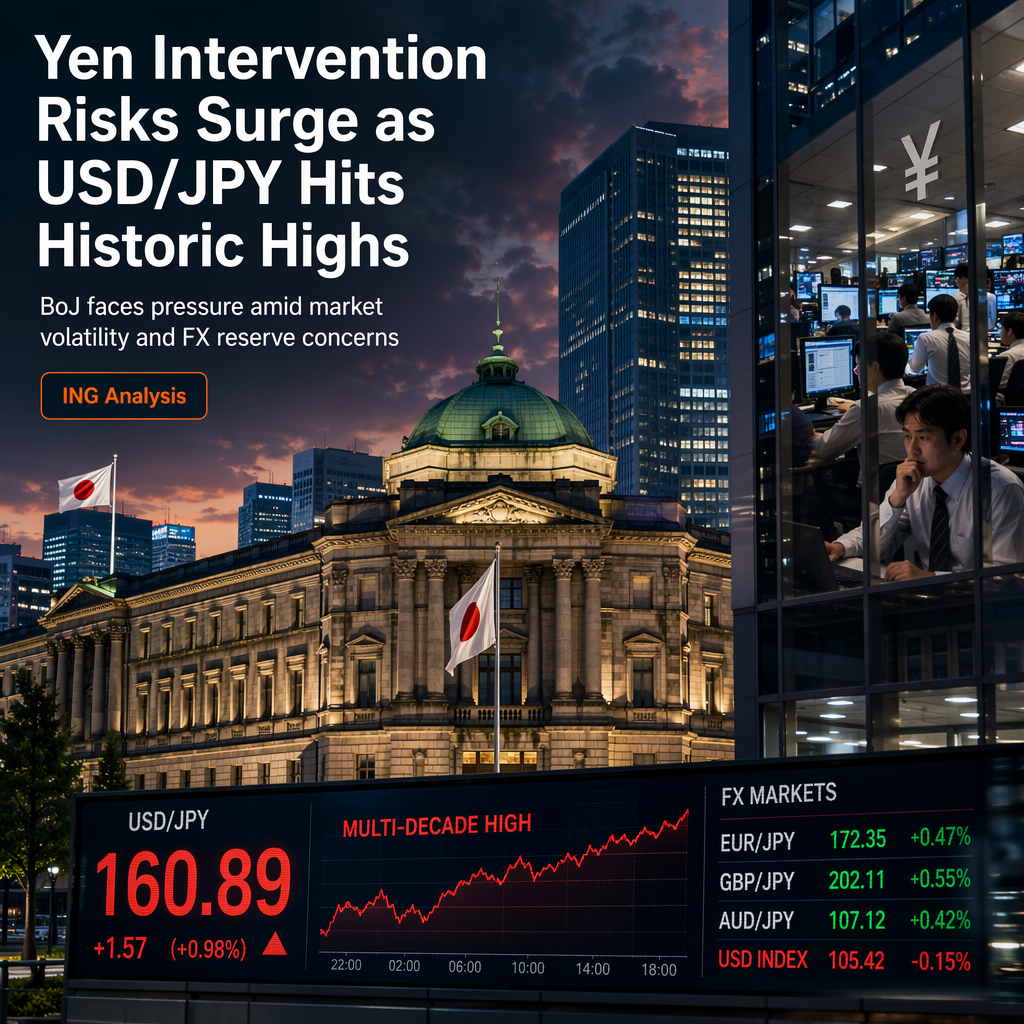
The Japanese Yen faces heightened intervention risks as the USD/JPY exchange rate has surpassed its 2024 highs near 162, reaching levels not seen since the 1980s, according to ING’s Chris Turner [1]. This surge has intensified market focus on potential action from the Bank of Japan (BoJ), especially as traders monitor a range of factors including intervention timing, foreign exchange (FX) reserve constraints, and concerns over the International Monetary Fund (IMF) regime classification [1].
Turner notes that the BoJ previously sold just over $70 billion in late April and early May when USD/JPY was just above 160, and the market widely expects further intervention in the coming days or weeks [1]. Japanese officials have emphasized that the weak yen threatens import costs and exacerbates Japan’s cost of living crisis, a key issue for the electorate. The government is currently addressing these concerns through subsidies, though this approach has raised some worries regarding the bond market [1].
Regarding timing, Turner suggests the BoJ may delay intervention until after potential dollar-positive events, such as remarks from Federal Reserve Chair Kevin Warsh and the upcoming June US jobs report, with the US July 4th holiday seen as a possible window for action [1]. If the BoJ refrains from intervening this week, it may wait until 16–17 July, just before Japan’s Marine Day holiday on 20 July, following its 2024 intervention playbook. Should US data and Federal Reserve commentary remain hawkish, Turner warns that USD/JPY could reach 164–165 by then [1].
Japan’s FX reserves currently stand at close to $1.1 trillion, with the decade’s low point around $1.07 trillion. Turner doubts that the $1 trillion mark is a psychological floor, but notes that FX reserves are finite and interventions are used judiciously [1]. Additionally, Turner highlights that Japan is mindful of the IMF’s classification system for ‘free floating’ exchange rates, as intervening more than three times in six months could result in a downgrade to ‘floating’ status. The IMF defines an ‘instance’ of intervention as lasting no longer than three business days [1].
CONCLUSION
The Japanese Yen’s rapid depreciation has put the BoJ under pressure to intervene, with market participants closely watching for official action. ING’s analysis suggests intervention is likely but may be timed around key US economic events and holidays, with FX reserve levels and IMF classification concerns influencing the BoJ’s strategy. The situation remains fluid, with the potential for further yen weakness if US monetary policy remains hawkish.