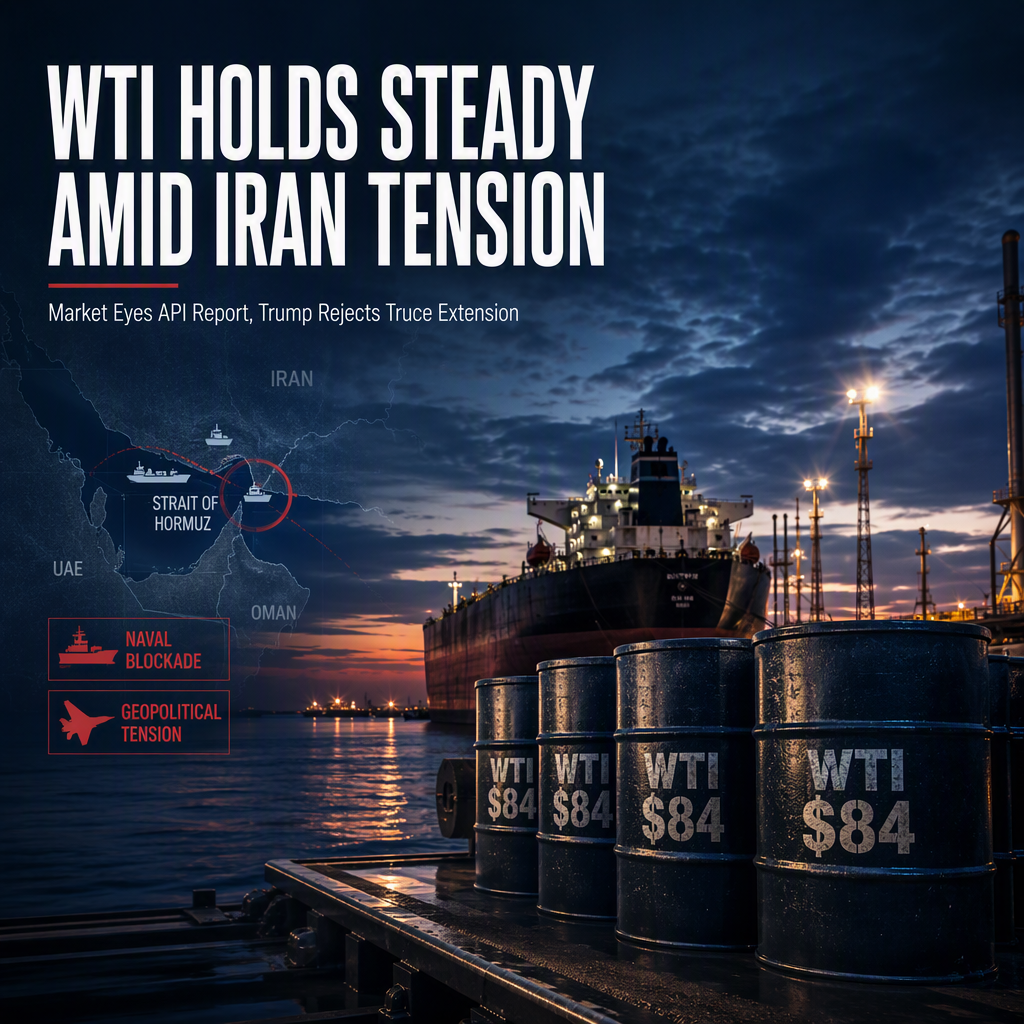
West Texas Intermediate (WTI), the US crude oil benchmark, traded around $84.00 during early Asian hours on Tuesday as market participants digested developments in Middle East geopolitics and awaited key inventory data [1]. The core event driving sentiment was the rejection by US President Donald Trump of an extension to the Memorandum of Understanding (MoU) with Iran, which was originally signed in June to end the conflict. Trump emphasized that the US has leverage over Iran, referencing a naval blockade of Iranian ports and asserting, “We control it with the blockade, and I like the idea of declaring it a territory. We have total control over the strait” [1].
On the Iranian side, officials signaled readiness to escalate tensions in the Strait of Hormuz and the wider region, with an Iranian official stating that entities must be prepared for difficult decisions and actions. Iran’s Foreign Ministry spokesman, Esmail Baghaei, attributed the lack of agreement to security complexities and what he described as the “obstructionist behavior of destructive elements,” calling for the US to remove its blockade [1].
Market participants are closely watching the upcoming American Petroleum Institute (API) weekly crude oil report, due later on Tuesday. The report’s outcome could influence WTI prices: a larger-than-expected inventory draw would indicate stronger demand and potentially support prices, while a bigger build could signal weaker demand or excess supply, pressuring prices lower [1].
Analysts at TD Securities noted that crude oil positioning leaves the market vulnerable to a sharp short-covering rally, as fundamentals still point to persistent supply deficits and ongoing inventory drawdowns. They suggested that renewed risk aversion or supply concerns could quickly push key benchmarks higher [1]. Technically, WTI maintains a bearish near-term bias, trading below the 100-day Simple Moving Average (SMA), with initial resistance at $86.20 and further resistance at $90.25. The Relative Strength Index (RSI) at 56.03 indicates modest positive momentum, but the market remains capped by longer-term averages [1].
CONCLUSION
WTI prices remain steady near $84.00 as geopolitical tensions between the US and Iran escalate following the rejection of a truce extension. Market participants are awaiting the API crude oil report for further direction, while analysts highlight the potential for a short-covering rally if supply concerns intensify. Technical indicators suggest a bearish bias persists, with key resistance levels ahead.