
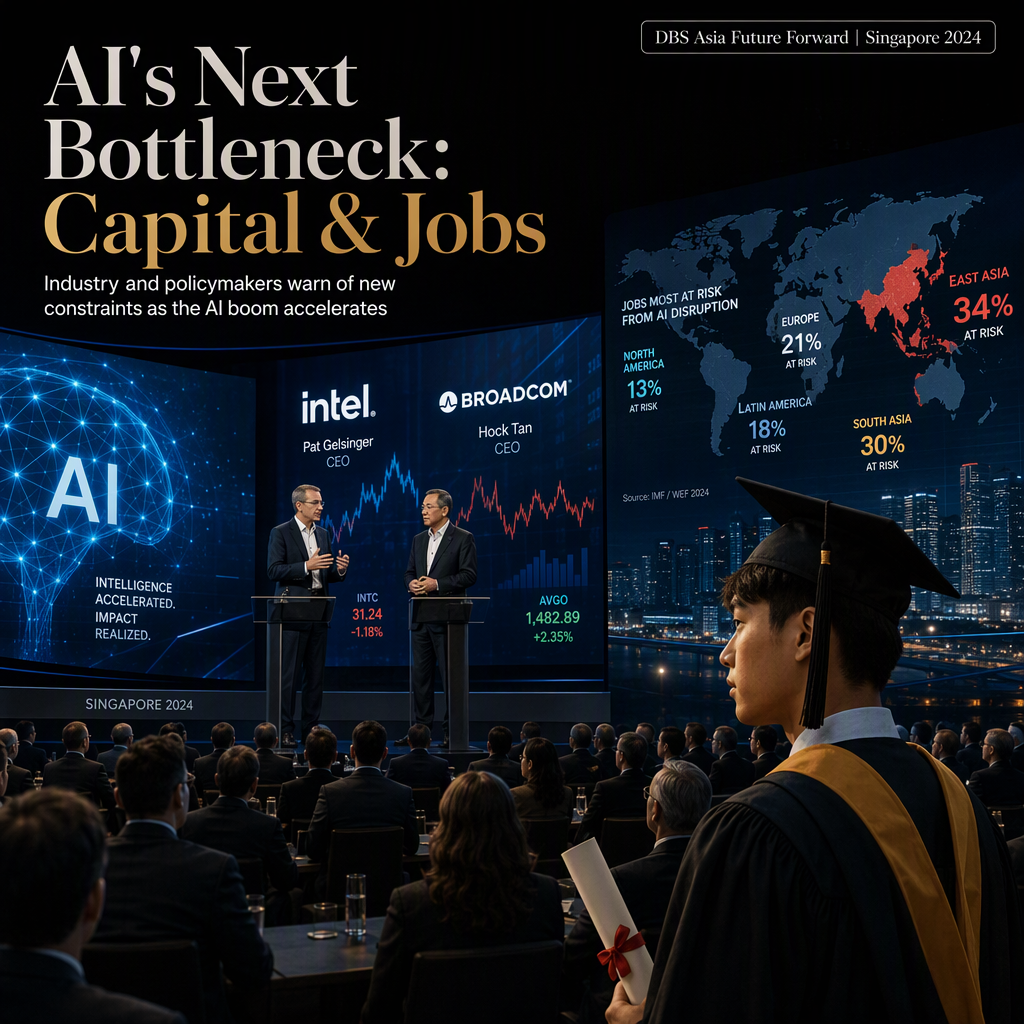
At the DBS Asia Future Forward Conference in Singapore, the CEOs of Intel and Broadcom warned that access to capital could become the primary bottleneck for the ongoing artificial intelligence (AI) boom, potentially surpassing previous constraints such as semiconductor, memory chip, or electricity shortages [1]. Broadcom CEO Hock Tan stated, "[What] I think might be the biggest constraint is capital," emphasizing that financing could become a bigger obstacle to AI expansion than supply chain issues [1]. Intel CEO Lip-Bu Tan echoed these concerns, highlighting the rising cost of capital and the uncertainty over whether heavy investments in AI will yield sufficient returns, saying, "If there's any challenge in the front, it's capital and the cost of capital, and then the other part is in the longer run, people want to see the ROI" [1].
Both executives noted that the industry has faced a series of supply bottlenecks over the past two years, but expect some constraints, such as memory and wafer shortages, to ease by 2028 or 2029 as production capacity expands [1]. Despite these challenges, they remain optimistic about near-term demand for AI computing infrastructure, with Hock Tan stating, "There is more demand for compute infrastructure than we can supply," and predicting that this imbalance could persist through 2029 and potentially into 2030 [1]. Intel’s Tan similarly projected continued strong demand for the next two to three years, driven by growing adoption of AI applications [1].
Meanwhile, at a separate panel, International Monetary Fund (IMF) Managing Director Kristalina Georgieva described AI's impact on the global labor market as a "slow-moving tsunami," warning that young graduates are particularly vulnerable to job displacement [2]. Singapore President Tharman Shanmugaratnam, co-chair of the World Bank's Jobs Council, called for governments to make "crisis-era" employment support measures a permanent part of structural policy to help young people enter the workforce [2]. World Bank President Ajay Banga estimated that 1.2 billion young people will turn 18 over the next 15 years, stressing the need for private sector job creation and government policies to "de-risk" private capital investment [2].
The IMF estimates that about 40% of jobs worldwide will eventually be "augmented, downgraded or eliminated" by AI, with exposure reaching 60% in advanced economies and 23% in low-income countries [2]. Shanmugaratnam noted that in the U.S., "for the first time in a century, demand for graduates has gone down," and the wage premium for a college degree is shrinking [2]. Policymakers are now focused on cushioning the fallout from AI-driven disruption, rather than debating its likelihood [2].
CONCLUSION
Industry leaders and global policymakers agree that the AI boom faces significant challenges from both capital constraints and labor market disruption. While demand for AI infrastructure remains robust, rising financing costs and job displacement risks require coordinated action from both the private sector and governments. The market impact is high, as both investment and employment trends are at a critical inflection point.