
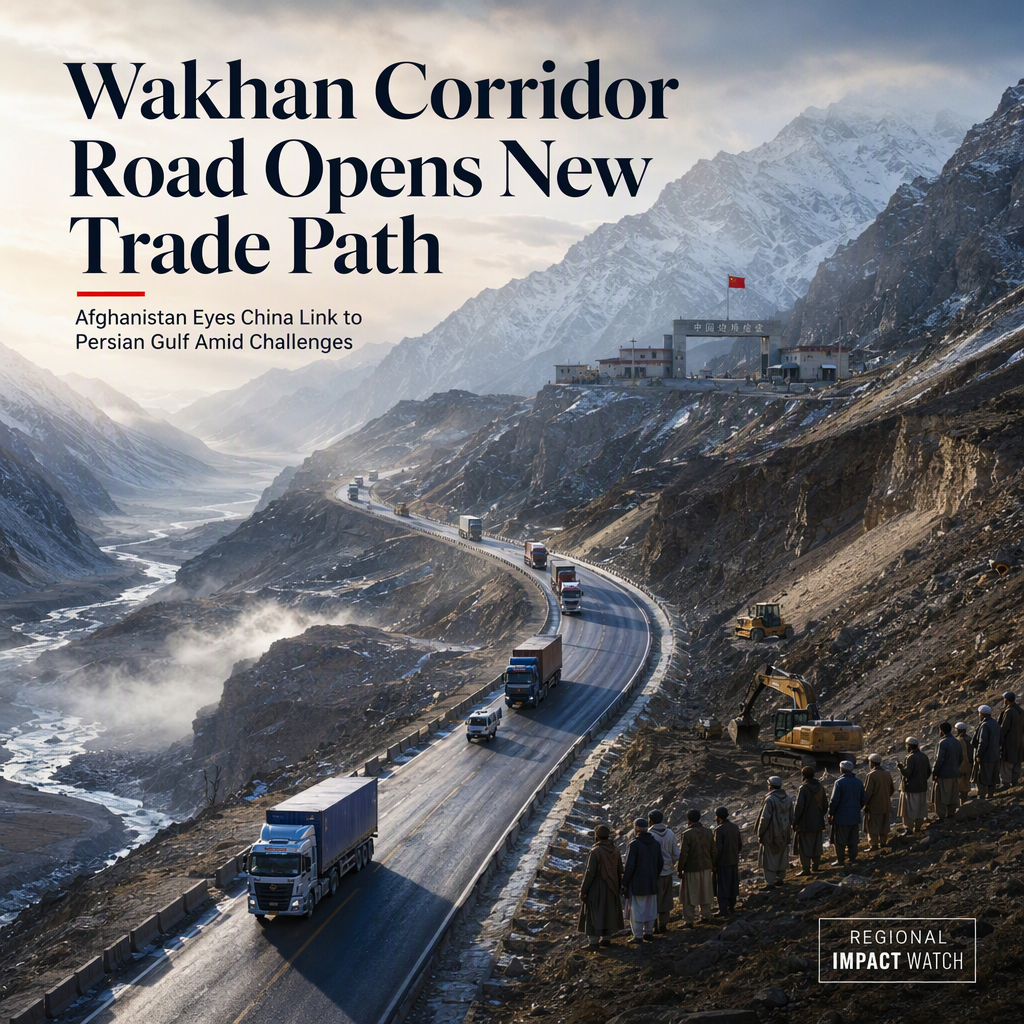
Afghanistan's Taliban government has recently opened a road through the Wakhan Corridor in Badakhshan province, aiming to establish a direct trade route with China that could eventually connect to the Persian Gulf [1]. The Wakhan Corridor, a narrow strip of land in northeastern Afghanistan, is seen by experts as a potential gateway for China to access the Persian Gulf, bypassing traditional routes through Pakistan and Iran [1].
While the completion of the road marks a significant milestone, analysts caution that the route is far from operational. Key challenges include security concerns, logistical hurdles, and the need for substantial infrastructure investment before the corridor can support regular commercial traffic [1]. A regional analyst emphasized the strategic potential of the corridor, noting that it could become a major trade route but would require considerable investment, security guarantees, and political stability in Afghanistan to realize its full potential [1].
No specific financial values, trade volumes, or investment levels have been disclosed at this stage [1]. The development is attracting attention from international investors and regional governments, as it could influence trade flows, transport costs, and market sentiment in Central and South Asia [1].
The opening of the Wakhan Corridor road signals Afghanistan's intention to play a larger role in China's Belt and Road Initiative and may present future opportunities for cross-border trade and investment [1].
CONCLUSION
The opening of the Wakhan Corridor road marks a strategic step for Afghanistan and China, with the potential to reshape regional trade dynamics. However, significant challenges remain before the route can become fully operational, and no concrete financial or market data have been disclosed. The development is being closely monitored for its possible impact on trade and investment in Central and South Asia.