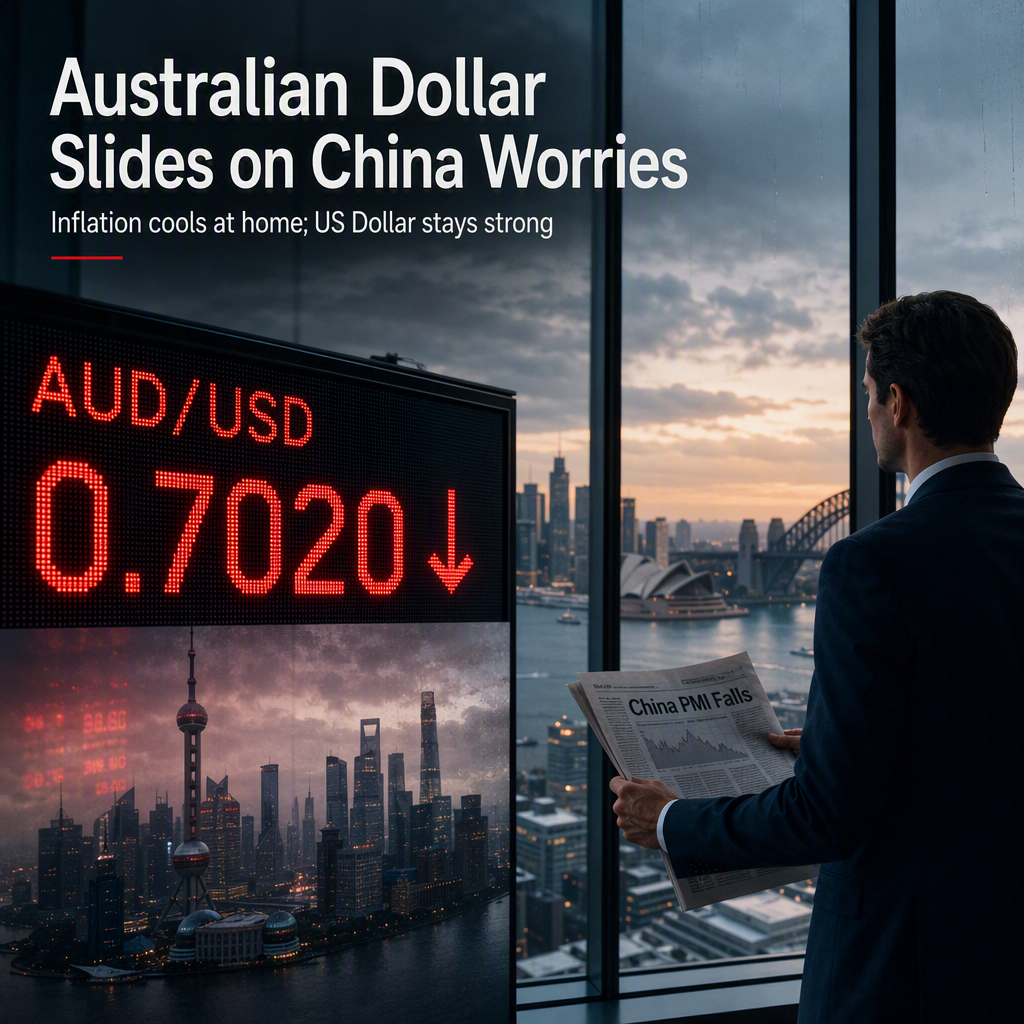
The Australian Dollar (AUD) edged lower against the US Dollar (USD), trading around 0.7020 during Asian hours on Friday, following the release of disappointing Chinese economic data [1]. China’s NBS Manufacturing Purchasing Managers' Index (PMI) dropped into contraction territory at 49.2 in July, down from 50.3 previously and below market estimates of 50.0. The Non-Manufacturing PMI also declined to 49.0, missing expectations of 50.0, highlighting persistent weakness in China, which is Australia’s largest trading partner [1].
In Australia, inflation data showed further cooling, with annual inflation moderating from +4.0% to +3.8% year-over-year. Analysts at Deutsche Bank noted that this incremental slowdown in headline inflation reinforces the perception that underlying price momentum is gradually cooling. This has tempered expectations for additional near-term tightening by the Reserve Bank of Australia (RBA) and contributed to a softer tone in the Aussie Dollar [1].
Meanwhile, the US Dollar remained firm despite an easing of global risk aversion, as positive diplomatic developments were reported. Negotiations between the US and Iran showed progress toward restoring stability in the Strait of Hormuz, and US President Donald Trump announced a historic agreement aimed at the disarmament of Hamas and the withdrawal of Israeli forces from Gaza, reportedly confirmed by senior Hamas officials [1].
On the monetary policy front, the US Federal Reserve left interest rates unchanged for a fifth consecutive meeting, with a 9-3 vote revealing a lively debate within the FOMC about the appropriate policy path going forward, according to strategists at HSBC [1].
CONCLUSION
The Australian Dollar weakened as disappointing Chinese PMI data and easing domestic inflation reduced expectations for further RBA tightening. While global risk sentiment improved on positive geopolitical developments, the US Dollar remained resilient and the Federal Reserve maintained its policy stance. Market participants are likely to remain cautious amid ongoing uncertainty in China and divergent central bank outlooks.