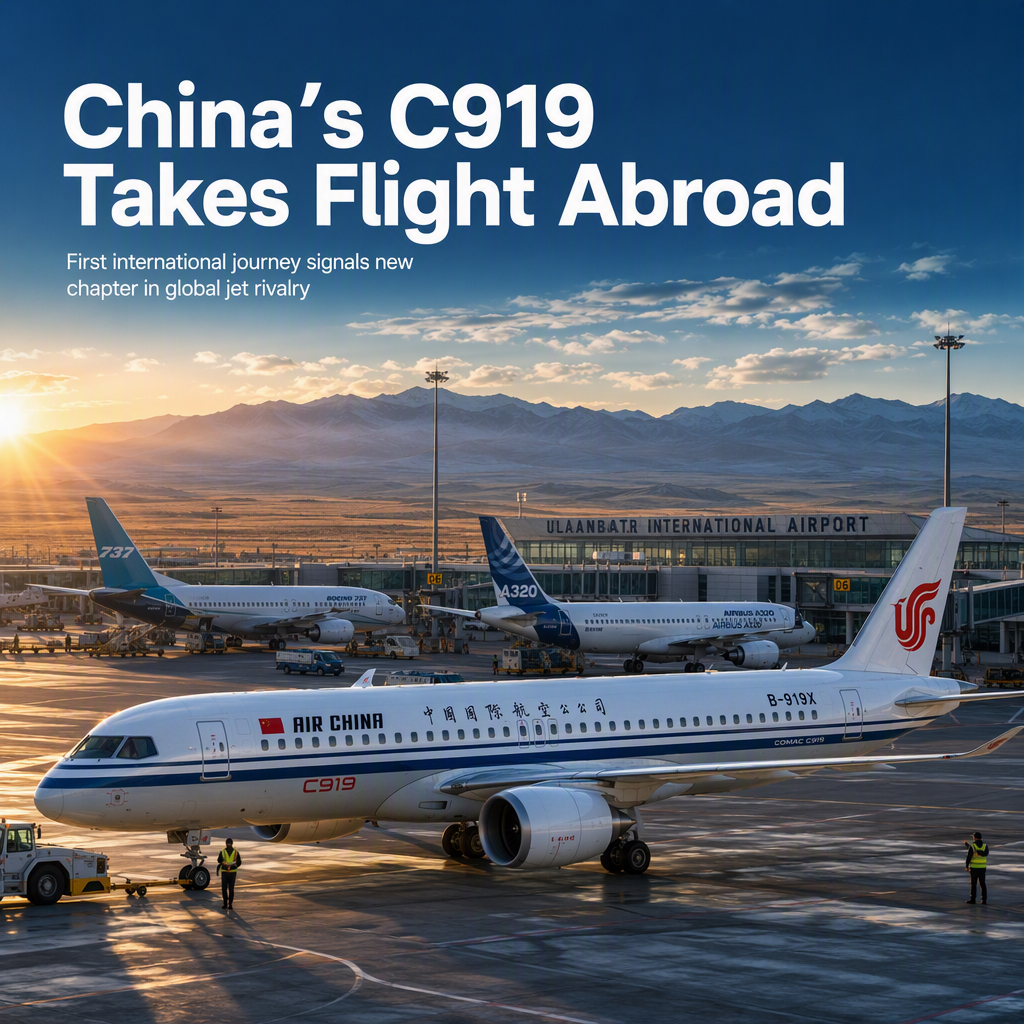
China's domestically developed C919 passenger jet, produced by the state-owned Commercial Aircraft Corporation of China (COMAC), completed its first scheduled international commercial flight on Wednesday. Operated by Air China, the C919 departed from Beijing Capital International Airport and landed in Ulaanbaatar, Mongolia, marking the first time the narrow-body aircraft has operated beyond Chinese territory. The new Beijing-Ulaanbaatar service is set to operate daily, according to Air China [1].
The C919, which can carry up to 174 passengers, is designed to compete in the same market segment as Boeing's 737 MAX and Airbus's A320neo. Despite this milestone, the aircraft remains reliant on foreign components and has not yet received certification from major U.S. or European aviation regulators, which restricts its ability to secure customers in many overseas markets [1].
COMAC has showcased the C919 and its smaller C909 model at international events, including their debut at the Dubai Airshow in November 2025, signaling the company's intent to deepen ties with the global aviation industry. However, China's domestic airlines continue to depend heavily on Boeing and Airbus aircraft. In May, China confirmed an order for 200 Boeing planes, along with engines and spare parts, highlighting the ongoing reliance on U.S.-made jets even as Beijing supports COMAC's growth [1].
While COMAC has accumulated a substantial order backlog, mainly from Chinese airlines and leasing companies, it delivered only 15 C919 aircraft last year—well below its target of 75, according to Air Data News. Production ramped up towards the end of the year, but output remains far behind that of Airbus and Boeing. Aviation analyst Rob Morris noted that COMAC's development and production pace is too slow to pose a genuine competitive threat in the near term, citing the need for greater airline and passenger acceptance and robust in-service support [1].
CONCLUSION
The C919's first international flight marks a significant step for China's ambitions in the global aviation market, but challenges remain due to slow production, regulatory hurdles, and continued reliance on foreign components. While COMAC is making progress, it will take time before it can meaningfully challenge the dominance of Boeing and Airbus.