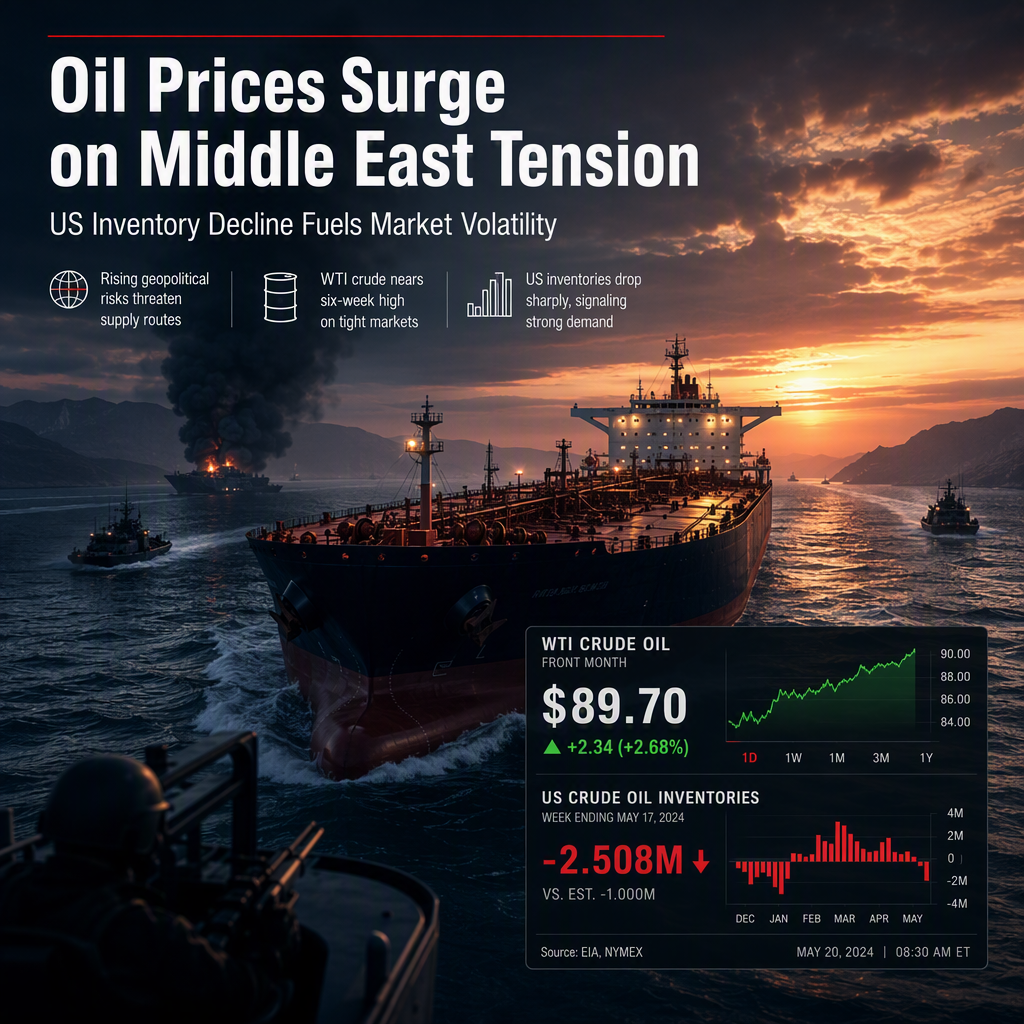
West Texas Intermediate (WTI) Oil experienced significant volatility on Wednesday, fluctuating near a six-week high as geopolitical tensions in the Middle East heightened market uncertainty and sustained a risk premium in energy prices. At the time of reporting, WTI was trading around $89.70 per barrel, after reaching an intraday peak of $90.78, its highest since July 24 [1]. The volatility was fueled by reports from Iran’s Islamic Revolutionary Guard Corps (IRGC) that two oil tankers struck naval mines while transiting a waterway, resulting in the vessels being disabled and their crews forced to disembark after allegedly ignoring warnings about an 'illegal route' [1].
Oil prices also found support from a larger-than-expected decline in US crude inventories. The Energy Information Administration (EIA) reported a drawdown of 4.45 million barrels last week, significantly exceeding expectations for a 1.1-million-barrel decrease and reversing the prior week’s modest increase of 95,000 barrels [1].
Strategists at Brown Brothers Harriman noted that further upside in oil prices may be limited as Persian Gulf oil exports recover. They referenced Goldman Sachs estimates indicating that oil flows from the region have returned to roughly two-thirds of their pre-war level of 20 million barrels per day. This assessment aligns with the US Energy Secretary’s statement that, on average, 8 million barrels a day are passing through the Strait of Hormuz, with another 4 to 5 million barrels bypassing it via pipelines, suggesting that supply disruptions are easing despite ongoing geopolitical risks [1].
Looking ahead, traders are focused on the upcoming OPEC+ meeting scheduled for Sunday. According to Reuters, citing three sources familiar with the matter, the alliance is likely to maintain its current oil production policy for October [1]. Technical analysis shows WTI holding above key moving averages, with resistance in the $90-$92 range and initial support at the 100-day SMA around $85. A break above $92 could target $95 and potentially $100, while a drop below $85 would expose further downside levels [1].
CONCLUSION
WTI Oil prices are being driven by heightened Middle East tensions and a sharper-than-expected US inventory draw, but the recovery in Persian Gulf exports may cap further gains. Market participants are closely watching the upcoming OPEC+ meeting, with expectations for production policy to remain unchanged. Overall, while volatility persists, the outlook for significant price moves appears limited barring new supply disruptions.