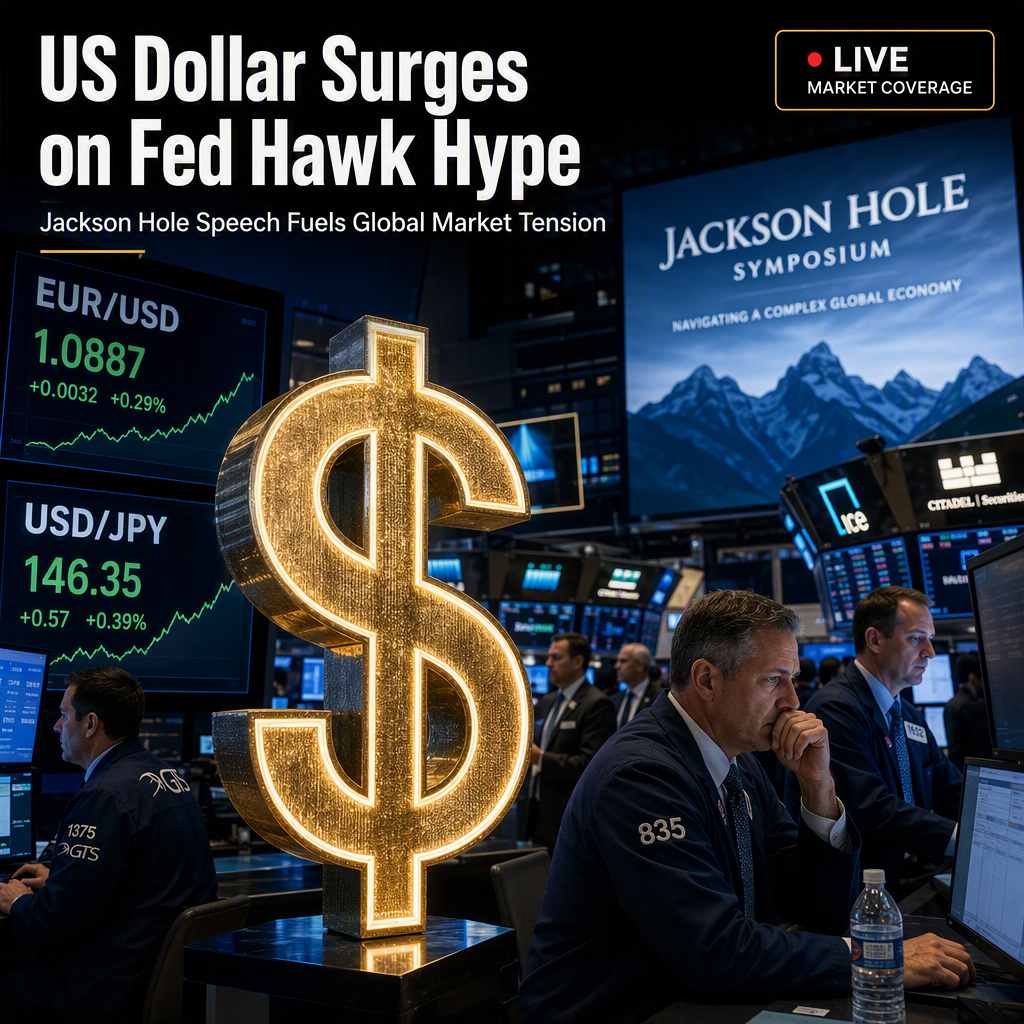
The US Dollar (USD) gained ground against both the Euro (EUR) and the Japanese Yen (JPY) on Friday, as investors adopted a cautious stance ahead of a highly anticipated speech by Federal Reserve (Fed) Chair Kevin Warsh at the Jackson Hole Symposium [1][2]. The EUR/USD pair traded around 1.1645, posting a modest 0.07% decline, while USD/JPY rose 0.14% to approximately 159.60, marking its fifth consecutive day of gains [1][2].
The market's focus has shifted to the Fed after several US central bank officials signaled a more hawkish stance. Cleveland Fed President Beth Hammack stated that it is time for the central bank to raise interest rates, warning that delaying action could cause more pain later. Hammack also projected that inflation could end the year at around 3%, which remains above the Fed’s 2% target, and argued that financial conditions are not particularly restrictive [1][2]. Kansas City Fed President Jeffrey Schmid echoed these concerns, highlighting persistent inflationary pressures and the need for continued efforts to bring inflation under control [1][2].
In the Eurozone, the EUR/USD pair remains under pressure, with technical analysis showing the pair trading below key moving averages and resistance levels. The Relative Strength Index (RSI) near 44 suggests a neutral-to-soft bias, with sellers retaining the upper hand. Immediate resistance is seen at 1.1655 and 1.1658, while support lies at 1.1614. A break below this level could reinforce the bearish tone for the Euro [1].
Meanwhile, the Japanese Yen failed to find support from domestic data, despite Tokyo's core inflation accelerating to 1.8% year-on-year in August, beating expectations, and the unemployment rate falling to 2.4%, its lowest in 12 months [2]. Bank of Japan (BoJ) Deputy Governor Ryozo Himino warned about persistent inflationary pressures and advocated for timely interest rate hikes. Economists at Societe Generale noted that underlying price pressures remain, with further price revisions expected toward year-end, supporting the BoJ’s hawkish path. However, the resumption of electricity and gas subsidies has temporarily weighed on headline inflation [2].
Despite these supportive Japanese data points, the Yen continued to weaken as market participants prioritized the outlook for US monetary policy. The firmer US Dollar, underpinned by hawkish Fed commentary and anticipation of Warsh's speech, outweighed the impact of Japanese inflation and employment figures [2].
CONCLUSION
The US Dollar's strength is being driven by hawkish signals from Fed officials and anticipation of Chair Warsh's Jackson Hole speech, overshadowing supportive economic data from both the Eurozone and Japan. Both the Euro and Yen remain under pressure as markets await further clarity on US monetary policy direction. The prevailing sentiment suggests continued USD dominance unless the Fed signals a more cautious approach.