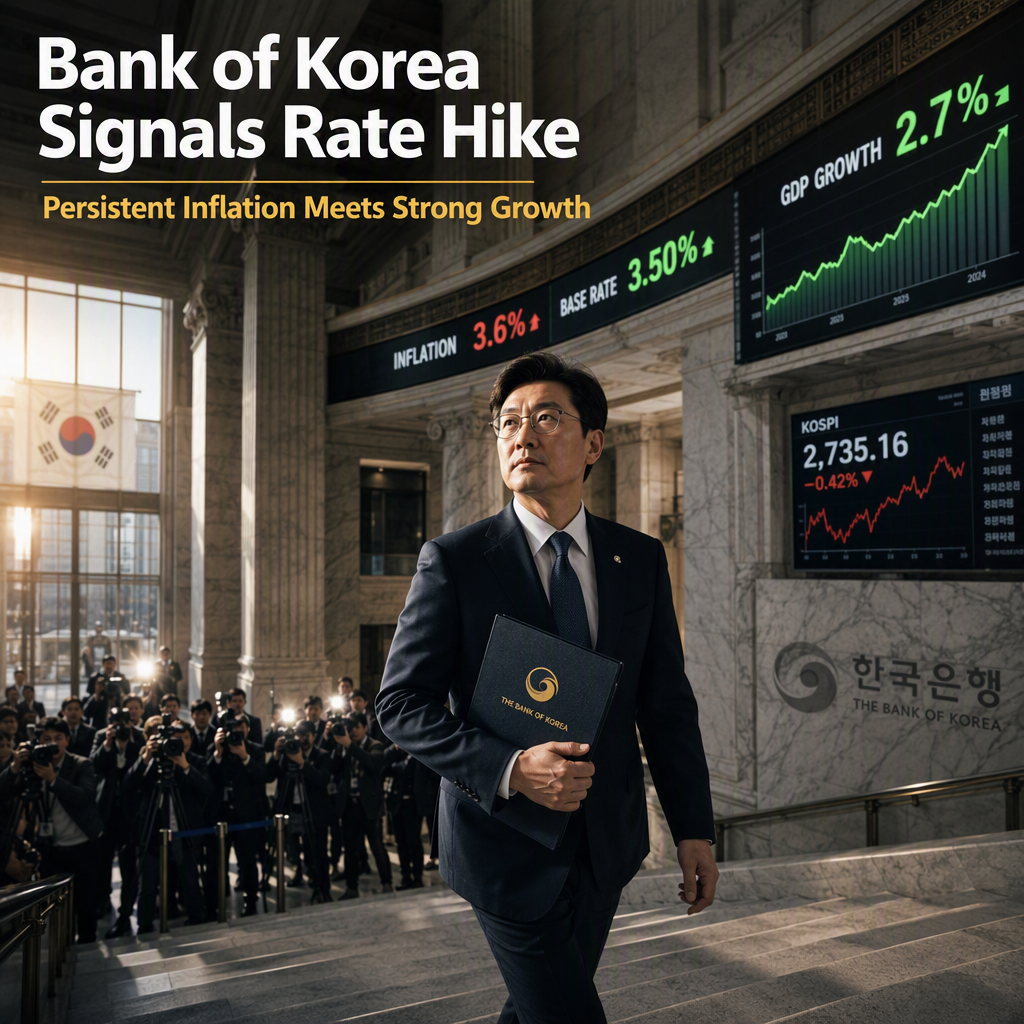
DBS economists Taimur Baig and Radhika Rao anticipate that the Bank of Korea (BoK) will increase its base rate by 25 basis points to 3.00% at the upcoming August meeting, citing stronger-than-expected first-half GDP growth, persistent core inflation, and rising housing prices as key drivers for this move [1]. The economists expect the BoK to upgrade its annual macroeconomic forecasts, with potential for the 2026 GDP growth forecast to be revised up to around 3.5% from the current 2.6%, reflecting the robust 3.8% year-on-year growth recorded in the first half of the year [1].
Inflation remains a central concern, as the July headline Consumer Price Index (CPI) moderated slightly to 2.8% year-on-year from 3.2% in June, but core CPI edged up to 2.6% from 2.5%, and housing prices increased to 2.7% from 2.6% [1]. DBS notes that these developments suggest inflation could remain above the BoK's 2% target for an extended period, warranting a cautious policy stance [1].
Despite these inflationary pressures, the economists acknowledge that a 'hawkish hold'—where the BoK keeps rates unchanged but signals the possibility of a future hike—cannot be ruled out. This is due to recent tightening in financial market conditions, driven by strong appreciation of the South Korean Won (KRW) and heightened volatility in the KOSPI index [1]. In this scenario, the BoK could opt to maintain rates at the current meeting while indicating a potential rate increase at the October meeting [1].
CONCLUSION
DBS expects the Bank of Korea to raise rates in August, driven by strong economic growth and persistent inflation, but notes that recent market volatility and KRW strength could prompt a more cautious approach. The central bank's decision will likely hinge on balancing inflation risks with tightening financial conditions.