
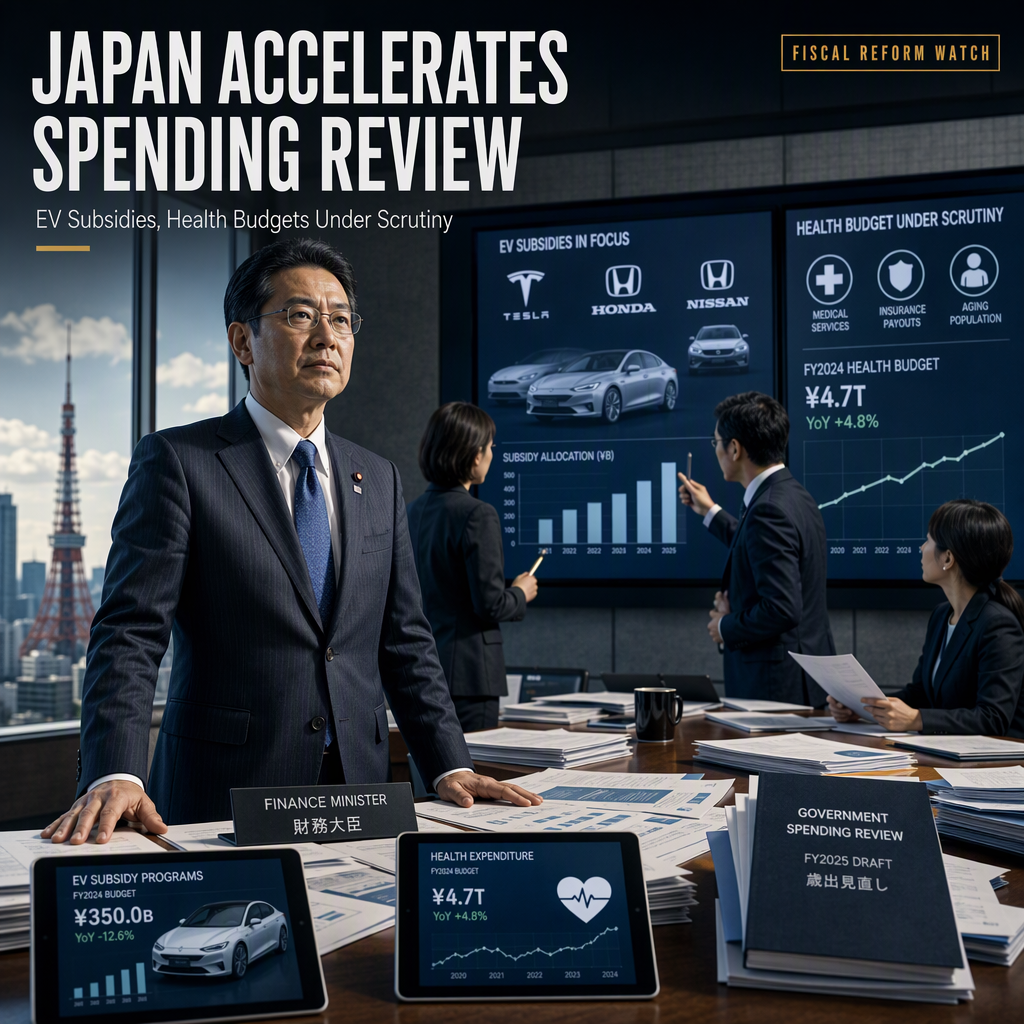
Japan's government is set to accelerate its initiative to review and streamline public spending, with a particular focus on subsidies for electric vehicles (EVs) and health check expenditures, according to Finance Minister Satsuki Katayama [1]. The initiative, modeled after the Trump administration's Department of Government Efficiency (DOGE), aims to identify and eliminate redundant or inefficient government programs [1]. Katayama stated during a high-level policy meeting that previous efforts under the DOGE framework have only achieved modest savings, with a recent review resulting in $110 million in reductions [1].
The review is expected to scrutinize the effectiveness and necessity of various government programs, including EV subsidy schemes. These subsidies have reportedly benefited foreign automakers such as Tesla more than domestic companies like Honda and Nissan, raising questions about their alignment with national interests [1]. Katayama emphasized the need for more aggressive action to achieve meaningful fiscal reform and indicated that the government will "step up" its review process [1].
Further details on which specific programs may face cuts or restructuring are expected as the review progresses. The government has signaled its intention to use evidence-based policy approaches, relying on data and analysis to guide spending decisions [1].
While no immediate market reaction was reported, the potential reassessment of EV subsidies could have implications for both foreign and domestic automakers operating in Japan [1].
CONCLUSION
Japan's government is intensifying its review of public spending, with EV subsidies and health expenditures under particular scrutiny. The outcome of this review could impact automakers and other stakeholders as the government seeks to achieve more substantial fiscal reform.