
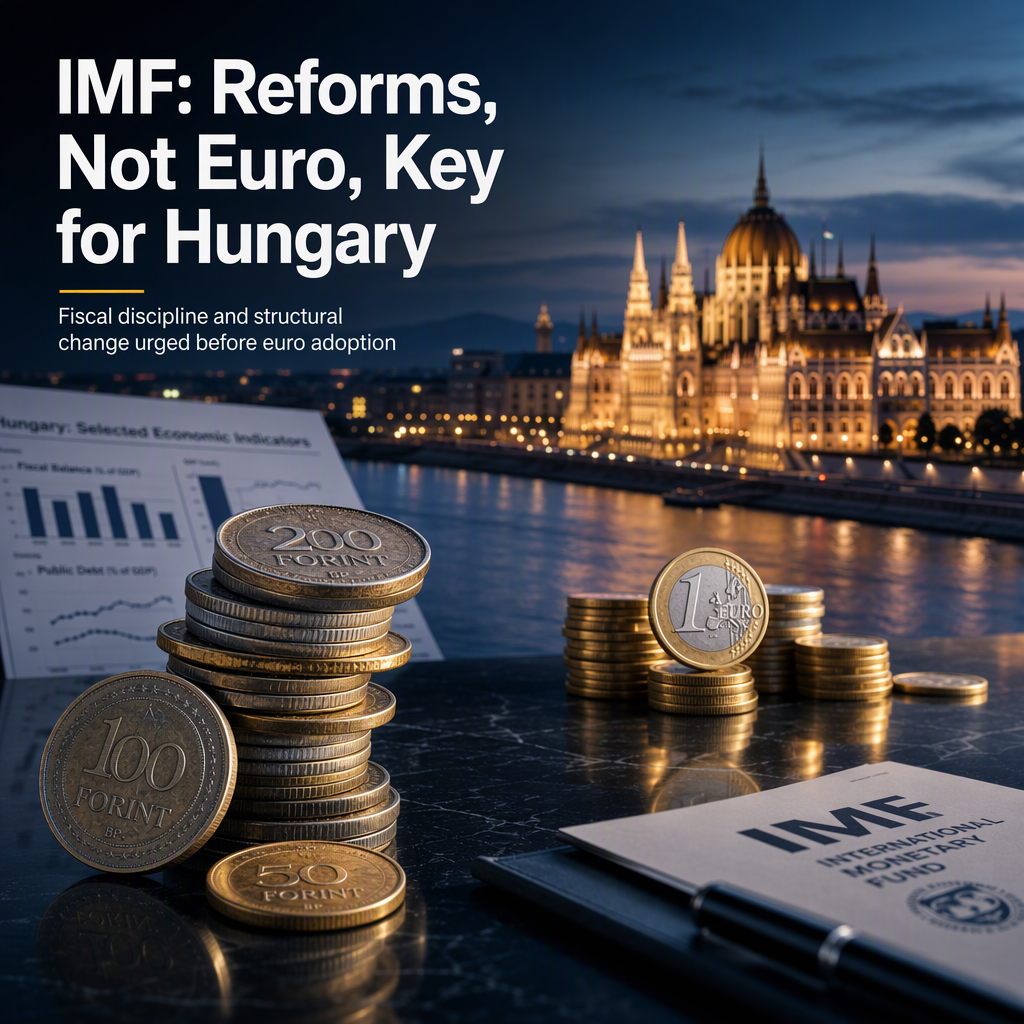
The International Monetary Fund (IMF) has released its Article IV assessment on Hungary, emphasizing that the country must undertake significant fiscal and structural reforms before considering a timetable for euro adoption, according to Commerzbank’s Tatha Ghose [1]. The IMF estimates Hungary’s fiscal deficit at 7-7.5% of GDP for the current year, warning that without policy changes, the deficit will remain above the Maastricht threshold in the medium term and public debt will continue to rise [1].
The IMF recommends credible, growth-friendly, and front-loaded fiscal consolidation, which should include reducing subsidies and administrative spending alongside tax reform [1]. The assessment also highlights the importance of monetary policy, welcoming the National Bank of Hungary’s (MNB) decision to pause interest rate cuts and noting that the new 2.5% inflation target, set for January 2028, will require a more hawkish monetary stance [1].
Ghose underscores that euro adoption should be viewed as a medium-term prospect and not as an immediate solution to Hungary’s economic or foreign exchange challenges. The IMF asserts that the euro can serve as an anchor for reform but cannot replace the need for substantive reforms themselves [1]. Month-on-month inflation is reported to be sharply accelerating, further supporting the need for a combined approach of fiscal, structural, and hawkish monetary policies to sustainably strengthen the Hungarian Forint (HUF) [1].
No specific market reactions or analyst forecasts beyond these recommendations are mentioned in the source article.
CONCLUSION
The IMF’s assessment signals that Hungary must focus on fiscal and structural reforms, supported by tighter monetary policy, before considering euro adoption. Without these measures, the Forint is unlikely to see sustainable strength. The euro is positioned as a medium-term goal rather than a near-term fix for Hungary’s economic challenges.