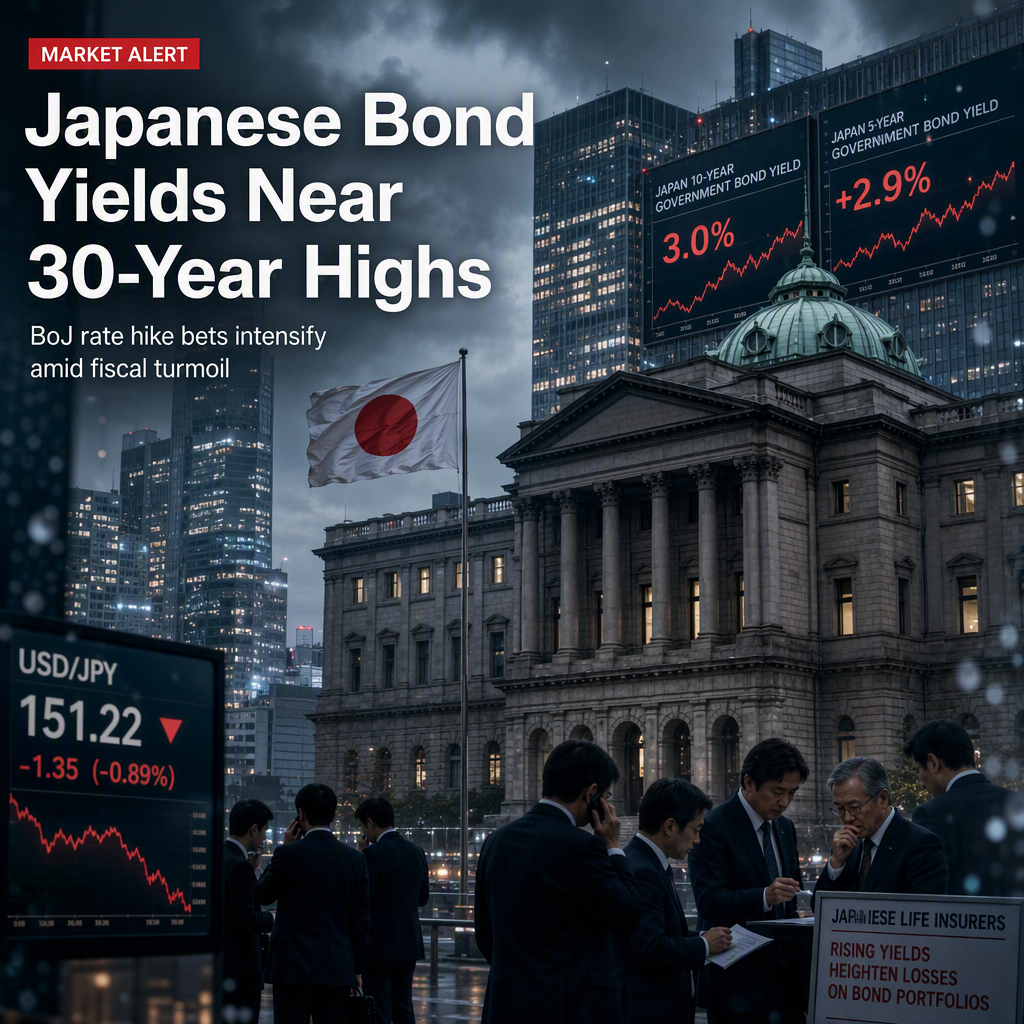
Japanese government bond yields have surged, with the benchmark 10-year yield rising past 2.9% and approaching the 3% mark for the first time in nearly thirty years, driven by uncertainty over the Takaichi administration's fiscal plans and concerns about how these policies will be perceived by US policymakers [1]. The Takaichi administration is preparing its first full fiscal 2027 budget, with markets bracing for potential increases in government spending and deficits, which has heightened volatility in the bond market [1].
This spike in yields is also fueled by speculation that the Bank of Japan (BoJ) may tighten monetary policy sooner than previously anticipated, as traders react to the likelihood of earlier rate hikes [1]. Market participants are closely watching technical resistance at 2.9% for 10-year JGBs, with a break above this level potentially signaling a further move toward 3% [1]. Japanese life insurers are under pressure, facing unrealized bond losses nearing $200 billion as rates climb, raising concerns about the financial sector's stability [1].
Simultaneously, the Japanese Yen has strengthened against the US Dollar, with the USD/JPY pair edging lower to around 159.45 during Asian trading hours, as market expectations for another BoJ rate hike increase [2]. Overnight index swaps are pricing in about an 80% probability of a rate hike as soon as September, according to Reuters [2]. This expectation is supported by recent BoJ policymaker comments and inflation data that remains above the central bank’s 2% target [2]. However, fiscal concerns, particularly Prime Minister Sanae Takaichi’s plan to cut the consumption tax on food to 1% for two years without an identified alternative revenue source, have raised market apprehensions about fiscal discipline and the effectiveness of such measures in combating inflation [2].
Analysts highlight the policy dilemma facing the BoJ: raising rates to support the Yen could further harm Japan’s life insurers, intensifying the trade-off between currency support and financial stability [2]. Technical analysis shows the USD/JPY pair remains capped under the 100-day Simple Moving Average, with resistance at 160.00 and support at 155.40, indicating a bearish near-term bias and fading upside momentum [2].
Market participants are advised to exercise caution amid persistent volatility, closely monitoring resistance at 3% for JGB yields and awaiting signals from both the BoJ and US officials regarding fiscal and monetary policy coordination [1].
CONCLUSION
Japanese bond yields are nearing historic highs as markets react to fiscal uncertainty and rising expectations of a BoJ rate hike. The situation is complicated by fiscal policy concerns and the potential impact on Japan’s life insurers, creating a challenging environment for both the bond and currency markets. Investors are urged to remain cautious as volatility is likely to persist until greater policy clarity emerges.