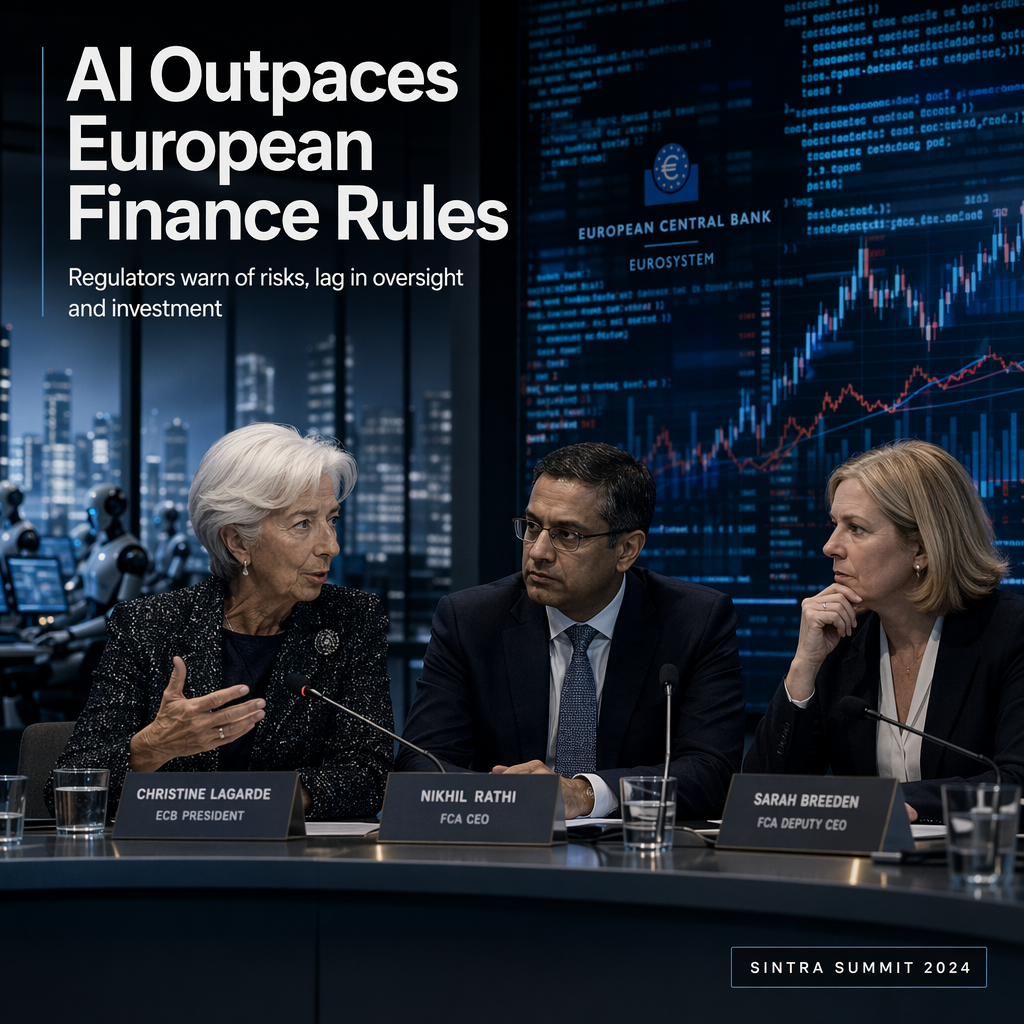
European regulators and central bankers have issued warnings that the rapid development of artificial intelligence (AI) is outpacing the ability of rulemaking to keep up, raising concerns about risks to market integrity and financial stability [1]. Nikhil Rathi, CEO of the U.K.'s Financial Conduct Authority, stated that the traditional cycle of rulemaking 'doesn't work' in the current era of fast-moving technological change, especially as agentic AI development accelerates [1]. Rathi emphasized the need for new approaches and highlighted the efforts of the Financial Stability Board on frontier AI, as well as the establishment of the AI Safety Institute in the U.K., to help policymakers, regulators, and businesses better understand and safely adopt AI technology [1].
Christine Lagarde, president of the European Central Bank, acknowledged AI as a source of productivity gains but also described it as a 'major risk.' She noted that while cybersecurity risks have been discussed for about a decade, the acceleration and deepening of AI models present a much more serious risk due to the speed of development and the lack of adequate defensive measures and funding [1]. Lagarde's comments followed discussions at the ECB's annual meeting in Sintra, Portugal, where AI's impact on productivity and market integrity was a central topic [1].
Sarah Breeden, deputy governor of the Bank of England, warned that agentic AI could amplify volatility during periods of market stress. She noted that, currently, trading firms use autonomous AI mainly for lower-risk operational tasks such as research, but this could change rapidly [1]. Breeden suggested that increased use of agentic AI in financial markets may require greater oversight, including the implementation of guardrails similar to circuit breakers or kill switches to limit or halt trading if faulty AI models trigger a market meltdown [1].
Despite recognizing the productivity benefits of AI, top European bankers and regulators also highlighted that Europe is lagging behind in AI investment and the development of frontier companies driving breakthroughs, partly due to the region's bank-based financial system, which offers fewer financing channels for AI investment compared to the U.S. [1].
CONCLUSION
European financial leaders are sounding the alarm that AI's rapid evolution is outstripping current regulatory frameworks, posing significant risks to market stability and integrity. While AI offers productivity gains, the lack of adequate oversight and investment in Europe could leave the region vulnerable to emerging threats. Policymakers are calling for new approaches and safeguards to address these challenges.