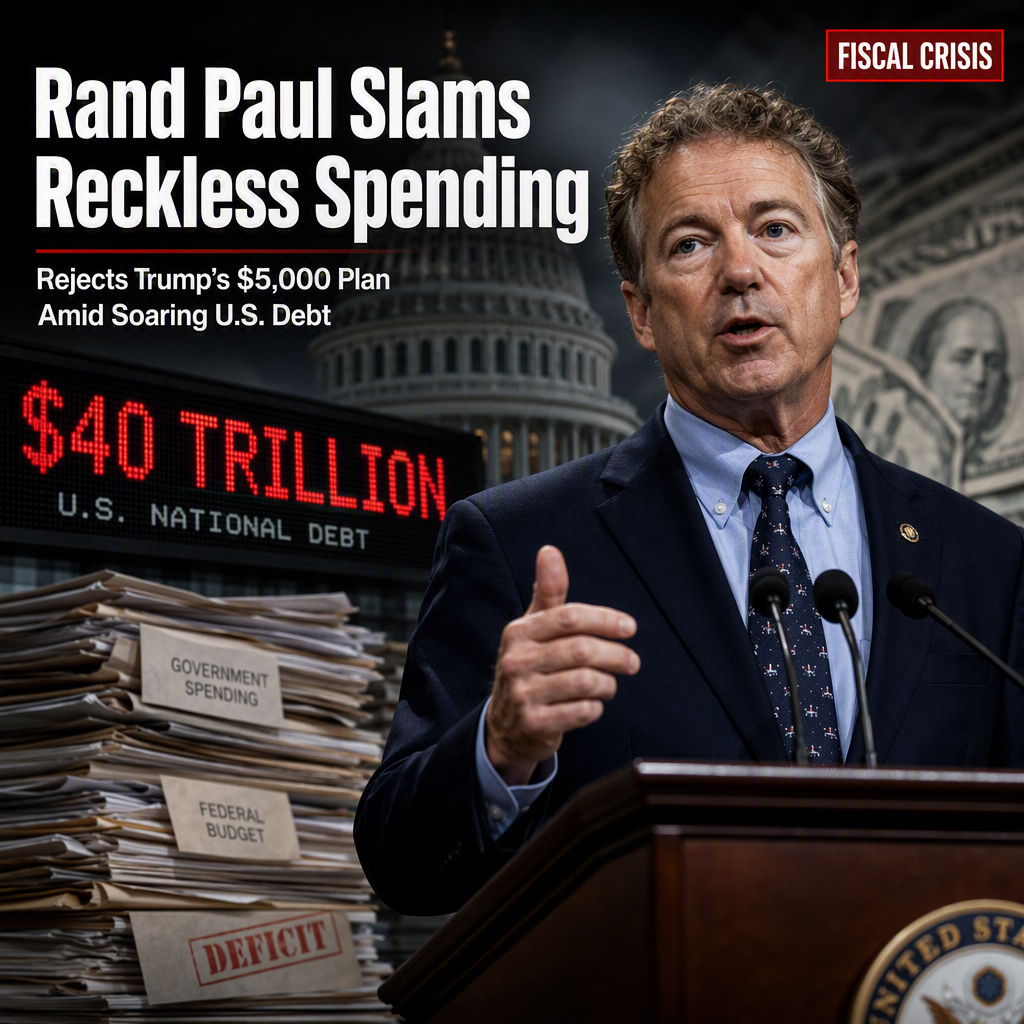
Sen. Rand Paul, R-Ky., a prominent fiscal hawk, has raised alarms over the U.S. national debt surpassing $40 trillion and ongoing massive deficit spending, describing the situation as 'out of control' and attributing blame to both major political parties for failing to address the issue [1]. Paul specifically criticized President Donald Trump’s recent proposal to distribute $5,000 to every American adult if Republicans win both chambers of Congress, labeling the idea as irresponsible given the current deficit [1].
Paul stated, 'We're running $2 trillion dollars short,' and expressed disbelief at the notion of giving out money while the government is operating at a deficit [1]. He warned that the growing debt is not only a future risk but is already 'stealing the value' of Americans’ earnings on a daily basis [1].
To address the fiscal imbalance, Paul outlined his plan to balance the budget through a series of spending cuts over five years. Initially, his 'one-penny plan' called for a 1% annual cut, but due to increased spending during the COVID-19 pandemic, he now advocates for a 'six-penny plan,' requiring 6% annual cuts to balance the budget in five years [1]. Paul clarified that while his proposal would not affect Social Security, it would include Medicare, suggesting that cuts could be achieved without reducing health benefits by targeting waste and fraud and implementing additional means testing [1].
Paul also indicated he is considering another presidential run, stating, 'I'd say we're 50-50,' and emphasized the need for a Republican candidate focused on fiscal responsibility [1].
CONCLUSION
Sen. Rand Paul’s strong opposition to increased federal spending and his rejection of President Trump’s $5,000 ‘dividend’ proposal highlight deep concerns about the sustainability of the U.S. fiscal path. His advocacy for significant spending cuts and budget balancing measures signals potential policy debates ahead, with implications for entitlement programs and overall economic stability.