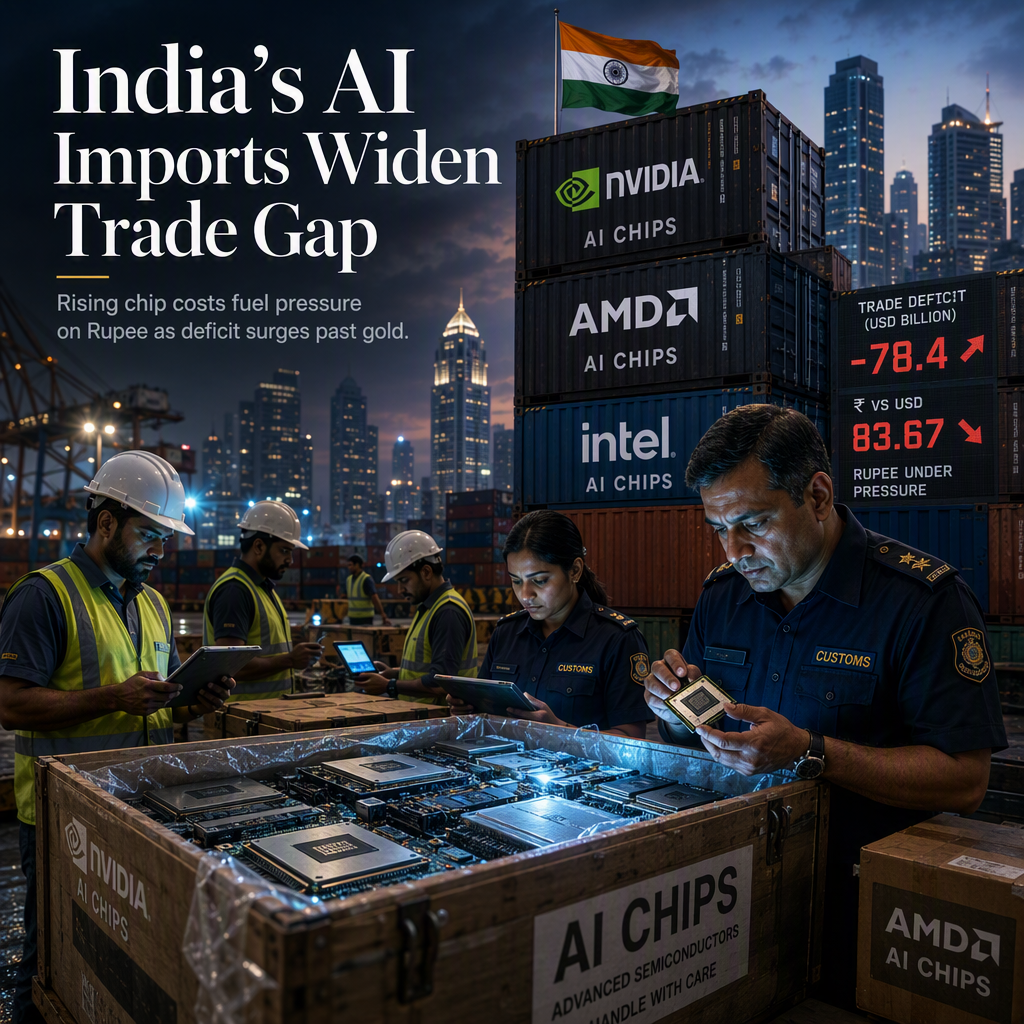
According to Standard Chartered economists Anubhuti Sahay and Saurav Anand, India’s trade deficit in AI-enabling goods has become the second-largest contributor to the country’s overall trade gap, surpassing gold and trailing only oil [1]. The 12-month rolling trade deficit for AI-enabling products—including advanced semiconductors, processors, memory chips, data-processing units (DPUs), and networking hardware—rose to 2.0% of GDP (USD 77 billion) in July 2026, up from 1.5% a year earlier [1].
The economists note that the recent deterioration in the AI-enabling goods trade deficit appears to be driven more by price increases than by higher import volumes [1]. If current trends persist, they project that the AI-linked deficit could widen further to approximately 2.3% of GDP by the end of March 2027, which would add additional pressure on India’s current account deficit and the Indian Rupee (INR) [1].
However, the report also highlights that a recent surge in capital inflows, supported by policy incentives aimed at attracting non-resident deposits, is likely to help stabilize India’s external balance and the INR in the near term [1].
CONCLUSION
India’s growing AI-related imports are significantly widening the trade deficit and putting pressure on the Rupee, with the trend expected to continue into 2027. Nonetheless, increased capital inflows from non-resident deposits may provide short-term support for the currency and external accounts.