
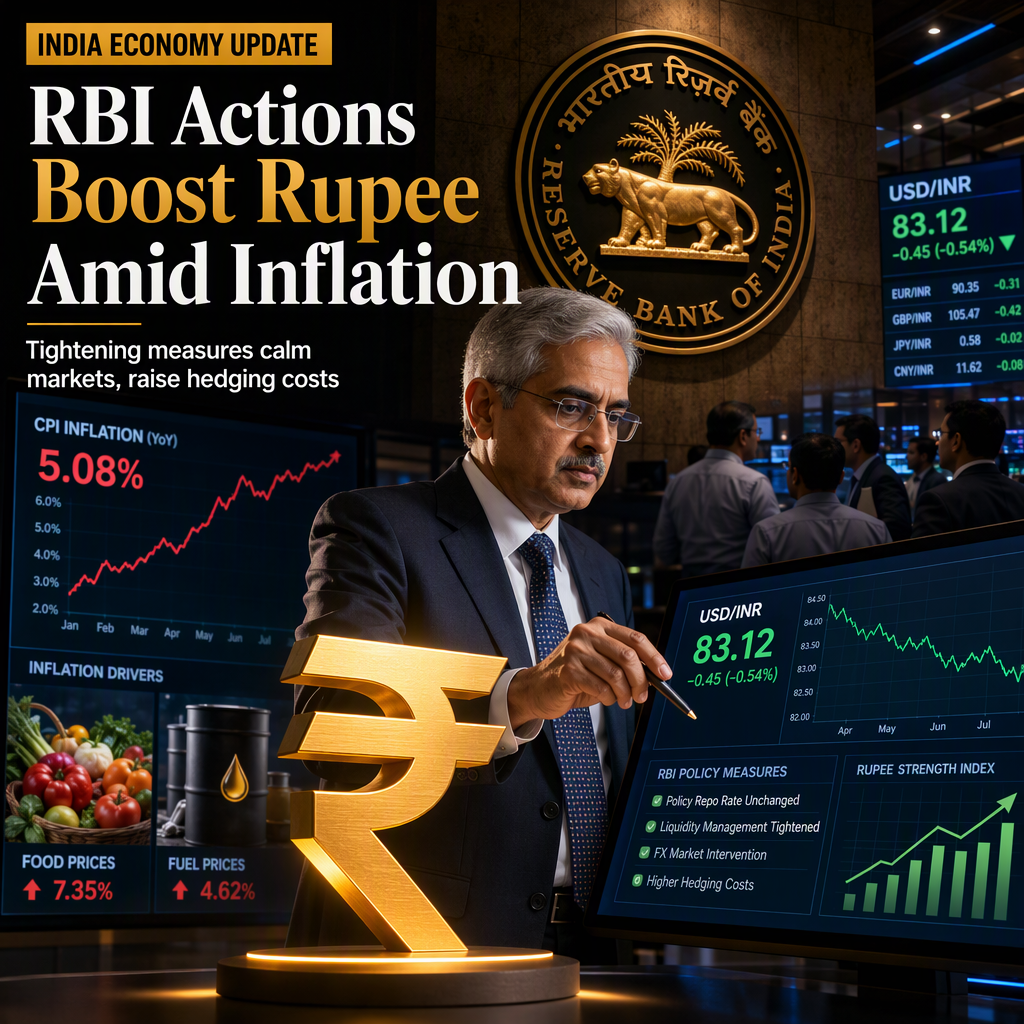
Commerzbank's India section highlights a notable rise in September CPI inflation to 5.5% year-on-year, surpassing August's 4.8% and marking the highest level since December 2024 [1]. This increase, primarily driven by higher food prices, signals broadening price pressures and suggests that headline inflation may breach the Reserve Bank of India's (RBI) 2-6% target range as early as October [1]. The RBI projects inflation to average 6.0% in Q4 2026 and has raised its forecast for fiscal year 2026-2027 to 5.2% from 5.0% previously, citing risks from elevated oil prices, INR weakness, and weaker rainfall due to the El Niño phenomenon [1].
In response to these inflationary pressures, the RBI has implemented several foreign exchange measures to support the Indian Rupee. These include a special USD facility for state-run oil marketing companies, a reduction in the threshold for INR derivatives without an underlying asset to USD5mn from USD100mn, and the introduction of a new Foreign Exchange Risk Reserve (FERR), which requires 20% of the notional value of each FX derivative transaction above USD2mn to be held with the central bank [1]. Following these actions, the USD/INR pair fell nearly 1.0% to 95.78 yesterday [1].
Commerzbank analysts suggest that these RBI measures could support the INR in the near term, potentially easing the USD/INR pair back to the 94–96 range, although the increased hedging costs may impact importers [1]. The RBI has signaled a calibrated tightening bias, leaving the door open for a possible 25bp rate hike to 5.75% at its next meeting on 4 December and another 25bp hike in Q1 2027 [1].
Overall, the combination of rising inflation, proactive RBI measures, and the potential for further monetary tightening is shaping market expectations for the Indian Rupee and inflation trajectory. The market reaction has been positive for the INR, but importers may face higher hedging costs as a result of the new regulations [1].
CONCLUSION
The RBI's recent actions have strengthened the Indian Rupee and signaled a tightening bias amid rising inflation risks. While the INR has appreciated following these measures, importers may encounter higher hedging costs. Market participants are now watching for further rate hikes and inflation developments in the coming months.