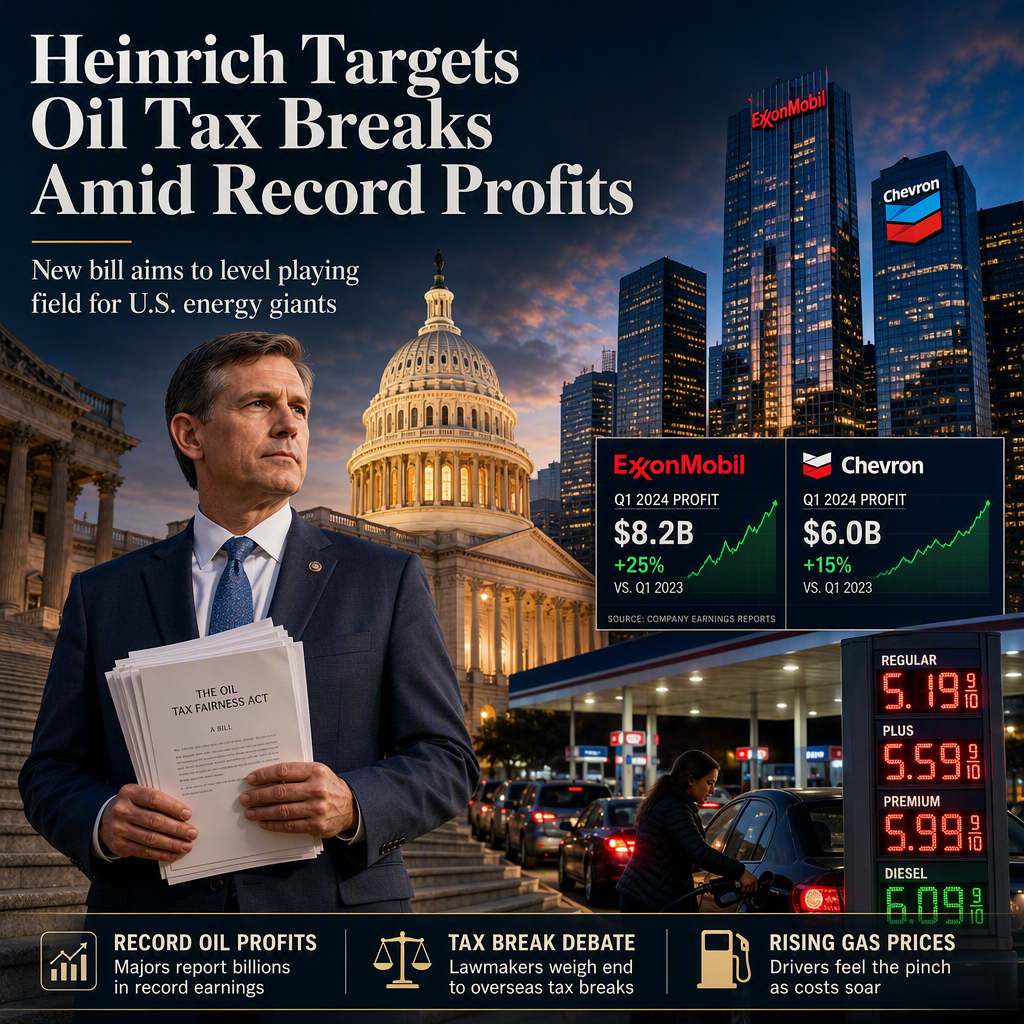
Sen. Martin Heinrich, the top Democrat on the Senate Energy and Natural Resources Committee, is set to introduce a bill aimed at ending tax breaks for U.S. oil and gas companies operating overseas, as the industry reports massive profits driven by the ongoing war with Iran and resulting spikes in oil prices [1]. The bill, shared exclusively with CNBC, seeks to eliminate preferential tax treatment for overseas oil and gas extraction income, aligning the tax code so that overseas fossil fuel profits are treated the same as other foreign business income [1]. It would also close provisions that allow companies to generate additional foreign tax credits from shale oil and tar sands development, and amend foreign tax credit rules to prevent misclassification of payments to foreign governments as taxes rather than royalties, which currently reduces U.S. tax liability for these companies [1].
The legislative move follows President Donald Trump's recent criticism of major U.S. oil and gas producers, including ExxonMobil and Chevron, for making 'too much money' amid the conflict, which has led to higher gasoline prices [1]. Trump warned that these companies would need to 'give some of that back to the public' and lower consumer prices, while also encouraging investment in Venezuela after the ousting of Nicolás Maduro [1].
Financially, the impact of the Iran conflict has been significant for oil majors. Chevron reported a net income of $12 billion for the second quarter, a nearly 400% increase from $2.5 billion in the same period last year, while Exxon posted profits of $14.5 billion, more than doubling from $7.1 billion year-over-year [1]. U.S. gas prices reached $4.06 per gallon on Thursday, according to AAA, fueling voter discontent ahead of the November midterm elections [1].
Heinrich stated that the bill would 'help put American energy development on an even playing field with energy development that's happening in the Middle East or anywhere else,' emphasizing that oil majors can afford to pay their fair share given their current profit levels [1].
CONCLUSION
Sen. Heinrich's proposed legislation targets the removal of overseas tax advantages for U.S. oil and gas companies amid record profits and rising consumer fuel costs. With major oil firms like ExxonMobil and Chevron posting substantial earnings increases, the bill signals potential changes to the industry's tax landscape and could have significant market implications if enacted.