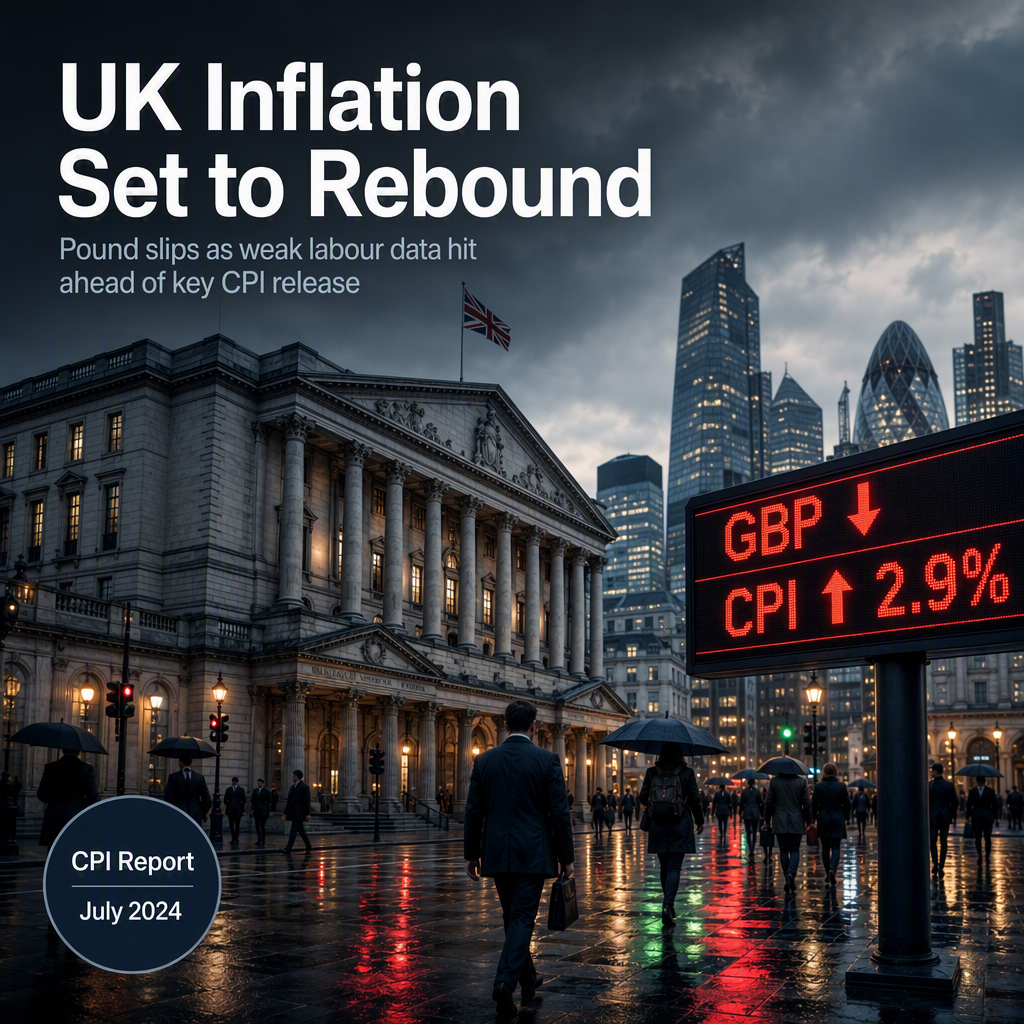
The United Kingdom is poised for a significant economic update as the Office for National Statistics prepares to release the July Consumer Price Index (CPI) report, which is expected to show inflation rebounding to a four-month high, largely due to higher energy bills and a recent surge in oil prices linked to Middle East tensions [1]. Economists anticipate the headline CPI to rise 2.9% year-over-year in July, up from 2.5% in June, surpassing the Bank of England’s (BoE) forecast of 2.8% and moving further away from its 2% target [1]. Core CPI inflation, excluding volatile items, is projected to ease slightly to 2.5% YoY, while service inflation is expected at 3.4% YoY. On a monthly basis, CPI is seen rising by 0.3% after a 0.1% increase in June [1].
TD Securities warns that the inflation outlook may be less benign than recent data suggests, citing risks from rising food prices due to fertilizer costs and adverse weather, as well as potential re-acceleration in airfare inflation and signs of higher core goods inflation amid renewed supply chain pressures [1]. These factors could make it increasingly difficult to sustain disinflation in late 2026 [1].
Meanwhile, the British Pound (GBP) has declined below 1.3550 against the US Dollar (USD), trading around 1.3535 during early Asian hours, following disappointing UK labour data [2]. The UK Unemployment Rate held steady at 4.9% in the three months to June, above the market consensus of 4.8%, while Average Earnings Including Bonus fell to 4.1% from 4.4% in the previous period [2]. Some economists suggest that the slowdown in pay growth could deter the BoE from raising interest rates this year [2]. Money market pricing indicates that City economists expect one BoE rate hike by year-end, potentially lifting the Bank rate from 3.75% to 4.0% [2]. ING’s James Smith notes that ongoing weakness in private sector hiring and wage growth means the bar for a rate hike in 2026 remains high unless there is a severe and prolonged spike in energy prices [2].
Strategists at Scotiabank observe that while Sterling is softer following the labour data, its losses are marginal and in line with core European peers [2]. Technical analysis shows GBP/USD maintains a constructive near-term bias, with the pair holding above key moving averages and the Relative Strength Index (14) at 60.8, suggesting further gains are possible if support levels hold [2].
The upcoming CPI data is seen as critical for gauging whether the recent disinflationary trend in the UK is reversing and if it will be significant enough to prompt the BoE to consider an interest rate hike at its September 17 meeting [1].
CONCLUSION
The UK is bracing for a potential inflation rebound, with July CPI expected to exceed both previous readings and the BoE’s forecast, driven by higher energy costs. At the same time, weak labour data has weighed on the Pound and may temper expectations for imminent BoE rate hikes. The forthcoming CPI release will be pivotal in shaping market expectations and the BoE’s policy trajectory.