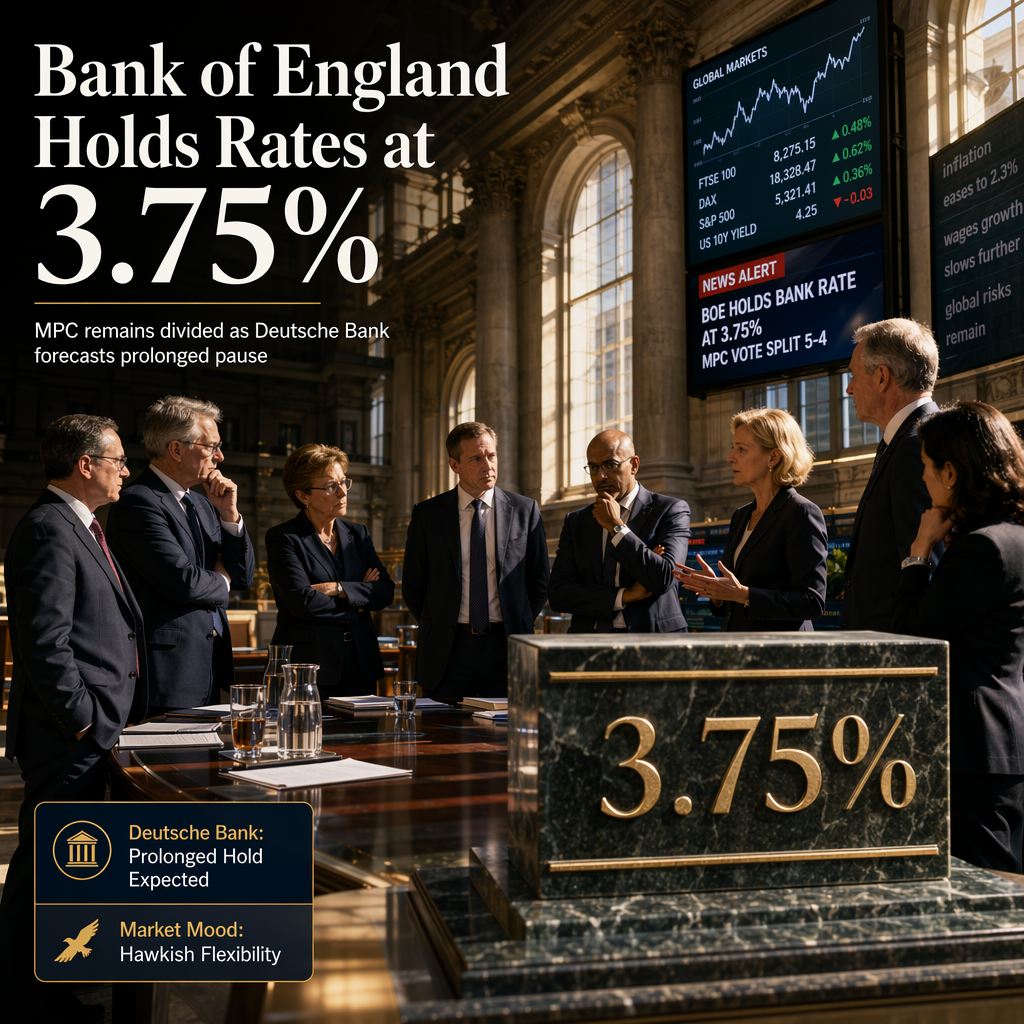
The Bank of England (BoE) decided to keep the Bank Rate unchanged at 3.75%, a move that was widely anticipated by both Deutsche Bank and market participants [1]. According to Deutsche Bank’s Sanjay Raja, while the Monetary Policy Committee (MPC) appeared more divided than in April—with two members, Pill and Greene, voting for a rate hike—there is a growing consensus for maintaining the current rate for an extended period [1].
Raja notes that recent economic data and a deal between Iran and the US have contributed to a reduction in perceived risks of second-round inflation effects. Although the MPC continues to see upside risks to inflation, lower wage and price inflation figures have increased the committee’s confidence that price pressures may be more contained in the near term [1]. The MPC is prepared to tolerate a temporary rise in inflation, expecting it to be a short-term phenomenon [1].
Despite improved data and a significant drop in energy prices over the past week, the MPC maintained a hawkish bias, signaling its readiness to respond if indirect or second-round inflation effects re-emerge [1]. The committee has retained full flexibility heading into the summer, avoiding a dovish tone in its communications [1].
Looking ahead, Deutsche Bank expects the Bank Rate to remain unchanged through 2026, with potential rate cuts next year that could bring the rate down to a more neutral level of 3.25% as inflation risks continue to recede [1]. However, Raja emphasizes that risks are now more balanced, given the improved inflation outlook and geopolitical developments [1].
CONCLUSION
The Bank of England’s decision to hold rates at 3.75% reflects a cautious but steady approach amid easing inflation risks and improved economic data. Market expectations align with Deutsche Bank’s forecast for a prolonged hold, with possible rate cuts next year if inflation continues to moderate. The MPC’s hawkish bias and retained flexibility suggest that policy could shift if new risks emerge.