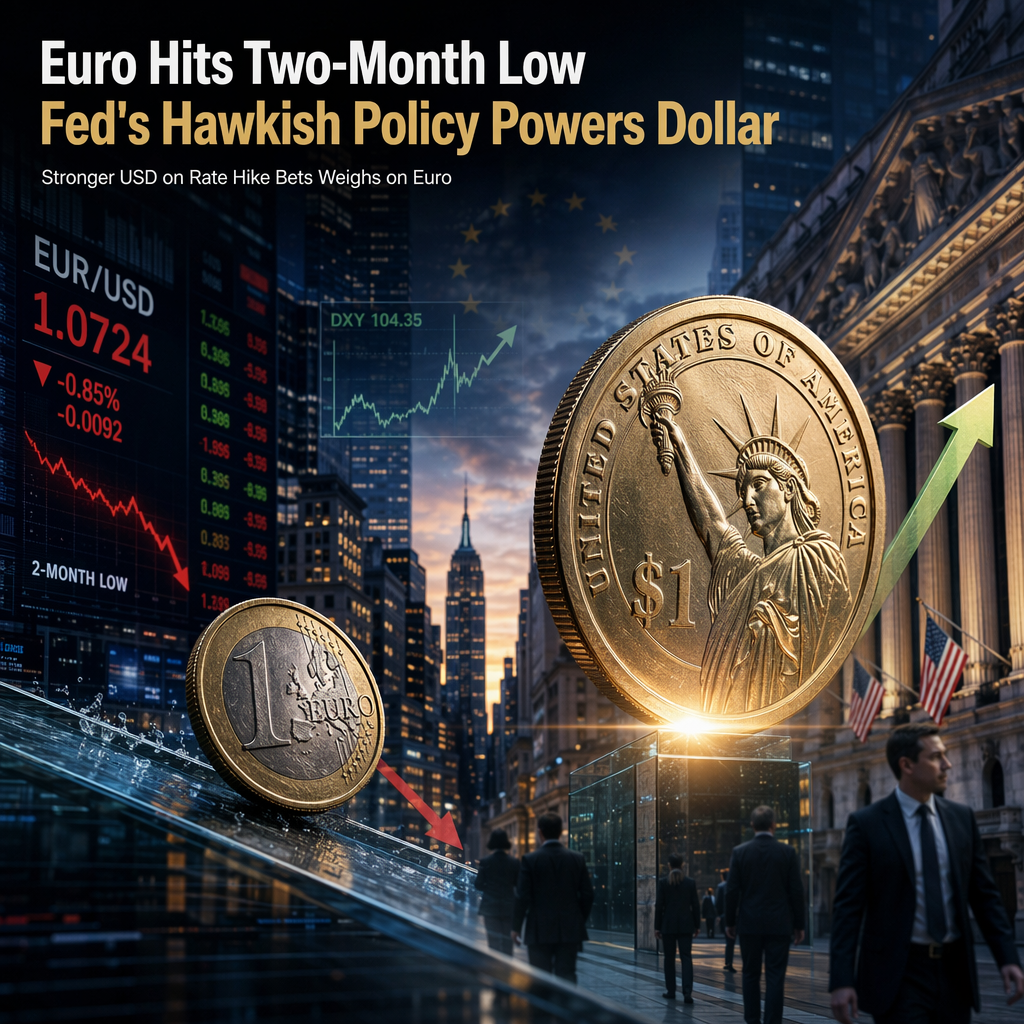
The Euro weakened to a two-month low against the US Dollar, with EUR/USD trading around 1.1470 on Thursday, down 0.22% on the day and extending its decline from above 1.1600 earlier in the week. This drop comes as the US Dollar continues to strengthen, supported by the Federal Reserve's hawkish policy outlook. The Fed kept its benchmark interest rate unchanged within the 3.5%-3.75% range on Wednesday, matching market expectations. However, updated economic projections revealed that about half of the Federal Open Market Committee (FOMC) members anticipate at least one more rate hike before year-end. Fed Chair Kevin Warsh, in his first press conference as head of the central bank, reiterated his commitment to bringing inflation back to the 2% target, emphasizing the resilience of the US labor market and persistent inflation pressures [1].
US economic data released Thursday further reinforced the Fed's stance. Initial Jobless Claims fell to 226,000 for the week ending June 13, down from a revised 230,000 previously, while Continuing Jobless Claims rose to 1.81 million. These figures suggest the labor market remains robust, supporting the Fed's restrictive policy bias. The US Dollar's strength is also being driven by this monetary policy outlook, even as geopolitical tensions have eased following a preliminary agreement between the US and Iran aimed at reducing hostilities in the Middle East. Rabobank noted that while improved geopolitical conditions could lessen demand for safe-haven assets, the Fed's hawkish shift is currently the dominant factor in currency markets [1].
On the European side, economic prospects remain subdued. Germany's IFO Institute confirmed its outlook for weak growth and elevated inflation in Europe's largest economy, projecting inflation to average 2.9% this year and 2.7% in 2027, with economic growth forecast at just 0.8% for both this year and next. These projections have heightened concerns about the region's economic momentum. Meanwhile, European Central Bank (ECB) Chief Economist Philip Lane stated that further rate hikes remain justified even under a milder economic scenario, and that the ECB could look through temporary shocks if they are not expected to have a lasting impact on inflation. Despite these comments, investors appear more concerned about slowing Eurozone growth than the risk of additional monetary tightening [1].
In terms of daily performance, the Euro was the strongest against the Swiss Franc among major currencies, but overall, it declined by 0.30% against the US Dollar [1].
CONCLUSION
The Euro's decline to a two-month low against the US Dollar reflects the market's focus on the Fed's hawkish outlook and robust US economic data, which continue to support the Dollar. Persistent concerns about weak growth and elevated inflation in the Eurozone further weigh on the Euro, despite the ECB's openness to further rate hikes. Market sentiment remains negative for the Euro in the near term.