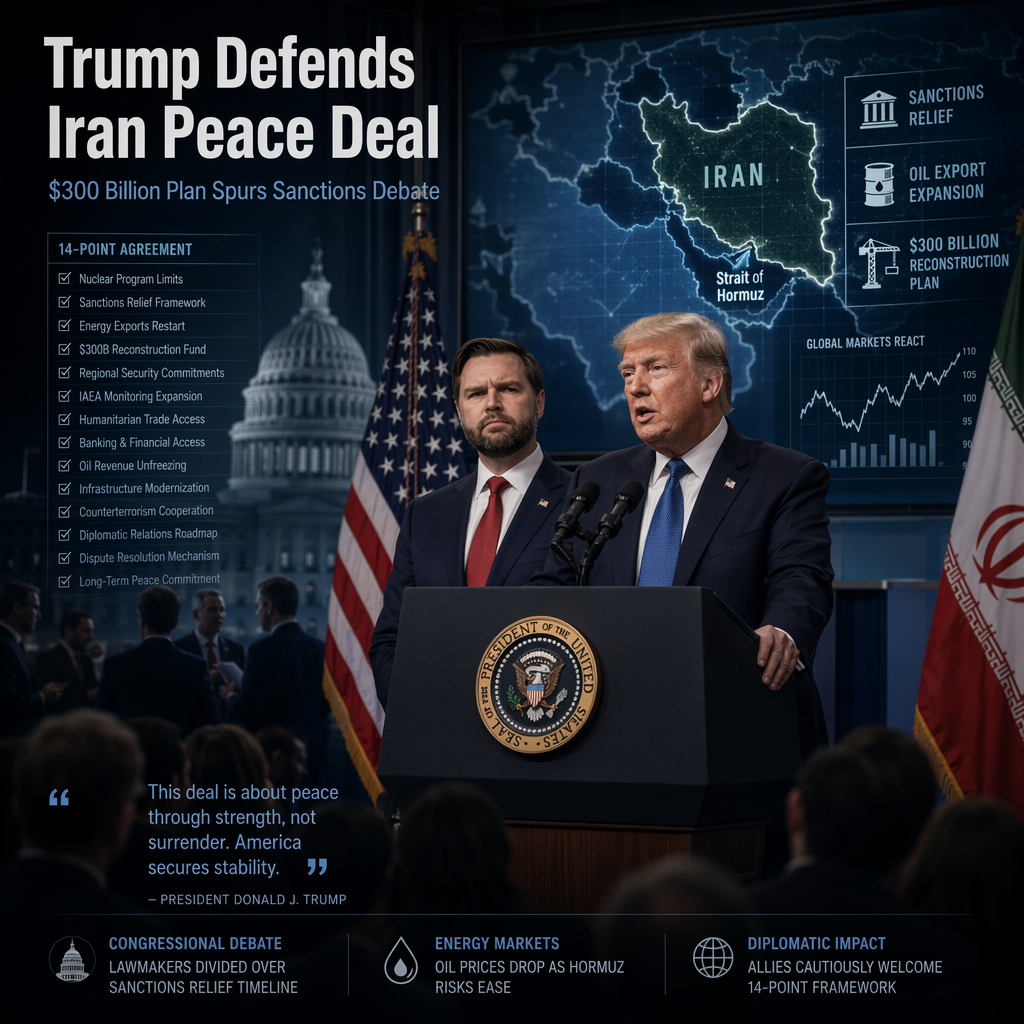
Vice President JD Vance publicly defended President Donald Trump's interim peace deal with Iran, emphasizing that the United States is not directly providing funds to Tehran and that any economic benefits for Iran are contingent upon full compliance with the agreement's terms [1]. The deal, signed by Trump and Iranian President Masoud Pezeshkian, includes a 14-point memorandum of understanding that features sanctions relief, access to frozen funds, and a proposed $300 billion reconstruction plan [1]. Vance stated, 'The United States isn't giving up a cent of money to Iran,' and clarified that the only way Iran would receive resources is through complete adherence to the deal [1].
Vance addressed criticism regarding the lifting of sanctions, arguing that sanctions had become 'fundamentally ineffective' as Iran was already selling oil despite them, and suggested that lifting sanctions could provide the U.S. with greater visibility into Iran's financial transactions [1]. He also asserted that Iran's nuclear program 'has been completely destroyed,' positioning the agreement as a continuation of Trump's pressure campaign rather than a concession [1].
The agreement halts military operations temporarily and reopens the Strait of Hormuz for at least 60 days, creating a window for further negotiations toward a final deal. This 60-day period, which began on Thursday, can be extended if necessary [1]. Vance indicated that the deal could potentially reshape regional dynamics if Iran complies, stating, 'If they do change their behavior, they are going to have a transformative relationship with the Middle East' [1].
Lawmakers have been briefed or will soon receive formal copies of the agreement, with a congressional briefing planned in the near future. Vance expressed confidence that the administration can temporarily lift some sanctions without congressional approval [1]. Despite the administration's assurances, there has been bipartisan concern that the deal risks rewarding Tehran after months of conflict. Senator Mark Warner (D-Va.) criticized the agreement, expressing skepticism about Iran's willingness to relinquish enriched uranium [1].
CONCLUSION
The Trump administration's interim peace deal with Iran introduces significant sanctions relief and a $300 billion reconstruction plan, but ties economic benefits to Iran's compliance. While the White House asserts the deal is not a concession and could reshape regional relations, bipartisan skepticism persists regarding its effectiveness and potential risks.