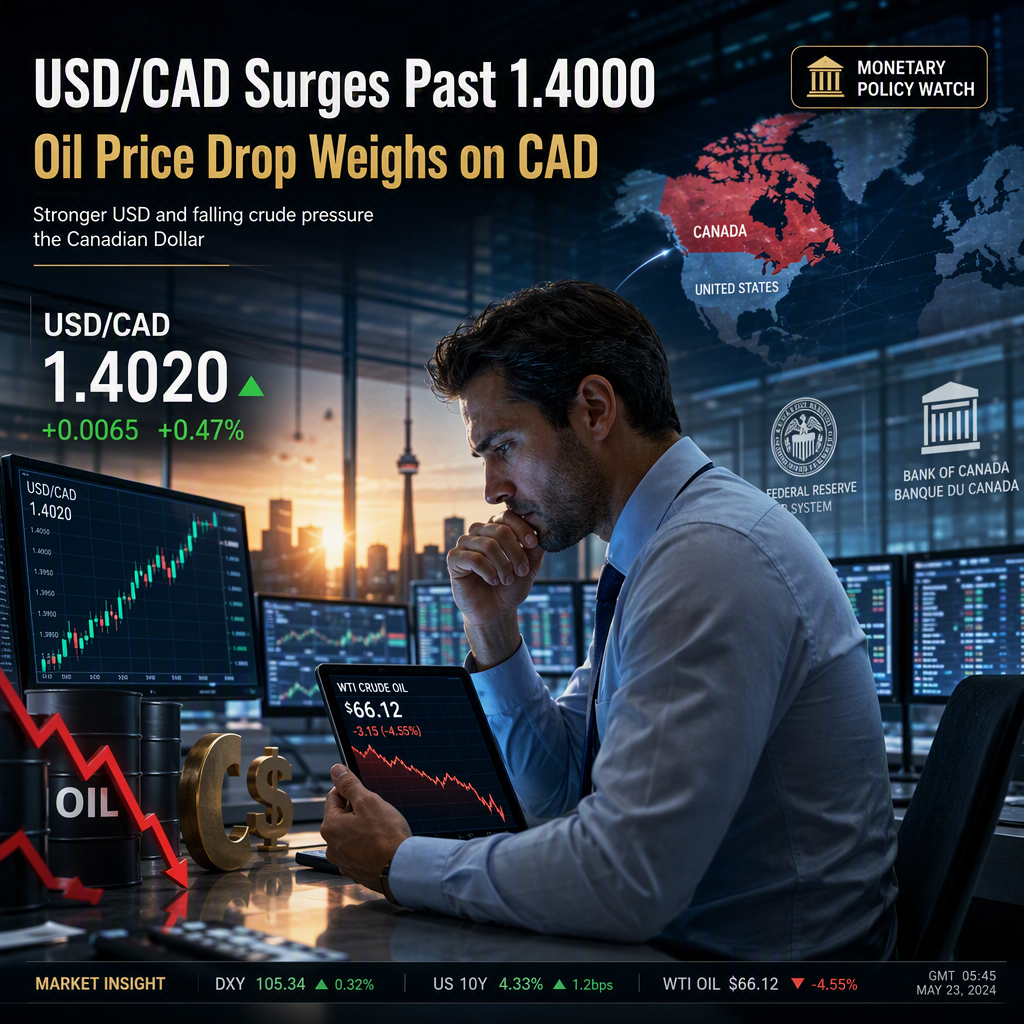
The USD/CAD currency pair strengthened to around 1.4020 during early European trading hours on Monday, surpassing the key psychological level of 1.4000 [1]. This move was attributed to falling crude oil prices, which negatively impacted the commodity-linked Canadian Dollar (CAD), as Canada is a major oil exporter [1]. The decline in oil prices followed market attention on the potential recovery of Saudi Arabian shipments after attacks by Iran-backed Houthis, according to CNBC [1].
Strategists at Scotiabank noted that wider US/Canada front-end spreads are the primary drag on the CAD, with the currency also described as 'somewhat overvalued' relative to their fair value estimate of 1.3910 [1]. They cautioned that a weaker CAD is unhelpful for the Bank of Canada (BoC) as it considers rising inflation risks [1]. The BoC recently kept its key policy rate unchanged at 2.25% during its September meeting, citing increased inflation risks and uncertainty from new tariffs [1]. Market participants see nearly a 60% chance of a rate hike at the BoC's next policy announcement on October 28 [1].
Technical analysis indicates that USD/CAD maintains a bullish near-term bias, trading above the 100-day simple moving average (SMA) and supported by a positive Relative Strength Index (RSI) of 63 [1]. Immediate resistance is identified at the August 4 high of 1.4080, with further resistance at the July 28 high of 1.4129 [1]. On the downside, support levels are at 1.4000, 1.3950 (100-day SMA), and 1.3880 (20-day Bollinger middle band) [1].
Currency heat maps from Monday show that the Canadian Dollar was the weakest among major currencies, with the Australian Dollar being the strongest against it [2]. The US Dollar also outperformed most peers, supported by expectations of further Federal Reserve rate hikes to counter persistent US inflation risks [2]. Minneapolis Fed Bank President Neel Kashkari emphasized that inflation remains a key concern across all sectors of the US economy, not just due to oil prices [2].
Looking ahead, both Federal Reserve Bank of Chicago President Austan Goolsbee and BoC Governor Tiff Macklem are scheduled to speak later on Monday, with Scotiabank suggesting that Macklem may reiterate concerns about intensifying inflation risks and potentially reinforce expectations for tighter BoC policy before year end [1].
CONCLUSION
USD/CAD's rise above 1.4000 reflects pressure on the Canadian Dollar from falling oil prices and widening US-Canada rate spreads. Market participants are closely watching upcoming central bank speeches for further signals on monetary policy, with inflation risks remaining a central theme. The outlook for the CAD remains cautious amid expectations of potential BoC tightening and ongoing US Dollar strength.