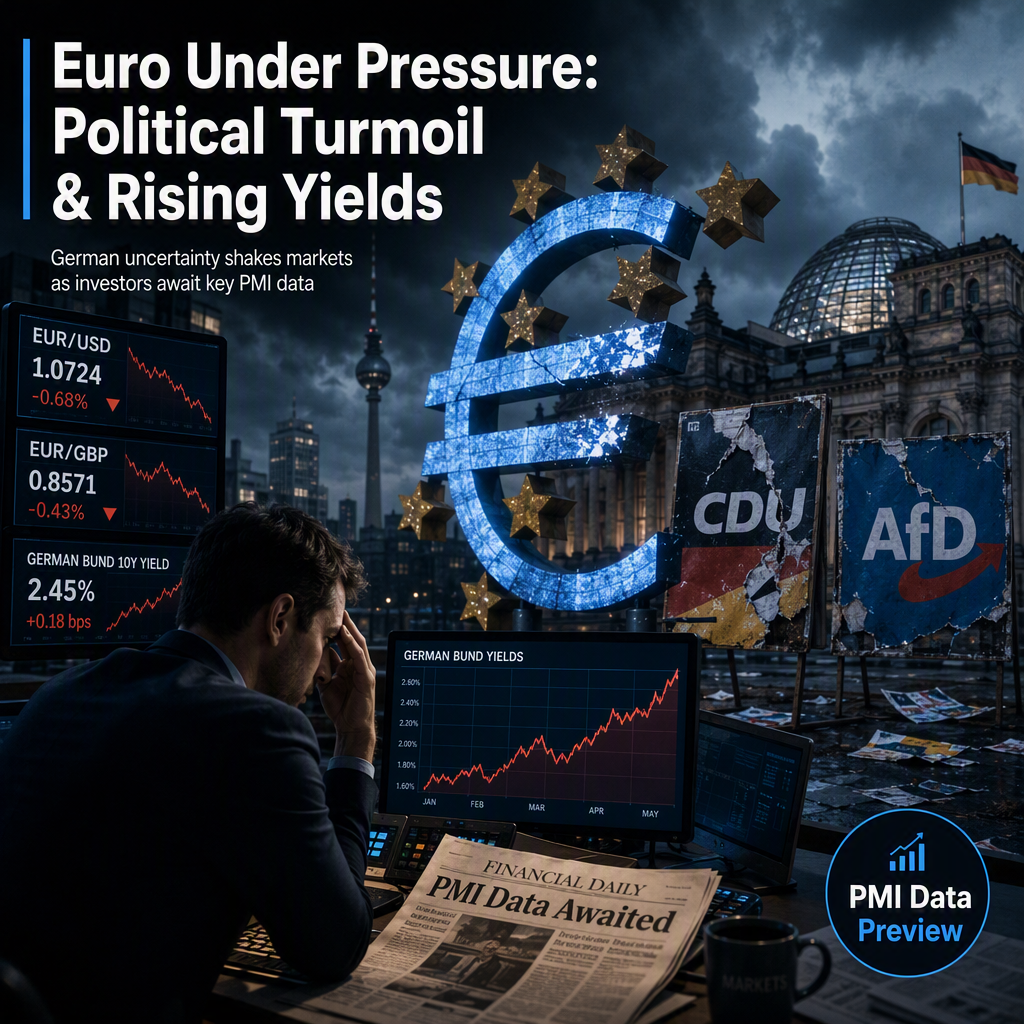
The Euro (EUR) remained under pressure against both the US Dollar (USD) and the British Pound (GBP) following a significant political setback for German Chancellor Friedrich Merz's CDU party in recent regional elections. According to Danske Bank, EUR/USD consolidated below 1.15 on Friday as European yields rose, with the Bund 2Y yield climbing 5-6 basis points to 3.28% and the Bund 10Y yield up 5 basis points to 3.52%, driven by increased French sovereign risk and firmer Eurozone inflation expectations [1]. Meanwhile, EUR/GBP traded just above 0.8570 on Monday, holding losses after a reversal from the 0.8600 area, with the Euro drawing some support from lower oil prices but weighed down by German political uncertainty [2].
The CDU's poor performance in the state elections was described by Merz as a "disaster," with the party falling to 4.9% in Mecklenburg-Vorpommern and 18.8% in Berlin, while the far-right AfD won 38.2% in Mecklenburg-Vorpommern compared to the SPD's 35.5% [1][2]. Merz has vowed to remain in office and continue his reform agenda, but the large victory of the Eurosceptic and pro-Kremlin AfD has heightened investor caution and reinforced a slowly building political-risk-premium narrative for the Euro [1][2].
Eurozone inflation expectations, as measured by the ECB's consumer survey, stabilized in August with the 1-year median expectation at 3.0% year-on-year and the 3-year median at 2.9% year-on-year, ending a previous downward trend. This stabilization is likely to be interpreted as hawkish by the ECB [1]. The ECB recently raised interest rates and hinted at further hikes, while the Bank of England kept rates unchanged but signaled possible future tightening, keeping EUR/GBP trading within a narrow range [2].
Looking ahead, markets are focused on Wednesday's preliminary September Purchasing Managers' Index (PMI) releases for the Eurozone and the UK, which are expected to provide further direction for the Euro. ECB President Christine Lagarde is also scheduled to speak at a roundtable in Frankfurt on Monday [1][2]. Technical analysis indicates that EUR/GBP remains in a choppy, sideways pattern below 0.8600, with immediate support at 0.8572 and resistance at 0.8600 [2].
CONCLUSION
The Euro faces ongoing pressure from German political uncertainty and rising European yields, with investor sentiment cautious following the CDU's electoral losses and the AfD's gains. Key upcoming data, including Eurozone and UK PMIs, as well as ECB communications, are likely to shape the Euro's near-term direction.