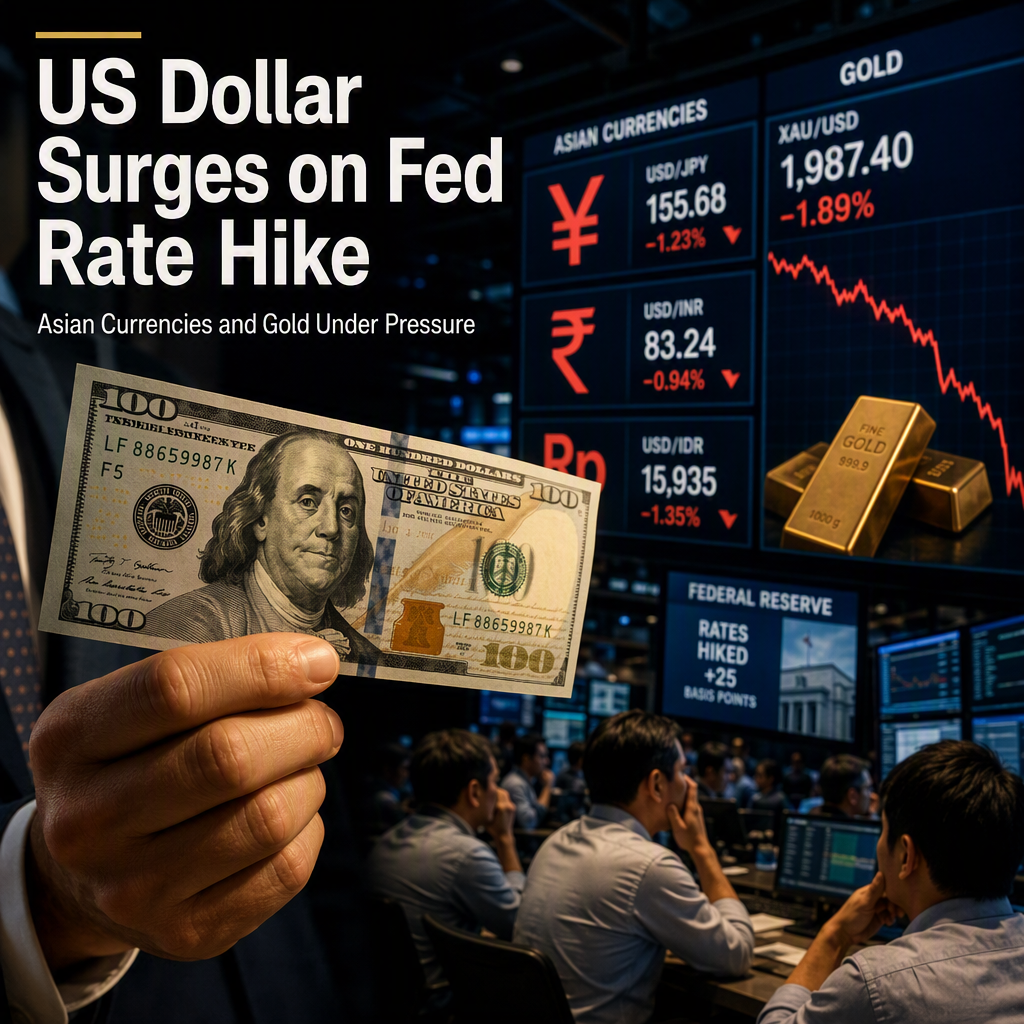
The US Federal Reserve implemented a 25-basis-point interest rate hike last week, marking its first increase in over three years and bringing the policy rate to the 3.75%-4.00% range, as expected [1][2][4]. The Fed's dot plot revealed that 16 of 18 officials anticipate at least one more rate hike this year, with market pricing indicating a 56.5% chance of another hike at the next meeting in October, up from 42.5% a week prior [1][2][4]. Fed Chair Kevin Warsh emphasized that 'inflation is too high and has been for too long,' while other officials, such as Kashkari, highlighted persistent inflationary pressures and a resilient US economy, supporting a more restrictive policy stance [2][4]. Nordea analysts maintain their forecast for two additional hikes, noting upside risks due to robust labor market and inflation data [2].
The hawkish Fed outlook has bolstered the US Dollar against major currencies. The Japanese Yen (JPY) underperformed, with USD/JPY trading 0.1% higher near 157.00 and stabilizing above its 20-day EMA at 156.56 [1]. The Bank of Japan (BoJ) raised its policy rate by 25 basis points to 1.25%, the highest in 31 years, though two board members opposed the move [1]. The BoJ signaled openness to further hikes, warning that recent Yen depreciation could push inflation above its 2% target [1]. Despite the rate hike, the JPY remained the weakest among major currencies, particularly against the Australian Dollar [1].
In emerging markets, the Indian Rupee (INR) and Indonesian Rupiah (IDR) faced diverging fortunes. The INR strengthened, with USD/INR dropping to near 95.75, supported by a 2.7% decline in crude oil prices and hopes for increased energy supply from Saudi Arabia and diplomatic efforts involving China and Iran [3]. However, rising inflation in India, which reached 4.8% year-over-year in August, has kept expectations alive for a potential 50-basis-point rate hike by the Reserve Bank of India in the second half of FY27, making October's meeting a 'live one' according to MUFG analysts [3]. Conversely, the IDR weakened for the eighth consecutive day, with USD/IDR trading around 17,850 as the US Dollar's strength persisted [4]. Bank Indonesia is set to begin its policy meeting this week after previously holding rates steady at 5.75% [4].
Gold (XAU/USD) drifted lower, trading near $4,350 after failing to break above $4,400, as the stronger US Dollar and hawkish Fed outlook weighed on the non-yielding asset [2]. Geopolitical tensions in the Middle East, including Houthi attacks in Saudi Arabia and Iran's refusal to reopen the Strait of Hormuz, maintained a risk premium, but a pullback in US bond yields and easing oil prices limited further losses for gold [2][3]. Traders are also awaiting the upcoming Trump-Xi summit and further comments from FOMC members for additional direction [2].
Technical analysis across the USD/JPY, USD/INR, and USD/IDR pairs shows stabilization or mild bullish bias for the US Dollar, with all pairs trading above key moving averages and relative strength indices indicating neutral to slightly positive momentum [1][3][4].
CONCLUSION
The US Federal Reserve's hawkish stance and recent rate hike have strengthened the US Dollar, pressuring Asian currencies and gold while supporting expectations for further tightening. Market participants are closely watching upcoming central bank meetings and geopolitical developments for additional cues. The overall market sentiment remains cautious but leans toward further US Dollar strength in the near term.