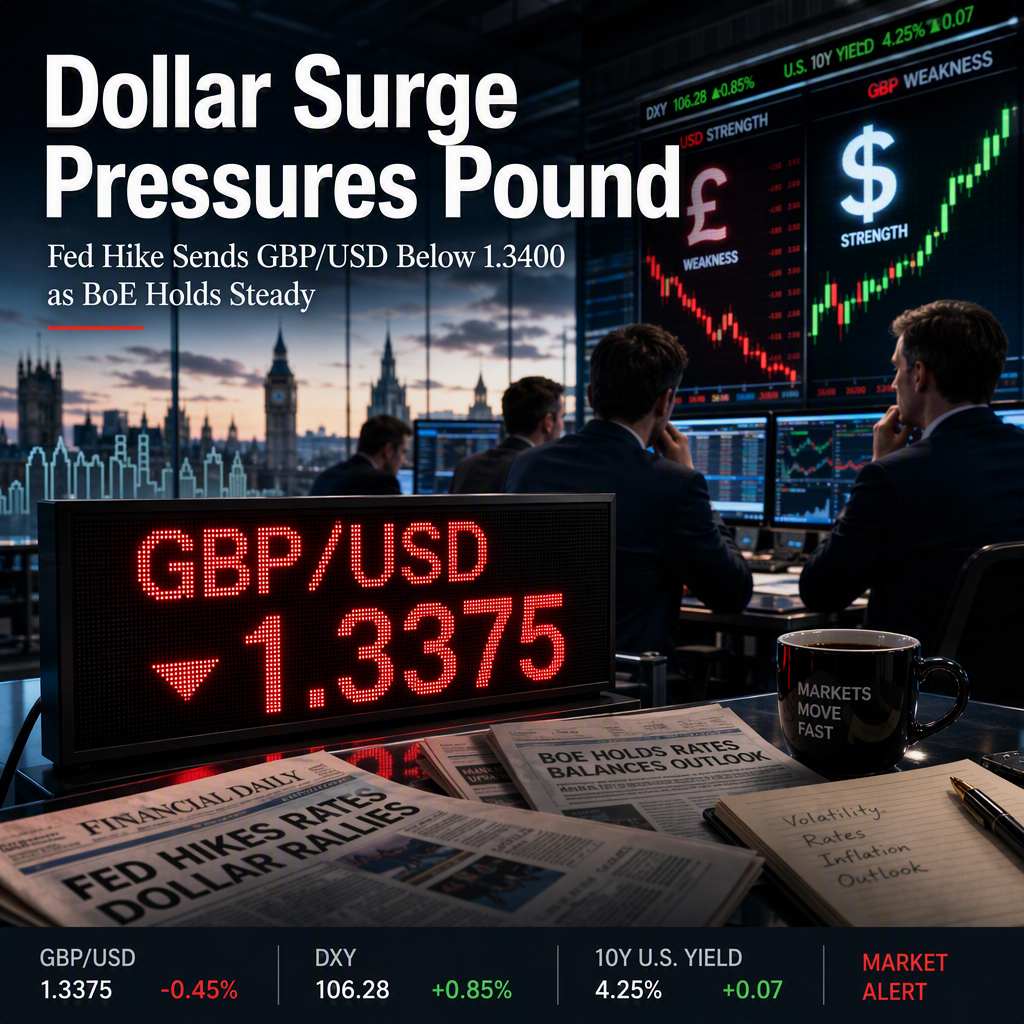
The GBP/USD currency pair declined to near 1.3375 during early European trading hours on Monday, reflecting persistent bearish momentum as the pair trades below its 100-day simple moving average (SMA) and the Bollinger midline [1]. This move follows the US Federal Reserve's decision last week to raise its benchmark interest rate by 25 basis points to a range of 3.75%–4.00% at its September policy meeting, with the Fed also signaling an additional hike later this year to contain inflation [1]. According to the CME FedWatch tool, traders now assign a 56.5% probability to another US rate hike at the Fed's next meeting in October [1].
On the UK side, the Bank of England (BoE) kept its interest rate unchanged at 3.75% last week but forecasted that inflation could exceed 4% early next year [1]. J.P.Morgan analysts anticipate a 25 basis point rate hike from the BoE in February, with the possibility of further tightening if the Iran war continues [1]. Despite the bearish technical outlook for GBP/USD, strategists at Scotiabank highlight that the UK's political backdrop remains supportive for the Pound, citing ongoing market and media confidence in the government's commitment to fiscal responsibility as a key factor underpinning sentiment toward UK assets [1].
Technical analysis indicates that GBP/USD maintains a bearish near-term bias, with the Relative Strength Index (RSI) at 35, suggesting weak momentum but not yet oversold conditions [1]. Immediate resistance is identified at the 100-day SMA at 1.3435, with further resistance at the Bollinger midline near 1.3505 and the upper band at 1.3655 [1]. On the downside, support is seen at the lower Bollinger band at 1.3355, with a break below this level opening the way for further losses toward the September 18 low of 1.3335 and the July 28 low of 1.3273 [1].
CONCLUSION
GBP/USD is under pressure following the Fed's hawkish rate hike and the BoE's steady policy stance, with technical indicators pointing to further downside risk. While the UK's political stability offers some support for the Pound, market sentiment remains cautious amid expectations of additional US rate hikes and persistent inflation concerns.