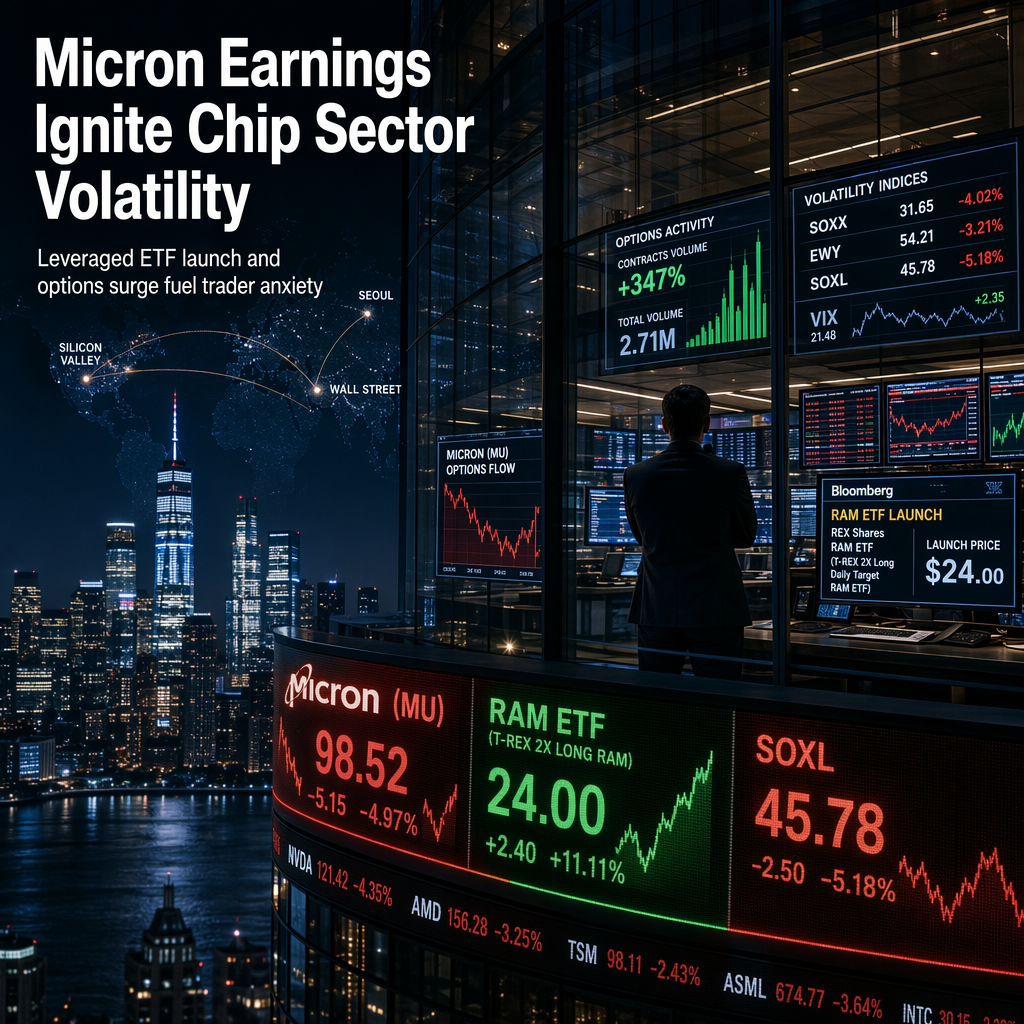
Micron Technology is set to report earnings on Wednesday night, an event widely anticipated to trigger significant market volatility. The launch of the Roundhill T-REX 2X Long DRAM Daily Target ETF (RAM), a 2x levered version of the successful DRAM ETF, coincides with Micron's earnings release. RAM began trading at around $24 per share, aiming to capitalize on Micron's popularity and the broader artificial intelligence-driven rally in semiconductor stocks. DRAM has amassed over $22 billion in assets and more than doubled in value since its April debut, while Micron itself has rallied 700% over the past year and is now the fourth-largest holding in the $73 billion VanEck Semiconductor ETF (SMH), with a 28% weight in DRAM and 8% in the $30 billion Direxion Daily Semiconductor Bull 3X ETF (SOXL). Micron's market cap is just below $1.2 trillion, and it regularly trades billions of dollars in options daily, with $1.4 billion traded on Wednesday alone [1].
Options traders are showing heightened concern about the sustainability of the chip stock bull market. On Tuesday, puts traded on the iShares Semiconductor ETF (SOXX) reached 1.5 times the 20-day average volume, totaling 74,468 contracts, indicating strong demand for downside protection. Volatility in chip stocks has doubled since the start of the year, making insurance strategies more expensive but potentially more necessary. The South Korean KOSPI Index, a proxy for the global hardware and memory supply chain, has experienced at least three drawdowns exceeding 10% this year, including one nearly 20%. Despite semiconductors rallying more than 300% from 2025 lows to this month's highs, the risk of sharp declines remains elevated [2].
Leveraged ETFs, particularly those targeting tech companies, are contributing to daily rebalancing flows in excess of $20 billion, which could exacerbate market swings around major events like Micron's earnings. Traders currently expect a 10% swing in Micron's stock, with implied volatility at 111—the highest in the S&P 500 alongside Sandisk. The South Korean memory-makers SK Hynix and Samsung account for around 40% of the KOSPI market cap, and volatility in the iShares MSCI South Korea ETF (EWY) is at 92, considered relatively cheaper. On Wednesday morning, a trader executed a bullish risk reversal in EWY, selling $1.2 million of 170-strike puts expiring July 17 and buying $700,000 of 240-strike calls, betting on a 23% rally by the same date [1].
Analysts and market participants are closely watching the S&P 500's June 2nd high as a potential warning sign for broader risk, drawing parallels to historical tech market tops. Strategies such as put spreads are recommended to hedge against severe downside moves in chip stocks, balancing cost and protection. The August 570/450 put spread on SOXX pays roughly 3:1 and costs just over $31, about 5% of the underlying, reflecting the increased cost of protection amid heightened volatility [2].
CONCLUSION
Micron's earnings report and the launch of a new leveraged ETF are expected to drive substantial volatility in semiconductor stocks, with options activity and ETF flows amplifying market swings. Despite extraordinary gains in the sector, traders are increasingly seeking protection against sharp declines, highlighting elevated risk and uncertainty. The market is bracing for significant moves, and hedging strategies are becoming more prominent as volatility surges.