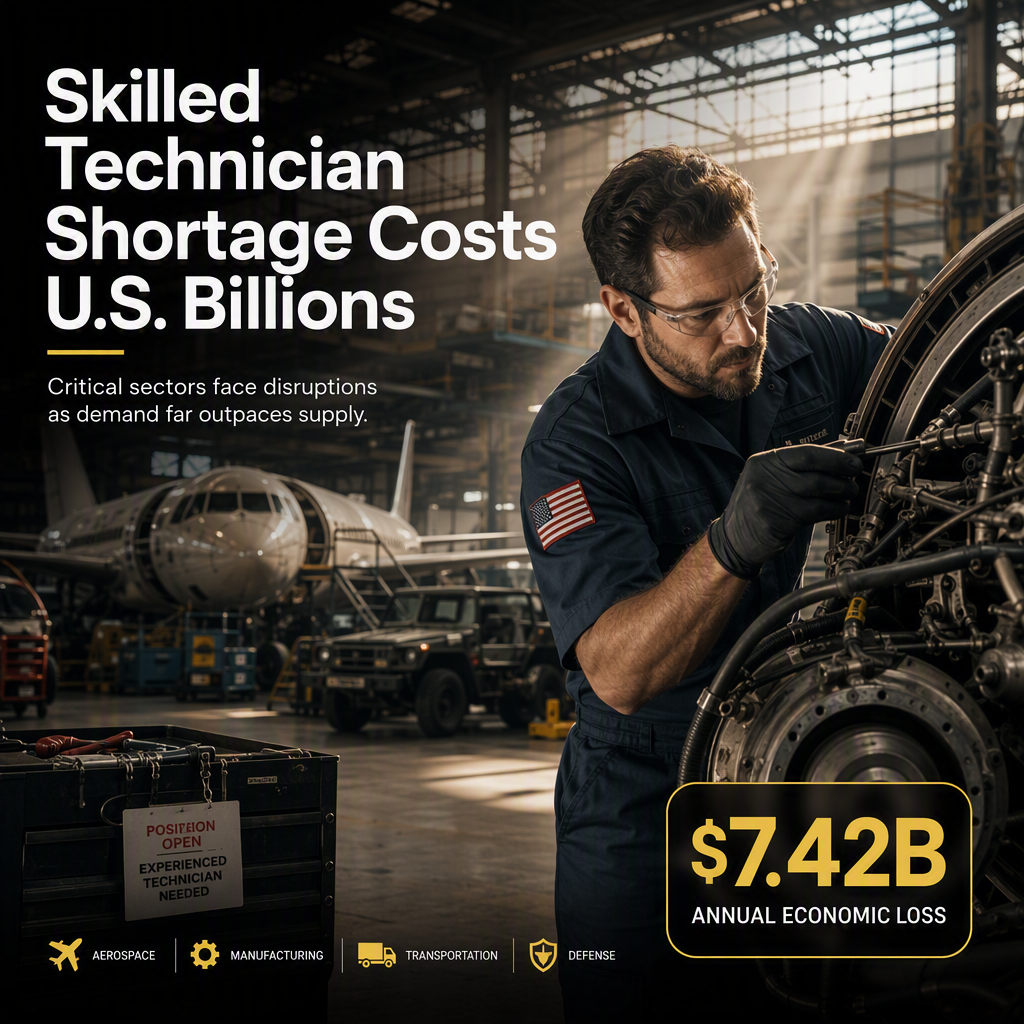
The U.S. economy is experiencing a significant shortage of skilled technical talent across ten critical sectors, including automotive, aviation, and HVAC, with industry supply meeting only about 42% of total demand [1]. This shortage is not hypothetical; it is already impacting essential services such as transportation, supply chains, and emergency response, with scenarios described where flights are grounded, vehicles remain unrepaired, and factories experience prolonged downtime due to a lack of technicians [1]. The economic consequences are substantial, with the shortage draining $7.42 billion in wage-based economic output from the U.S. economy every year [1].
Despite the high demand, skilled technician roles are attractive, offering starting salaries between $50,000 and $80,000, often without requiring a four-year degree, and the potential for top earners to make six figures [1]. The Bureau of Labor Statistics estimates nearly 6 million workers in the maintenance-and-repair workforce, excluding welders and the self-employed, while the broader technician workforce is approximately 7 million strong, collectively earning more than $375 billion annually [1].
Employers such as Ford, Carrier, and Snap-on have responded by investing in scholarships, grants, and workforce training, with hundreds of millions of dollars pledged this year alone to support the skilled trades [1]. However, the shortage persists, partly due to a lack of recognition of technicians as a distinct and vital workforce, and misconceptions about the nature of skilled labor [1].
The article highlights that independent shops handle most vehicle repairs, and a significant portion of technicians aspire to own their own businesses, indicating both entrepreneurial potential and the importance of supporting this workforce ecosystem [1].
CONCLUSION
The U.S. technician shortage is causing measurable economic losses and threatens critical infrastructure and services. While employer investment and rising interest in skilled trades are positive developments, addressing the persistent gap requires broader recognition and support for the technician workforce. Market participants should monitor ongoing investments and policy responses to this labor market challenge.