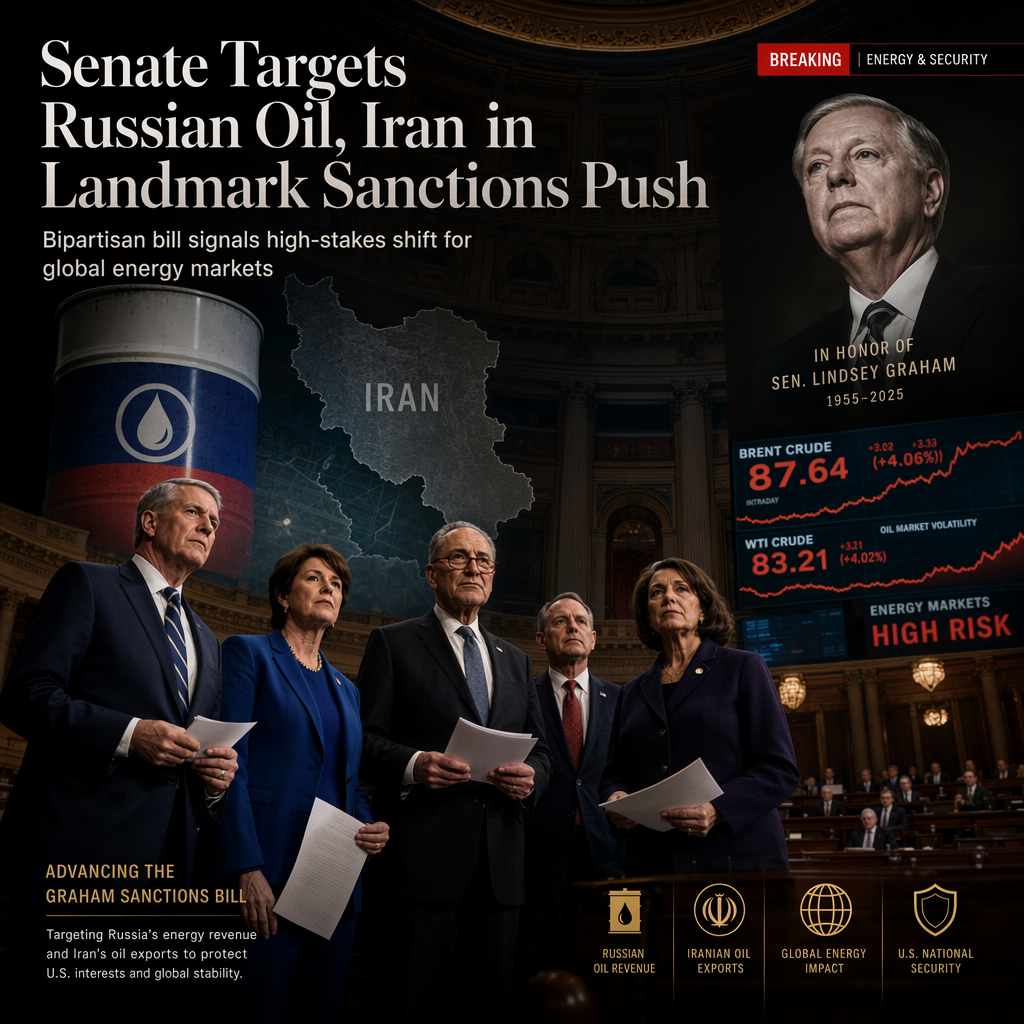
The U.S. Senate is set to begin votes on a significant sanctions bill named for the late Sen. Lindsey Graham, which is designed to target Russian oil sales and restrict Iran's energy and weapons sectors [1]. The legislation, announced on Tuesday, represents a bipartisan agreement among Senators Richard Blumenthal, Darline Graham, Katie Britt, Jeanne Shaheen, Roger Wicker, and Jim Risch, and is intended to undermine Russia's ability to finance its war in Ukraine by targeting its most lucrative commodity—oil [1].
The bill combines sanctions on Russia with additional measures against Iran, aiming to stop purchasers of Russian oil and gas from supporting President Vladimir Putin's war efforts and to further limit Iran's capacity to support terrorism and develop its nuclear program [1]. The sanctions package includes measures against Russian officials, oligarchs, their families, foreign persons, Russian banks and financial institutions, and the so-called Russian shadow fleet [1].
A notable provision in the bill grants the president new authority to impose tariffs on imported goods from countries that are among the top five importers of Russian oil or gas, or that enable Russian sanctions evasion. This authority is modeled after tools favored by former President Donald Trump and is intended to increase pressure on countries facilitating Russian energy exports [1].
The timing of the vote coincides with Ukrainian President Volodymyr Zelensky's visit to Washington for Senator Graham's funeral, underscoring the bill's symbolic significance. Lawmakers emphasized that advancing this bipartisan agreement is a fitting tribute to Senator Graham's legacy [1].
CONCLUSION
The Senate's move to advance a comprehensive sanctions bill against Russia and Iran signals a strong bipartisan effort to curtail both nations' energy revenues and military capabilities. If enacted, the legislation could have significant implications for global oil markets and international trade, particularly for countries importing Russian energy. The market impact is expected to be high given the scope and targets of the proposed sanctions.