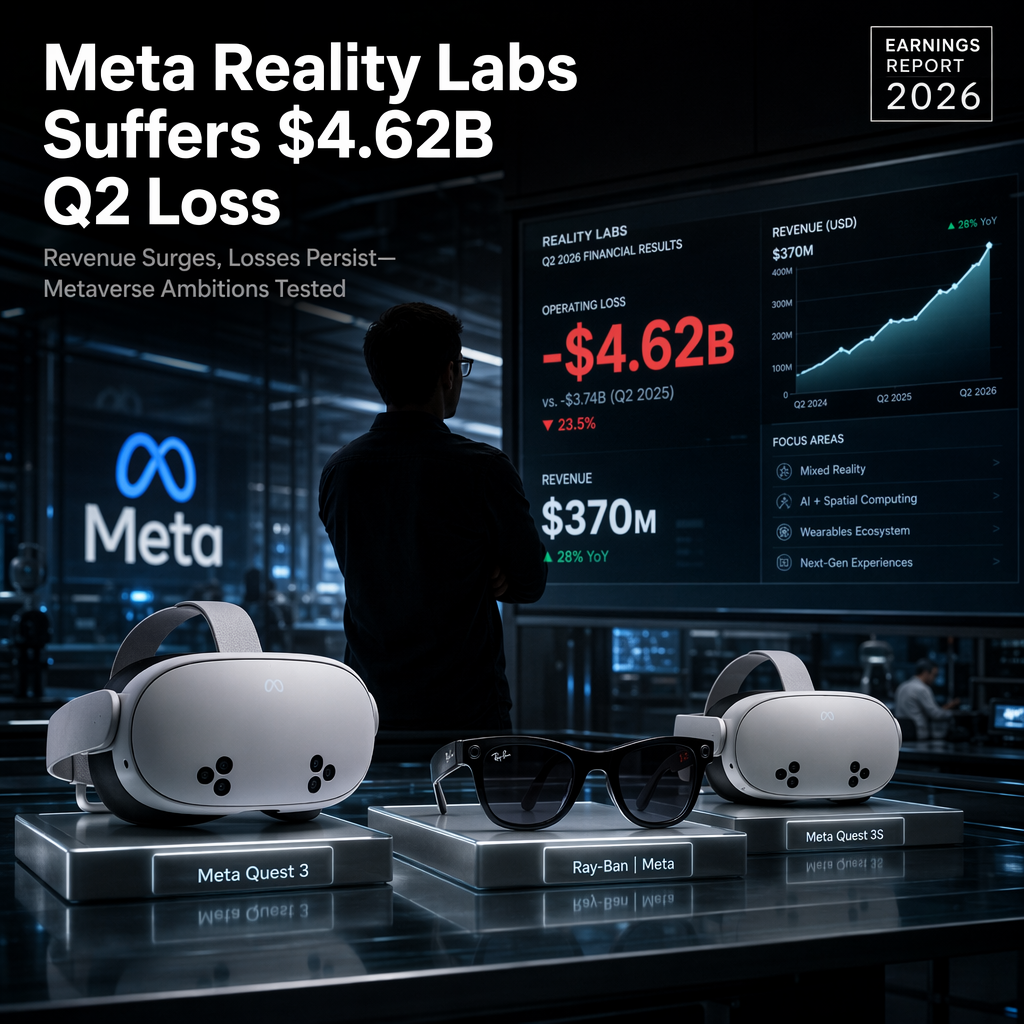
Meta's Reality Labs division, responsible for developing virtual reality devices and AI-powered wearables, reported an operating loss of $4.62 billion for the second quarter of 2026, according to the company's earnings report released on July 29, 2026 [1]. This loss widened from $4.53 billion in the same quarter a year earlier [1]. Despite the increased losses, Reality Labs generated $431 million in revenue, up from $370 million a year ago and surpassing analyst expectations of $423.4 million in revenue [1]. Analysts polled by StreetAccount had anticipated a larger loss of $5.07 billion, indicating the actual results were slightly better than expected on the bottom line [1].
Reality Labs is known for its Quest-branded VR headsets and Ray-Ban Meta glasses, the latter developed in partnership with EssilorLuxottica [1]. Since late 2020, the division has accumulated over $80 billion in total operating losses [1]. Meta CEO Mark Zuckerberg rebranded Facebook as Meta in 2021 to emphasize the company's commitment to digital worlds, but the VR market has not gained significant consumer traction [1]. As a result, Meta has shifted the focus of Reality Labs toward devices like the Ray-Ban Meta glasses [1].
The ongoing losses highlight the challenges Meta faces in its metaverse ambitions, even as it achieves modest revenue growth in the Reality Labs segment [1]. The market implications suggest continued skepticism about the profitability of Meta's investments in virtual and augmented reality, though the narrower-than-expected loss may offer some reassurance to investors [1].
CONCLUSION
Meta's Reality Labs continues to post significant losses, with a $4.62 billion operating deficit in Q2 2026, despite revenue growth and a smaller-than-expected loss. The division's ongoing challenges underscore the uncertain market outlook for Meta's metaverse strategy.