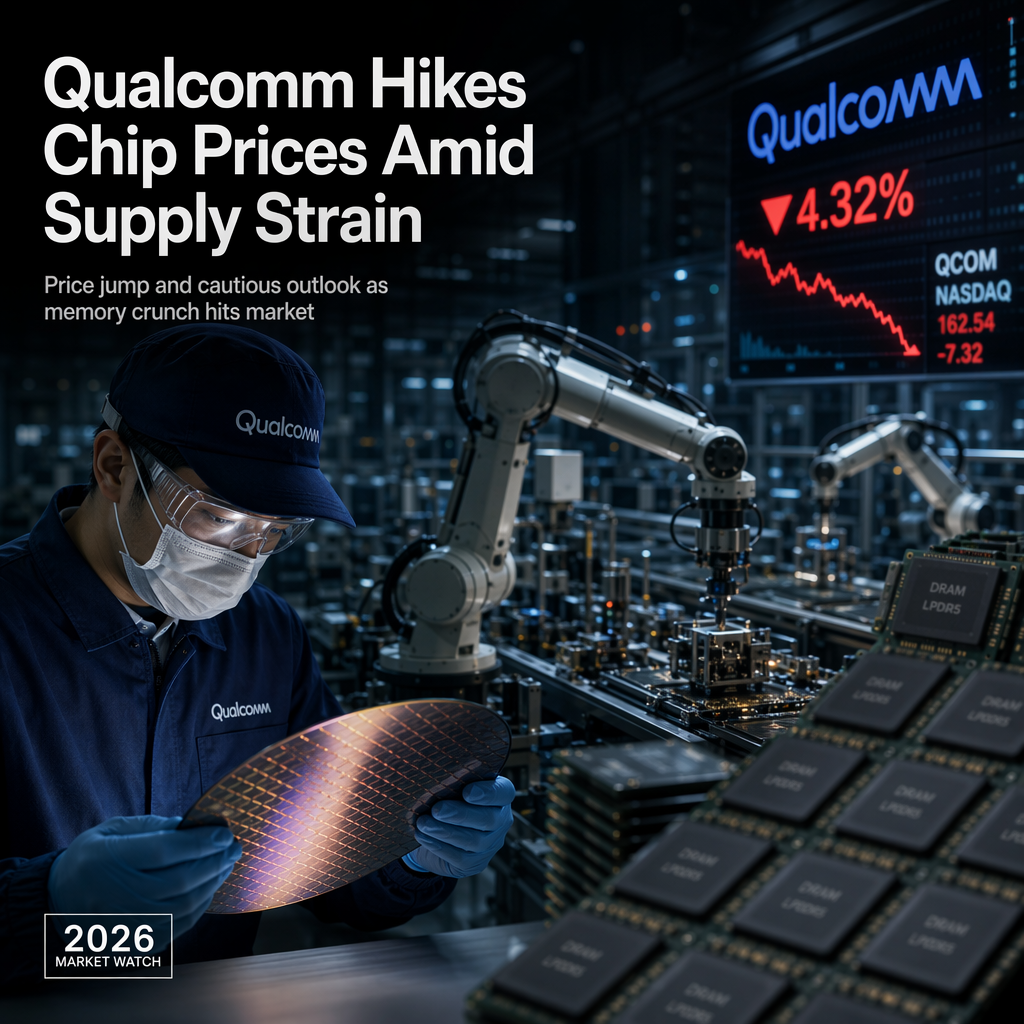
Qualcomm reported its fiscal third-quarter earnings on July 29, 2026, meeting analyst expectations for both revenue and earnings per share, but issued lighter-than-expected guidance for the current quarter due to an ongoing supply crunch, particularly in memory components [1]. The company posted adjusted earnings per share of $2.21, slightly below the $2.23 estimated, and revenue of $9.95 billion, surpassing the $9.67 billion consensus [1]. For the upcoming quarter, Qualcomm expects adjusted EPS between $2.05 and $2.25 on revenue of $9.7 billion to $10.5 billion, compared to analyst expectations of $2.36 EPS on $10.02 billion in sales [1].
CEO Cristiano Amon announced that Qualcomm will raise prices across its chip portfolio starting September 1, citing broad-based increases in input costs across wafer fabrication, assembly, test, advanced packaging, memory, and other materials [1]. Amon stated, 'Cost went up, prices are going to go up,' and described the supply cost increases as a 'temporary, short-term thing we are addressing with price increases' [1]. Qualcomm shares declined in extended trading following the announcement [1].
The company's handset chip sales, its largest segment, totaled $5.1 billion, down 20% year-over-year, which Qualcomm attributed to a bottoming in the China market [1]. Amon noted that affordability issues have made low-end and mid-priced phones less competitive, and even premium Android phones are seeing customers shift toward lower-priced models or previous-year devices due to rising memory prices [1].
Despite challenges in the handset segment, Qualcomm's automotive business showed strength, reporting $1.59 billion in sales and announcing a new chip supply deal with BMW for digital cockpit chips [1]. The company reiterated its target of $10 billion in automotive revenue by 2029 and is also pursuing growth in AI data center infrastructure, with Amon stating that Qualcomm remains on track to report $5 billion in that segment, though the timeline was not specified [1].
CONCLUSION
Qualcomm's latest results highlight the impact of industry-wide supply and cost pressures, prompting the company to implement price increases and issue cautious guidance. While handset sales remain challenged, automotive and AI infrastructure segments offer growth opportunities. The market reacted negatively to the guidance and price hike announcement, reflecting concerns about near-term profitability.