
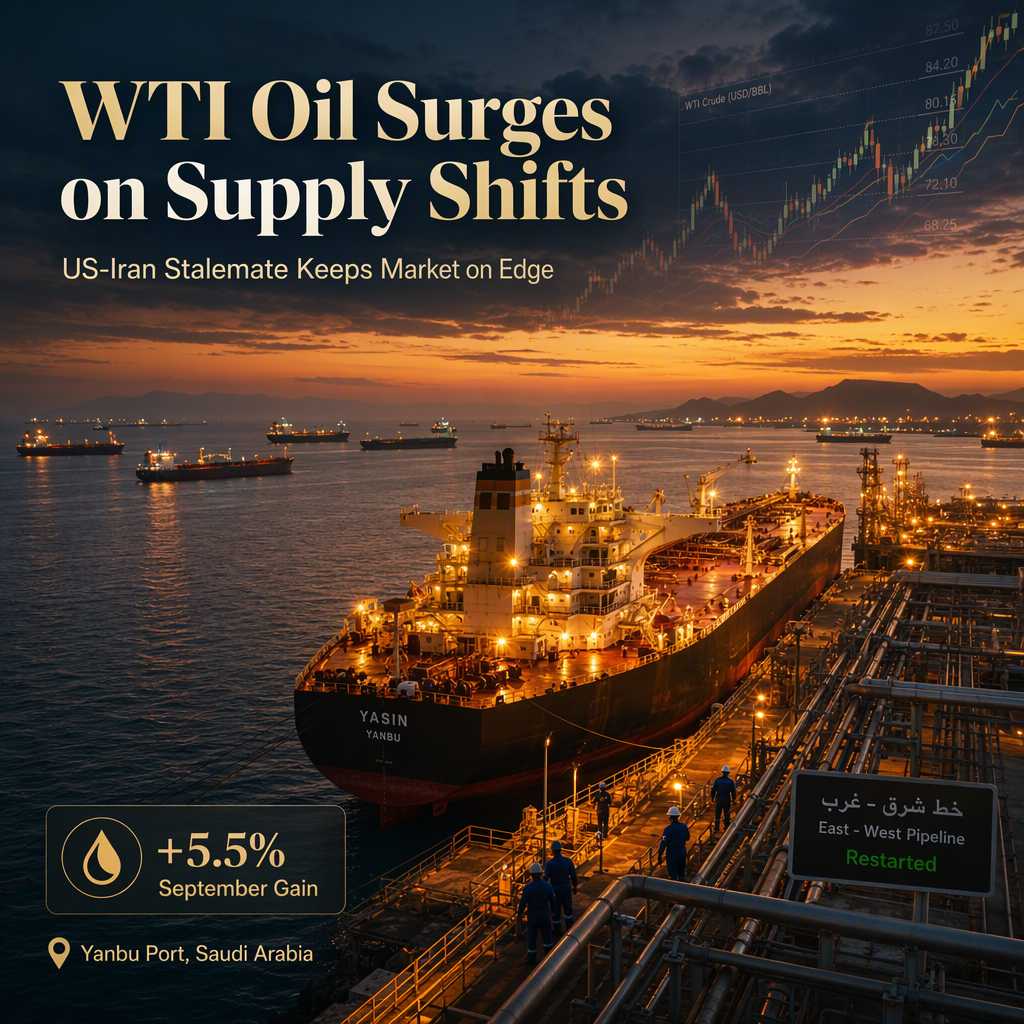
West Texas Intermediate (WTI) Oil rebounded on Wednesday and is on track for a monthly gain of approximately 5.5% [1]. At the time of reporting, WTI was trading around $90, recovering part of the previous day's losses, which saw the US benchmark fall over 4% to its lowest level since September 4 due to easing supply concerns [1]. The resumption of Saudi Arabian tanker loadings at Yanbu, following the restart of its East-West pipeline, has improved Middle East supply conditions by providing an alternative route around the Strait of Hormuz [1]. According to Goldman Sachs, Gulf Oil exports recovered to about 23.3 million barrels per day last week, aligning with their 2025 average [1]. Additionally, the US announced plans to offer up to 40 million barrels from its Strategic Petroleum Reserve [1].
US Energy Information Administration (EIA) data released Wednesday indicated that crude inventories increased by 922,000 barrels last week, surpassing market expectations for a decline of around 300,000 barrels but remaining significantly below the previous week's build of 2.969 million barrels [1].
Geopolitical risks remain elevated as negotiations between the US and Iran to reopen the Strait of Hormuz have stalled. Iran confirmed receipt of Washington's response to Tehran's seven-day proposal, which was initially rejected by US President Donald Trump. Tehran has indicated it will not soften its demands, which include lifting the naval blockade of Iranian ports and releasing frozen Iranian assets. Iranian Foreign Minister Abbas Araqchi is expected to review Washington's response with officials in Tehran [1]. Analysts note that a deal between Washington and Tehran could reduce the geopolitical premium in oil prices, while a prolonged stalemate may support further gains in WTI [1].
From a technical perspective, WTI remains above its 50-day, 100-day, and 200-day Simple Moving Averages, suggesting a constructive trend despite recent volatility. However, momentum indicators such as the Relative Strength Index (RSI) near 48 and a negative Moving Average Convergence Divergence (MACD) signal that bullish pressure is waning [1]. Key resistance levels are identified at $95 and $100, with support at $89.95, $87.03, $84.78, and $81.27 [1].
CONCLUSION
WTI Oil is set for a notable monthly gain, supported by improved supply conditions and ongoing geopolitical tensions between the US and Iran. While technical indicators suggest some loss of bullish momentum, the market remains sensitive to developments in US-Iran negotiations and supply dynamics. A resolution could ease prices, but continued stalemate may sustain upward pressure.