
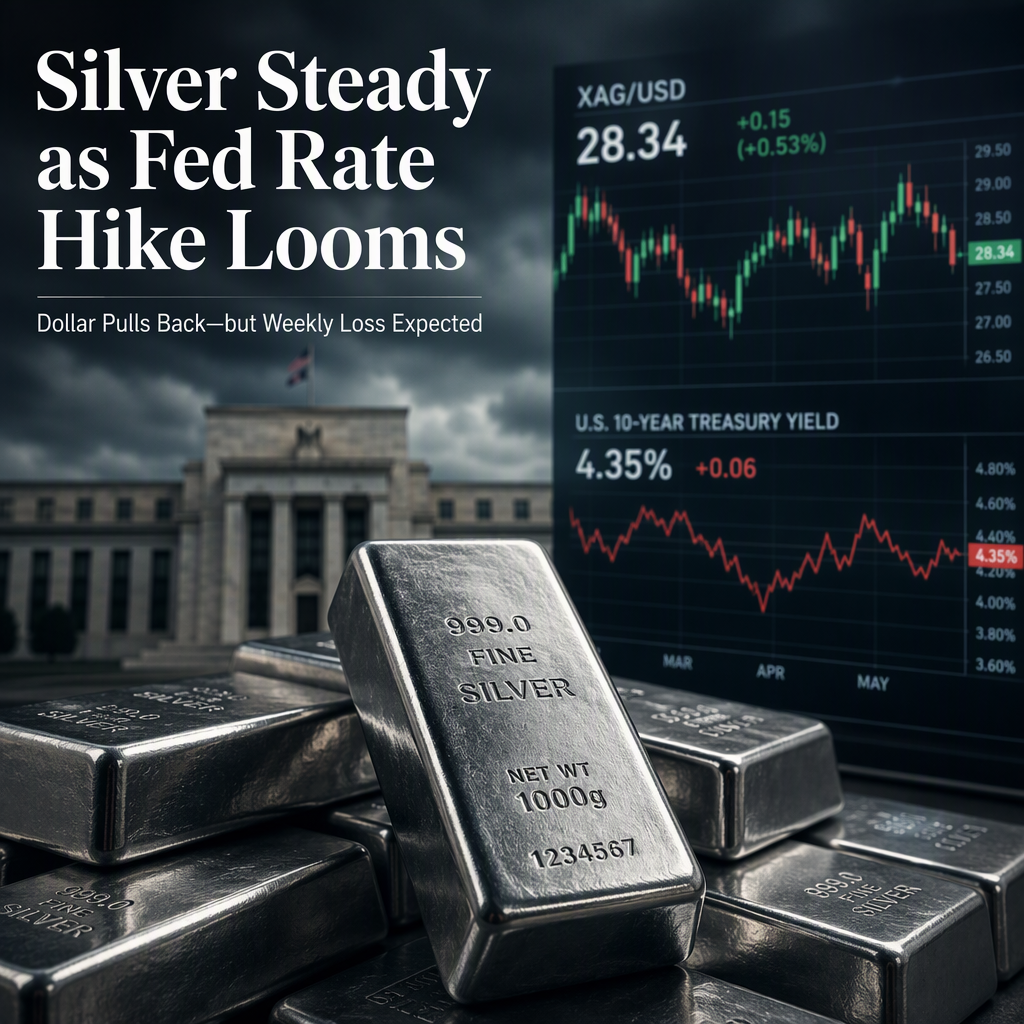
Silver (XAG/USD) traded around $64.30 on Friday, maintaining its position despite a modest pullback in the US Dollar following a strong weekly rally. However, Silver remains on track for a weekly loss, as higher US Treasury yields and increased market expectations for another Federal Reserve rate hike continue to weigh on non-yielding assets like Silver [1]. The CME FedWatch Tool indicates a 66% probability of another rate increase at the Fed's October meeting, following last week's 25-basis-point hike [1]. This has led to higher borrowing costs, making interest-bearing assets more attractive compared to Silver [1].
Technical indicators suggest a lack of clear direction for Silver. The Relative Strength Index (RSI) stands at 47, indicating balanced momentum, while the Moving Average Convergence Divergence (MACD) is slightly negative, pointing to modest downside pressure. The Average Directional Index (ADX) at 10 signals weak trend strength, and Silver continues to consolidate within a narrow range established over the past month [1]. On the daily chart, Silver's price is moving between contracted Bollinger Bands, with initial resistance at $65 and further resistance at $67, $70, and $75. Immediate support is seen at $62, followed by $60 and $55 [1].
Market participants are closely watching upcoming US economic data, including the Personal Consumption Expenditures (PCE) inflation report, ISM Manufacturing PMI, and Nonfarm Payrolls (NFP), which could further influence expectations for Fed policy and impact Silver prices [1]. Despite fundamental headwinds, the technical picture remains neutral, with neither buyers nor sellers in firm control [1].
CONCLUSION
Silver is currently consolidating, with price action reflecting balanced momentum and subdued volatility. While a softer US Dollar has provided some relief, expectations for further Fed rate hikes and rising Treasury yields continue to pressure Silver, keeping upside limited. Upcoming US economic data will be critical in shaping market direction for Silver in the near term.