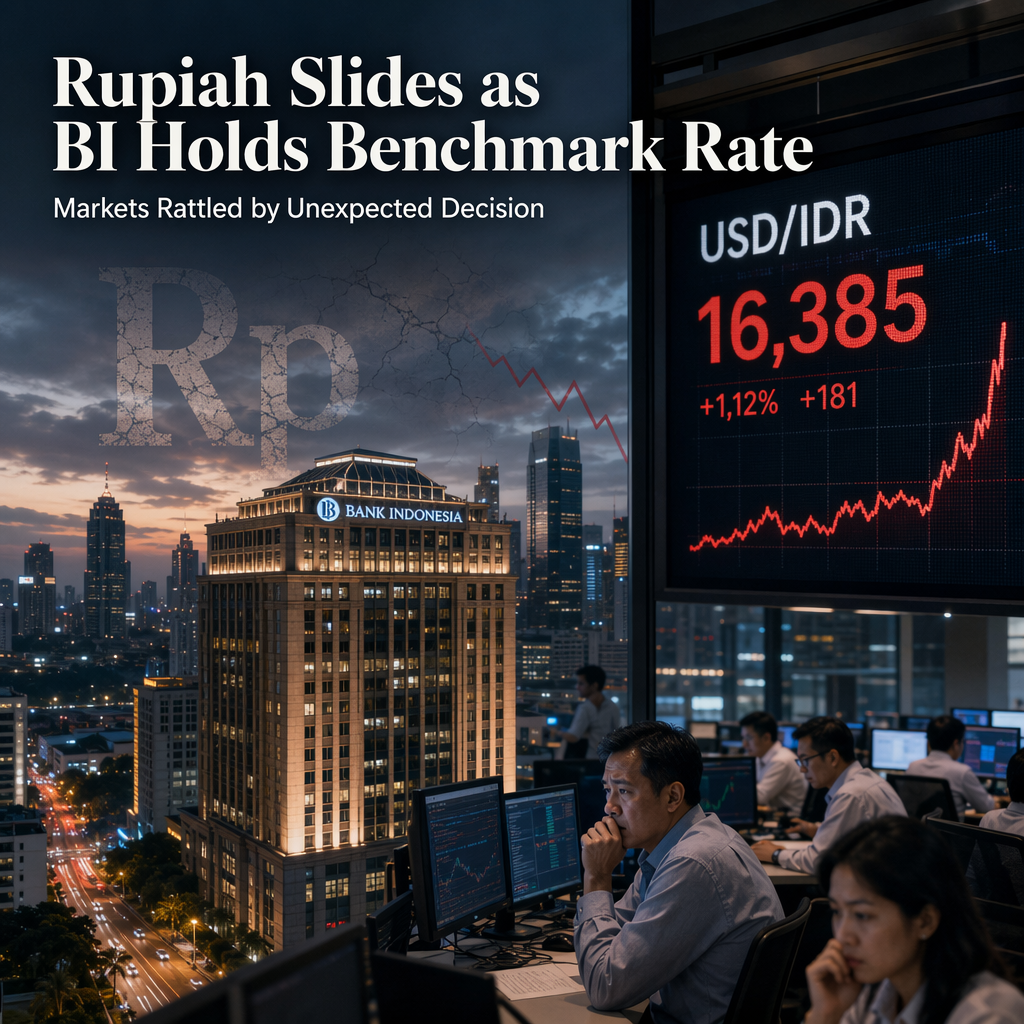
Bank Indonesia (BI) surprised market participants by holding its benchmark interest rate steady at 5.75% in July, defying widespread expectations of a 25-basis-point hike intended to stabilize the Indonesian Rupiah (IDR) [1]. The consensus among analysts had anticipated a rate increase to 6%, but the central bank opted to maintain the current rate, which was also the previous level [1]. Following the announcement, the USD/IDR currency pair recovered its earlier losses and traded around 17,950 during European hours on Wednesday, reflecting the Rupiah's weakness in response to the decision [1].
Bank Indonesia's KLM program has injected 431.9 trillion Rupiah in additional liquidity into the financial system as of early July, which has contributed to robust loan growth of +12.67% year-over-year in June [1]. The banking sector remains resilient, and full-year 2026 lending growth is projected to meet the 8%–12% target range, despite ongoing global economic headwinds [1].
The upside for USD/IDR may be limited as the US Dollar faces its own challenges, including risk aversion stemming from escalating geopolitical tensions between the United States and Iran [1]. However, the US Dollar could regain strength, as the CME FedWatch Tool indicates that markets are currently pricing in over 69% odds of at least a 25 basis-point rate hike at the upcoming September Federal Reserve meeting, even though the Fed is widely expected to keep the federal funds rate unchanged in the near term [1].
Overall, the decision by Bank Indonesia to hold rates rather than hike has led to immediate pressure on the Rupiah, while the central bank continues to support the financial system through liquidity measures and maintains confidence in meeting its lending growth targets for 2026 [1].
CONCLUSION
Bank Indonesia's unexpected decision to keep its benchmark rate at 5.75% has weakened the Rupiah, as markets had anticipated a rate hike. Despite this, the central bank's liquidity measures and strong loan growth projections suggest ongoing resilience in Indonesia's banking sector. Market attention now turns to global factors and upcoming US Federal Reserve decisions for further direction.