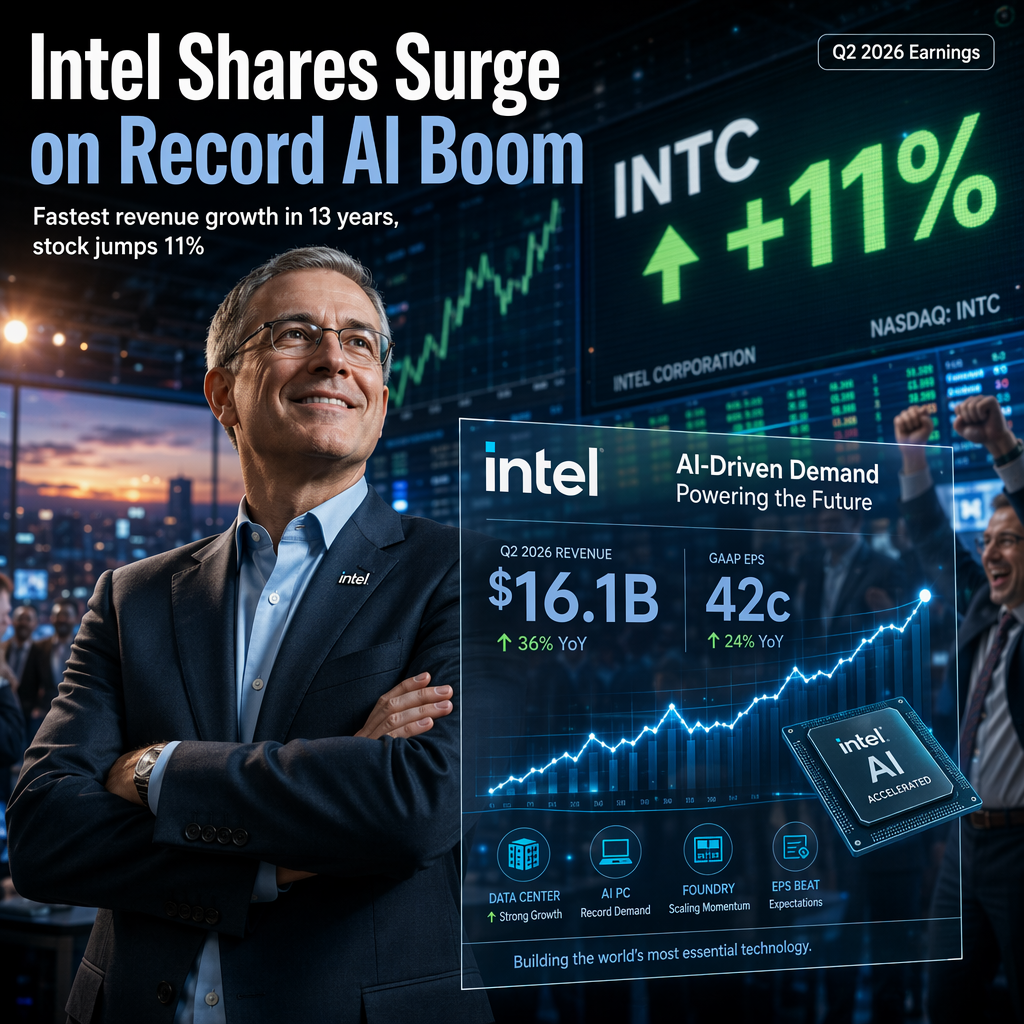
Intel reported its fastest quarterly revenue growth since 2011, with second-quarter revenue reaching $16.1 billion, surpassing the LSEG consensus estimate of $14.42 billion. Adjusted earnings per share came in at 42 cents, doubling analyst expectations of 21 cents per share. Following the results, Intel's stock jumped 11% in extended trading. The company has seen its shares rise over 170% in 2026 as of Thursday's close, after an 84% gain in 2025, which was partly driven by the U.S. government acquiring a 10% stake to support domestic chip manufacturing. However, the stock had recently declined 28% in July prior to this earnings report [1].
The surge in revenue is attributed to the ongoing artificial intelligence infrastructure boom, which has significantly boosted sales of Intel's server processors. CEO Lip-Bu Tan stated, 'AI is driving unprecedented demand for compute,' and emphasized Intel's strong positioning for sustainable growth in its CPU business. The company's data center business saw revenue climb 59% to $6.3 billion, while its client computing group, which produces PC chips, grew 13% to $8.9 billion. Intel's foundry business also reported $5.8 billion in sales, up 31% year-over-year. Despite these gains, Intel did not announce any major new foundry customers, though Fortinet was named as its first under Tan's leadership [1].
Looking ahead, Intel provided guidance for the current quarter, expecting adjusted earnings per share of 38 cents on revenue between $15.8 billion and $16.8 billion, both above analyst expectations of $15.1 billion in revenue and 27 cents EPS. The company is also increasing capital expenditures, targeting a 'meaningful increase' next year as it aims to expand its manufacturing capabilities for other companies. CFO David Zinsner noted that Intel is currently supply constrained, with data center customers demanding more than the company can produce. Intel has secured 10 long-term agreements for its server CPUs, with some contracts locking in pricing and others focusing on chip volume, a strategy aimed at maintaining pricing power amid the AI market surge. However, Intel expects flat PC sales in the third quarter due to a memory shortage [1].
CONCLUSION
Intel's robust Q2 results and optimistic guidance highlight the company's strong momentum amid the AI-driven demand for compute power. The significant stock rally and positive outlook suggest high investor confidence, though supply constraints and a lack of major new foundry customers remain areas to watch. Overall, Intel is well-positioned for continued growth as it capitalizes on the AI infrastructure boom.